Mon 02 Nov · 20:00 GMT
Newcastle United FC v Everton FC
St. James' Park · Newcastle upon Tyne
England & Wales
Premier LeaguePlan a trip around this →
The heartbeat of a one-club city, at a ground set right in the middle of town, with the loudest end in England on its day. The Saudi takeover, a first trophy in seventy years, and the friendliest away-day in the league.
By Carlos O. · Last updated 7 Aug 2026
One of the hardest tickets in England for a visitor, on a similar scale to Liverpool's. Newcastle has sold out almost every match since the 2021 takeover, the club's own season-ticket waiting list passed 50,000 names within months of opening, and that's stacked behind roughly 35,000 existing season-ticket holders already filling most of a 52,000-plus-seat ground, so genuinely little is left over for anyone else. A paid membership gets you into the members' ballot for whatever remains, but real odds vary wildly: the club's own leadership has quoted 'roughly one in three,' while fans who track their results across a season report figures as low as one in six, and attendance history likely favors long-time members over a first-time overseas buyer. Unlike Liverpool, though, Newcastle's international Official Supporters Clubs network (branches run from New York to Beijing) doesn't publish a dedicated per-branch ticket allocation; its one stated ticket perk is a single group booking per season, not the twice-yearly branch draw that makes Liverpool's OLSC route a workable plan, so joining a branch here isn't the reliable backup it is there. The Tyne-Wear derby against Sunderland is the hardest fixture of all: away allocations have been cut well below the usual Premier League limit on safety grounds in recent meetings, and demand from both sides swallows whatever's on offer. The club's official resale scheme, where season-ticket holders return seats at face value, is the safer route worth checking obsessively in the days before a lower-profile game. Hospitality guarantees entry at a premium. Touting is a criminal offence in England and tickets are named and checked, so treat any third-party resale site as a turn-away risk.
Newcastle is a one-club city in a way almost nowhere else in England is, and that is the single most important thing to understand before you go. There is no local rival to split the place, no second team to drift to; the nearest derby is thirty-odd miles down the road at Sunderland, and it is ferocious precisely because the two cities have so little else to argue over. On Tyneside, supporting Newcastle United is closer to a civic fact than a hobby, and a home game turns the whole centre of town black and white for the afternoon. That intensity is the product, more than any single player or result.
The recent history has two halves, and you need both. For most of the last fifteen years the club was owned by the retail magnate Mike Ashley, a period fans remember as a long, cynical drift: cheap ambition, a stadium renamed after his sports-shop chain for a while, and years of open protest, including an eleventh-minute walkout and a fan-group flag boycott. Then in October 2021 the club was bought by a consortium led by Saudi Arabia's Public Investment Fund, the kingdom's sovereign wealth fund, and everything changed at once.
That ownership is the defining fact about the modern club. To supporters on Tyneside it ended the Ashley years and delivered, fast, what the fans had waited a lifetime for. Like the other clubs now backed by nation-state wealth funds, it draws debate beyond its own support, and that is context to carry rather than an argument this guide will settle for you. What the money bought, on the pitch, was quick: under the manager Eddie Howe, Newcastle went from a relegation fight to the Champions League, and in March 2025 they beat Liverpool 2-1 at Wembley to win the League Cup, the club's first major domestic trophy since 1955. For a fanbase that had gone seventy years without one, and had watched near-misses curdle into a running joke, it is hard to overstate what that Sunday meant. Howe stepped away in the summer of 2026 after nearly five years in charge, and Matthias Jaissle took over as head coach.
Underneath all of it sits a deep, proud football culture that predates the money and will outlast it: Jackie Milburn and the Sir Bobby Robson years, Kevin Keegan's cavalier Entertainers side of the mid-nineties, and Alan Shearer, the local boy who came home to become the club's and the Premier League's record scorer. His statue stands outside the ground for a reason.
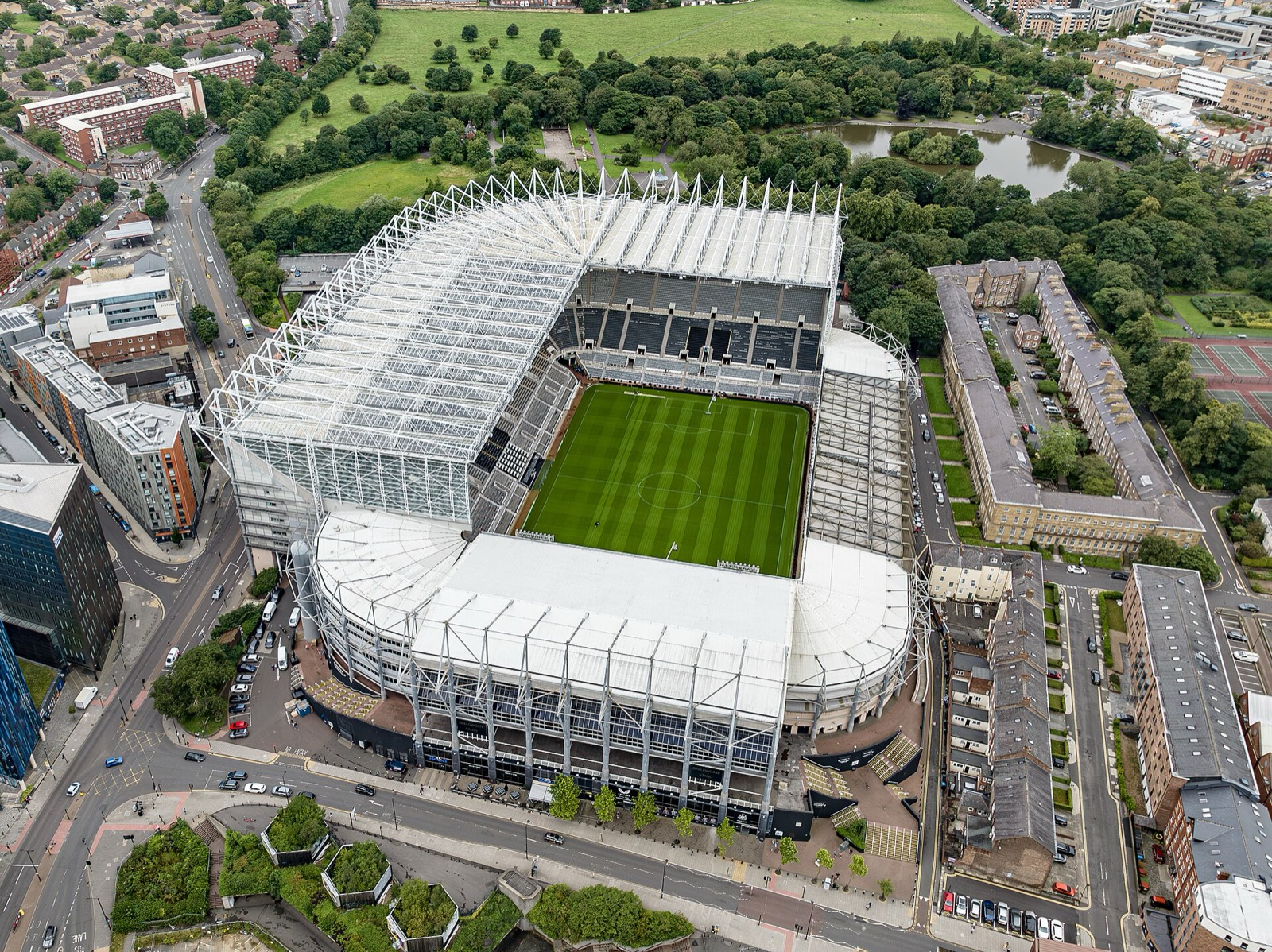
Here is the part that makes a Newcastle matchday genuinely easy, and unusual among the big grounds: St James' Park is not out on a ring road, it is right in the middle of the city, a few minutes' walk from the main shopping streets and the nightlife. If you are staying anywhere central, you walk to the football, joining the black-and-white tide moving up the hill, which is half the experience.
If you do need transport, the Metro is the answer. St James station on the yellow line sits directly under the ground and is the obvious drop, though it gets rammed straight after the whistle; Monument and Haymarket, both a short walk away, are calmer and let you avoid the immediate crush. Newcastle Central Station, on the East Coast Main Line, is a fifteen-minute walk downhill from the ground, so arriving by train from elsewhere in the country puts you in the centre of everything. There is no reason to drive.
Newcastle's pub culture on a matchday is one of the best in the country, and it comes with a quirk that visitors love: the club has no designated away end for drinking and, by long custom, away fans are welcome in almost every pub around the ground. Turn up in another team's colours and you will generally be met with banter rather than trouble, which is not something you can say everywhere. The one sensible caveat is to keep it good-natured, especially after a defeat.
The pub every first-timer is pointed to is The Strawberry, the black-and-white shrine tucked right against the Gallowgate End, its walls a museum of club history. It is a must for the pilgrimage, with the honest warning that it is heaving on a matchday and you may enjoy it more after the final whistle than in the ninety-minute scrum before kickoff. A close second, and less of a crush, is the Tyneside Irish Centre on the corner of Gallowgate and Stowell Street, a sociable three-floor club buzzing before and after. The Hotspur up on Percy Street is a classic town-centre matchday pub a few minutes away.
If you want to make an afternoon of it, the whole city centre is your pre-match. The Bigg Market and the streets around Grey Street are wall-to-wall pubs, and a session often starts down on the Quayside by the river and works uphill toward the ground. And there are two food rituals no visitor should skip. One is Greggs, the bakery chain born in Newcastle: a steak bake or a cheese-and-bean melt eaten on the walk to the ground is a genuine local rite, not a gimmick. The other is the Grainger Market, the grand Victorian covered market in the centre, where the delis do the real Geordie stuff, a ham and pease-pudding stotty or a saveloy dip. Football aside, The Back Page on St Andrew's Street is a small shop stuffed with football books and memorabilia that is worth a browse before a game.
Be straight about this, because it is the reason a lot of neutrals put St James' Park on their list: on its day this is one of the loudest, most intimidating grounds in England, and away teams do not enjoy coming here. The noise is not evenly spread, though. It pours out of the Gallowgate End, the home end behind the south goal, and specifically its Strawberry Corner, where the organised singers and the flag group Wor Flags cluster. Wor Flags are the people behind the huge surfer-style banners and the pre-match displays that have become part of the club's identity; they downed tools in protest during the Ashley years and roared back after the takeover, and on a big European night the Gallowgate display is a real spectacle.
The honest calibration is the same as at any big modern ground: a Champions League night, a Sunderland derby or a title run-in delivers the full cauldron, while a routine midweek fixture against mid-table opposition can be more subdued, especially in the higher, pricier tiers of the two big sides, the Milburn Stand and the towering Sir John Hall Stand. If you get a choice of seat and you are chasing atmosphere, aim for the Gallowgate. Away fans are housed high up, in the Level 7 corner where the Sir John Hall Stand meets the Leazes End, a long climb with a good view.
This is the Champions League anthem at a full St James' Park:
The anthem is "Blaydon Races," a Tyneside music-hall song from 1862 about a trip to the local races that has nothing to do with football and everything to do with being a Geordie; hearing a full ground sing it is the sound of the city, not just the club. The team walks out to "Going Home," the theme from the film Local Hero written by the Tyneside musician Mark Knopfler, a slow, swelling instrumental that is one of the better walkout tunes in the league. And listen for the bouncing "wa-oh" chant set to Earth, Wind and Fire's "September," which fans here will tell you, with some justification, started life in the Gallowgate corner before half of English football borrowed it.
The club store, the United Store, is at the ground on the Strawberry Place side and carries the full range; matchday hours are long, but if you want a calm browse go on a non-match day. For anything retro or collectable, The Back Page in town is the better hunt than the official shop.
This is the catch, and it is a real one. Since the takeover Newcastle have sold out St James' Park for essentially every game, and demand vastly outruns a ground that cannot easily be expanded, so a casual visitor cannot simply buy a ticket the week of the match. Most of the ground is season-ticket held, and what is left is released to members, so the realistic route in is to take out a paid membership in advance and buy in the member window for a lower-profile fixture, accepting that the big games are close to impossible that way.
The club runs an official ticket resale scheme, where season-ticket holders return seats they cannot use and members can buy them at face value, and that is the safe secondary route worth checking obsessively in the days before a game. Working a club's own resale is the standard fallback anywhere a game looks sold out; on Tyneside it is less a fallback than the main way a visitor ends up with a seat. Official hospitality guarantees a seat at a premium if you want certainty. What you should not do is turn to the open resale market: unauthorised ticket touting is a criminal offence in England, the tickets are named and checked, and the club will cancel one it identifies as touted, so a purchase from a stranger or a third-party resale site is a real risk of being turned away after paying well over the odds. Plan the membership route well ahead instead.
A permanently sold-out ground is the extreme case of the English problem, and planning an English trip covers what to do when the club you want is shut.
Go for the city as much as the game, because at Newcastle the two are the same thing in a way they aren't at an out-of-town stadium. Walk up from the Quayside with a Greggs in hand, get into the Strawberry for the history and the Gallowgate for the noise, and understand that you are dropping into a club that has just ended a seventy-year wait and is living through the most charged, complicated chapter of its life. Take the ownership question seriously, keep the away-day banter friendly, and you will have seen one of the genuine footballing cities of England at full volume.
Ticket rules, membership prices, the stadium-expansion question and the club's fortunes are all moving fast; check anything time-sensitive the week you travel, and only buy through the club or its official resale scheme.
Newcastle play at St James' Park, set right in the middle of Newcastle upon Tyne rather than out on a ring road, a few minutes' walk from the main shopping streets. The club is the only one in the city, with the nearest rival thirty-odd miles away at Sunderland, so a home game turns the whole center of town black and white.
Not easily. Since the 2021 Saudi-backed takeover, Newcastle have sold out St James' Park for essentially every game, so a casual visitor can't just buy a ticket the week of the match. Most of the ground is season-ticket held, so the realistic route is a paid membership bought in advance and a member window for a lower-profile fixture.
Check the club's official resale scheme, where season-ticket holders return seats at face value, in the days before a game. Official hospitality guarantees entry at a premium. Avoid the open resale market: unauthorised touting is a criminal offence in England, tickets are named and checked, and the club will cancel any it identifies as touted.
If you're staying anywhere central, you can just walk, joining the crowd moving up the hill, which is half the experience. The Metro's St James station sits directly under the ground on the yellow line, though it gets rammed after the final whistle; Monument and Haymarket are calmer alternatives a short walk away, and Newcastle Central Station is a fifteen-minute walk downhill.
The noise pours out of the Gallowgate End, the home end behind the south goal, especially its Strawberry Corner where the organized singers and the flag group Wor Flags cluster. On a Champions League night, a Sunderland derby or a title run-in it delivers a full cauldron; the Milburn Stand and Sir John Hall Stand on the sides can be more subdued in their higher, pricier tiers.
Dates more than a few weeks out show as “date & time TBC”. When do fixtures get confirmed? →