Tue 03 Nov · 20:00 GMT
Manchester United FC v AS Roma
Old Trafford · Manchester
England & Wales
Champions LeaguePlan a trip around this →
The story behind the badge, the pre-match street, where the noise actually is, and how a first-timer does an Old Trafford matchday without looking like one.
By Carlos O. · Last updated 7 Aug 2026
Almost everything runs through Official Membership and a ballot: membership just buys entry to the lottery, and returning members with more attendance history rank ahead of a first-timer. A first-timer's realistic routes for an ordinary fixture are a membership plus ballot luck, a local supporters' branch, or resale over face value. The Manchester Derby against Manchester City and the North West Derby against Liverpool are much harder again: derby ballot success has been reported as low as one in ten, low enough that hospitality or a verified resale marketplace are the realistic options rather than the ballot itself. Away tickets are effectively closed to visitors: even a paid membership doesn't get you into the ballot for a Premier League away game, only season ticket holders with three-plus years' tenure who've opted into cup competitions can apply, and around 3,000 tickets are split among roughly 50,000 eligible holders.
Before you go, it helps to know what you're walking into, because United carry their history closer to the surface than most clubs and a matchday makes more sense once you do.
The club started poor. It was founded in 1878 as Newton Heath, a team of railway workers from the carriage and wagon depot, and by 1902 it was thousands of pounds in debt and hours from being wound up for good. A local brewery owner put up the money, the club was relaunched as Manchester United, and it survived. That broke, railway-workers' beginning is why the club's oldest colours were green and gold. Fans brought them back in 2010, not as simple heritage but as the uniform of the anti-Glazer protest movement: a sea of green-and-gold scarves filled United's end at the 2010 League Cup final, a rebuke to the American owners who had loaded the club with debt, and you'll still see the colours around the ground today.
Then there's Munich. On 6 February 1958 the plane carrying the team home from a European Cup tie crashed on the runway at Munich, and eight United players died, one of them Duncan Edwards, who was 21 and might have been the best of all of them. This is the thing that sets United apart from a normal big club: the identity carries real grief, not as decoration but as fact. Ten years later, almost to the season, United won the European Cup at Wembley, the first English club to do it, with Bobby Charlton scoring twice and Matt Busby lifting the trophy. Both of them had been on the plane. When a supporter tells you why they love this club, that is usually the story underneath it, whether they say so or not.
The modern club rhymes with that. Alex Ferguson took over in 1986 and, over 26 years, built the most decorated run in the sport, and the side people remember best was homegrown: Beckham, Giggs, Scholes, the Neville brothers, kids who came up through the club together and won it all, capped by the 1999 Treble and the two goals in stoppage time against Bayern that still get replayed in every pub in Manchester. A railway workers' team that nearly went bust, that answered the worst day in its history by winning Europe with its own survivors, and that did it again decades later with a team it raised itself. That's the thread.
You don't need to know all of it. But walk up knowing the club nearly died twice, once from debt and once on a runway, and came back both times, and the place reads differently.
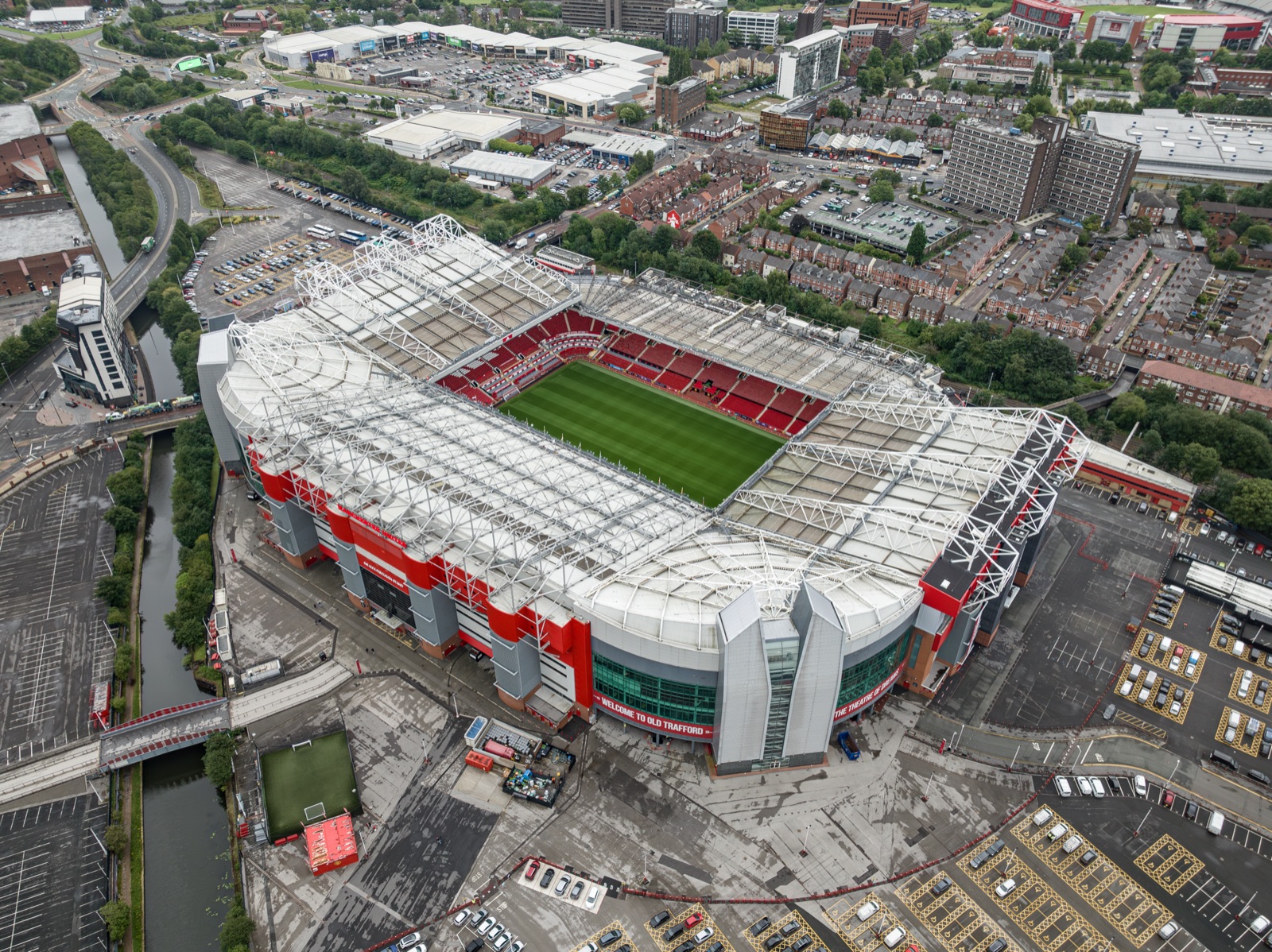
Approach the ground along Sir Matt Busby Way, which is closed to traffic on matchdays and turns into a real street scene an hour or two before kickoff: food vans and fried onions, sellers with scarves and pin badges laid out on boards, the noise building. The merch quality is average and the council periodically moves the sellers on, but a badge or a plain scarf is a few pounds and part of the day. Skip the half-and-half scarves, though. They're the tell locals clock instantly, even if a first-timer might reasonably want one as a keepsake of the trip. What you shouldn't buy off a stall is anything sold as a real shirt.
You'll also see people selling a fanzine called United We Stand, still going since 1989, still printed, and a better read than anything in the megastore if you want the actual voice of the place. The official matchday programme is sold from red kiosks outside and inside.
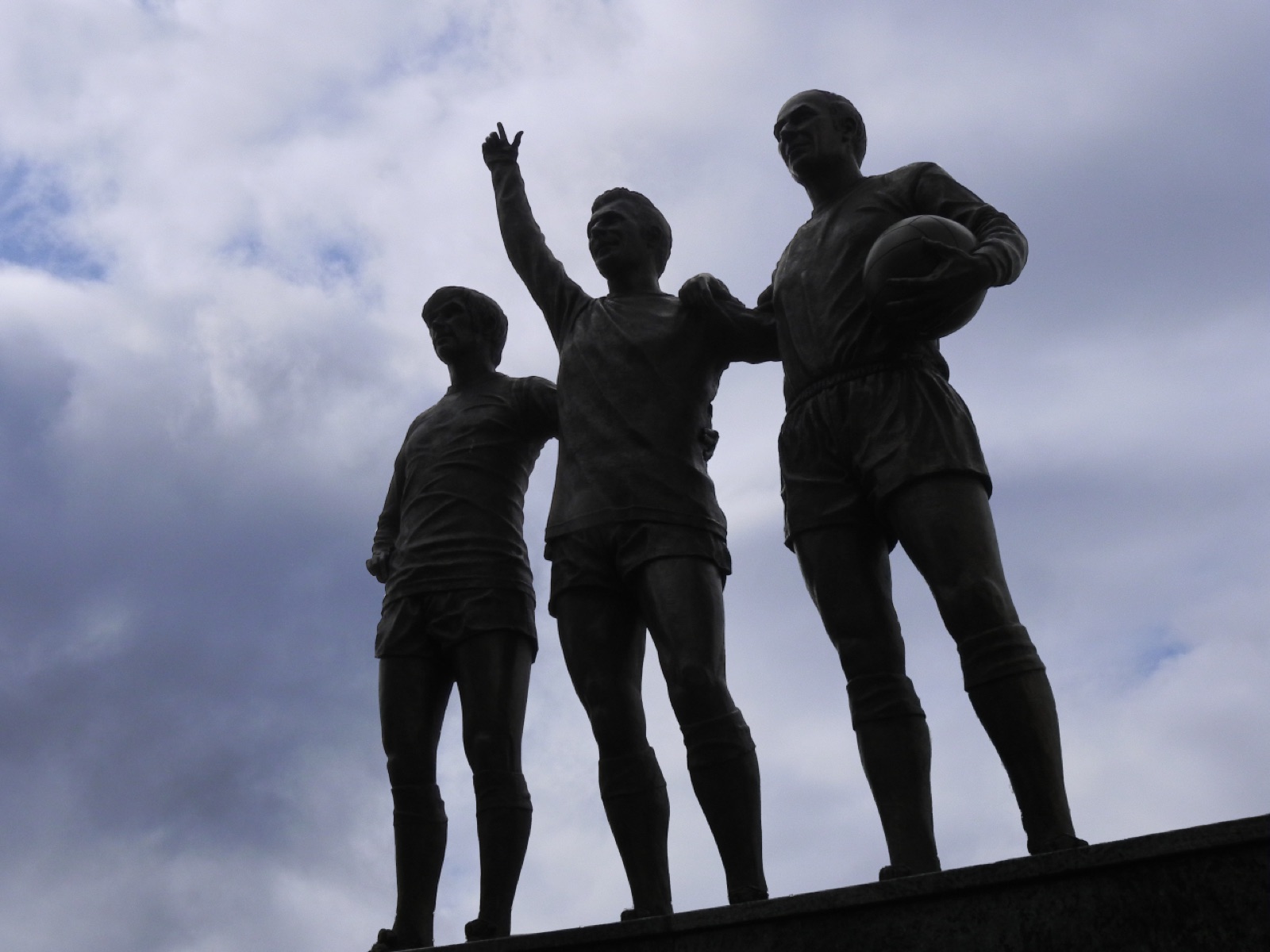
On the forecourt are the statues. The United Trinity, Best, Law and Charlton together, was unveiled in 2008, exactly forty years to the day after the 1968 final. There's a separate statue of Busby, and there's the Munich clock, stopped at 3:04, the time of the crash. The local move is to walk the forecourt about an hour before kickoff, take the statues and the clock in, then head inside for the warm-up rather than queuing early for photos on an empty concourse.
If you want to see the players arrive, the team bus pulls in around ninety minutes to two hours before kickoff by the Stretford End entrance near the Munich Tunnel, the W15 and W16 gates. Get there early for a spot on the barrier.
Here's the walk up, shot by the United We Stand lot themselves:
Take the Metrolink tram to the Old Trafford stop. From there you walk down Warwick Road and onto Sir Matt Busby Way, straight past the vendors and the statues, which is the approach you want on the way in. It's the closest useful stop and the best first walk to the ground. Wharfside is the other nearby stop if you're coming from the MediaCity side.
One thing older guides get wrong: there used to be a matchday train halt right at the ground. The last trains ran in December 2017 and it's been suspended indefinitely since, at the club's request, so if something tells you to take the train to the stadium itself, it's out of date. On the way out is when the crush is worst; regulars beat it by peeling off to Trafford Bar, about 15 minutes' walk and a direct tram to Piccadilly and Victoria, or by walking the 35 to 40 minutes back into the city centre along the water. But that's a leaving trick, not an arriving one. Coming in, use Old Trafford and take the walk.
Two things for the gate. Your ticket is issued inside the United app and there is no paper or PDF version, but the club's own advice is to load it into your Apple or Google Wallet before matchday and tap the back of your phone at the reader, so sort that the night before rather than at the turnstile, and leave real time to get in, because the queues have slowed since tickets went digital. And travel light: Old Trafford doesn't allow bags much bigger than A4, and there's nowhere to stash one at the ground, so a rucksack is a problem with no fix.
Worth understanding before you plan the day: there's no away pub and no real tourist pub right by the ground. The pubs on Chester Road are home turf and they mean it. So there are two honest ways to do a matchday, and locals do both.
If you want the pubs by the stadium, know what they are. The Bishop Blaize on Chester Road is the big Wetherspoons everyone piles into, rammed and singing a couple of hours before kickoff, so bring cash and don't expect a seat. The Trafford, just along the road, is the closest actual pub to the ground and the most hardline about it: home fans only, and they turn away anyone in a half-and-half scarf at the door. The Tollgate, up by the Trafford Bar tram stop, is roomier and just as loud, and it's the pub the protest marches tend to set off from, so if there's ownership anger about you might catch an organised walk down Sir Matt Busby Way three-quarters of an hour before kickoff. All three are home turf. A neutral or a visitor in normal clothes will be fine getting in early; in away colours, don't. The calmer option right by the ground is Hotel Football on Sir Matt Busby Way, the Neville and Giggs place, which is seated and screen-heavy and fine for families rather than a terrace pub.
The other way, the one away fans and plenty of locals take, is to drink in the city centre and tram out. Start on Deansgate at Mulligans, an Irish bar covered in United history and heaving on a matchday, or the Old Nag's Head on Jackson's Row a couple of streets over, a real United pub with the singing to match. MediaCity at Salford Quays, one tram hop from the ground, is the low-key pick: mixed crowds, no home-only door, good if you've got family or just want a quiet pint. City pubs start filling two and a half to three hours out, so leave yourself something like forty minutes to tram over and get through the queue.
Food is easier than the choice of pub. The one genuine stop is Lou Macari's, the chippy at 684 Chester Road run by the old United player, a landmark for a decade and more and actually decent, though a local will tell you it's the landmark rather than the best chippy in the city. Everything else at ground level is ritual, not cuisine. The pie and Bovril is lukewarm and overpriced and you should have one anyway, and the burger vans up Sir Matt Busby Way are exactly the crappy cheeseburger you'd expect, worth doing once. If you need halal, that got easier this season: the concourse kiosks now carry certified halal hot dogs, which they didn't before.
Afterwards, don't sprint for the nearest tram with everyone else. There's no secret exit, honestly. The two moves that work are walking to a quieter stop like Trafford Bar or Exchange Quay, or doing what a lot of locals do and having one more pint at The Trafford or the Tollgate while the crush clears, on the logic that you'll be waiting an hour for a tram either way, so you may as well spend it talking about the game.
Here's the honest part, and United fans will tell you the same thing. Old Trafford can be quiet. This is the ground Alex Ferguson, after a home game in 2008, said was "like a funeral," about his own crowd. The reputation is real, but it's specific rather than blanket. The big Sir Alex Ferguson Stand down the side and the Sir Bobby Charlton Stand behind the south goal are the older, calmer, more corporate parts of the ground, and they'll be flat for long spells of a normal league game.
The noise lives in the Stretford End, the historic loud end behind the west goal. The club put an official singing section in the first tier there in 2019, and as of the 2025/26 season there's a large safe-standing rail block in the second tier, one of the biggest in the league. Everyone stands, it stays up the whole game, and it's a different match from what you get in the quiet corners. If you have any choice over where you sit, sit there. This is what it looks like when it goes up:
Away fans, for what it's worth, sit in the southeast corner where the East Stand meets the Sir Bobby Charlton Stand, a block of around 3,000 tucked into the angle.
A few are worth knowing before you go, because it's hard to catch the words for the first time in a full ground and easier to join in if you've heard them once. "Glory Glory Man United" is the anthem, sung before kickoff and after the final whistle. "Take Me Home, United Road" is John Denver's "Country Roads" with the words swapped for the road the ground sits on, and it's the one you'll already know the tune to:
If you're coming in December, listen for "The Twelve Days of Cantona," a Christmas-carol tribute to Eric Cantona that only comes out around the festive fixtures. Worth knowing so you get the joke rather than looking around confused.
The official Megastore is at the ground and it's big, but the smart move is to do it the day before or the day after, not on matchday, when the queues are brutal and on a Sunday it doesn't reopen after the whistle at all. If you do go on the day, bring your ticket for the matchday discount. Beyond that, the honest split is the one every regular knows: a badge or a scarf from a street seller is a fine, cheap souvenir, the official programme is worth it if you want something with actual content, and United We Stand is the buy if you want the real insider read. Skip anything a stall calls an official or match-worn shirt.
The panel at the top has the short version. The longer, honest one is worth reading, because "buy through the club", the answer that holds at most grounds abroad, is the polite one here, not always the real one.
Start with the official path. Almost everything runs through Official Membership and a ballot. The membership is what earns you the right to buy at all. Every home game then releases member-only tickets over the eight weeks before kickoff, and for the biggest games you apply through a members' ballot when it opens. Members also get first shot at seats that season-ticket holders hand back through the club's own resale exchange, which is where a lot of single tickets quietly come from. For a normal league game, a membership plus a bit of ballot luck genuinely works.
Now the part official sources won't tell you. If you've decided three days out that you want the Manchester derby and you've no membership, be honest about the odds, because there's a hard split between an ordinary fixture and a marquee one.
For a marquee game, the only near-certain paid route is official hospitality, and it doesn't need a membership. You book it straight from the club, or an official partner like Seat Unique or SportsBreaks, for somewhere between roughly £300 and £600 a seat. The catch is that for the derby specifically even hospitality tends to go months ahead, so late availability is really a matter of chasing cancellations.
Below hospitality it gets riskier. The grey market, the big third-party resale sites, is what plenty of people actually use, but two things are worth knowing. Reselling tickets to English football matches is illegal, a 1994 law and one they do act on, and United's tickets are now fully digital and tied to your membership in the app. A ticket bought off a stranger only scans if both membership numbers are linked, so a resold ticket can be completely genuine and still fail at the turnstile. If a friend at the club is forwarding you a seat, the club sells a Forwarding Membership at around thirty pounds a season that exists purely to receive one; it does not let you buy tickets yourself, and it is the cheapest legitimate way in when someone else has the ticket. Prices swing wildly, from a bit over face to four figures for a derby. If you do end up on a resale ticket, get to the turnstile early, so that if it's been sold to more than one person you're the first one to scan in.
There's also a genuine face-value spares scene, fan-run spares accounts on X where supporters pass on tickets they can't use, at face value. It's the cheapest honest option and it works, but only for ordinary games. Nobody hands over a spare for the derby. As for the touts still standing on Sir Matt Busby Way shouting "buying or selling," in 2026 they're mostly moving stolen or fake app access that the turnstile readers catch. Don't.
The blunt version: for a normal home game you can get in, whether through membership and the ballot, a face-value spare, or hospitality if you want the comfort. For the derby at three days' notice, budget hospitality money and hope for a cancellation, accept a real turn-away risk on resale, or do the sensible thing and aim your trip at a league game instead, where all of this actually works.
Old Trafford sits at the hard end of a country-wide pattern, and how to plan an English trip covers the membership-first order the whole league runs on.
A few things specific to the away end, because it's a different day. Visiting fans are put in the southeast corner, roughly blocks E132 and E230 to E232, and go in through the S22 and E30 turnstiles. Entry there closes at half-time, so don't leave it late. The bag rule is tighter than the general one, around 20 by 15 by 5 centimetres, with paid storage at the E2 gate if you turn up with more. There's no away pub by the ground, so away support drinks out at Salford Quays and MediaCity, one tram stop away, where places like the Lime Bar, the Matchstick Man and the Dockyard take all comers.
The one that catches first-time away fans out: you'll often be held inside the ground for a while after the final whistle, on police instruction, before you're let out and sent toward the trams. It's routine, it isn't personal, and it's worth building into your plans for getting away.
Get there early. The walk up, the street, the statues and the ground slowly filling are half the point of a first visit, so give yourself an hour rather than sprinting in at kickoff. The one bit of local habit worth copying is the other end: don't leave on 85 no matter the score. And know the ground itself is on borrowed time now. The club has confirmed a new 100,000-seat stadium next door, with the land assembled but construction not yet started and a five-year build to come, so "I saw a game at the old Old Trafford" is quietly becoming a thing worth having done.
Pubs, prices and the street scene move around, and ticket rules and prices change season to season. Check anything time-sensitive the week you travel, and line up your ticket well before you go rather than gambling on the day.
Manchester United play at Old Trafford, the biggest club ground in England, approached along Sir Matt Busby Way. The club has confirmed a new 100,000-seat stadium next door, though it is still pre-construction with a five-year build ahead of it, so seeing a game at the current Old Trafford is becoming something worth having done.
Almost everything runs through Official Membership and a ballot. Membership earns you the right to buy at all, each home game then releases member-only tickets over the eight weeks before kickoff, and the biggest games go through a members' ballot. Away tickets are effectively closed to visitors.
For a normal league game, membership plus a bit of ballot luck genuinely works, and there's a face-value spares scene where fans pass on tickets they can't use. For the derby or another marquee game, the near-certain paid route is official hospitality, roughly 300 to 600 pounds a seat, and even that tends to sell out months ahead.
Take the Metrolink tram to the Old Trafford stop, then walk down Warwick Road onto Sir Matt Busby Way, past the vendors and statues on the way to the ground. There used to be a matchday train halt right at the stadium, but it stopped running in December 2017 and has been suspended ever since.
The noise lives in the Stretford End, the historic loud end behind the west goal, which got an official singing section in 2019 and a large safe-standing rail block in the 2025/26 season. The Sir Alex Ferguson Stand and Sir Bobby Charlton Stand are older, calmer, and more corporate, and can go flat for long spells of a normal league game.
Dates more than a few weeks out show as “date & time TBC”. When do fixtures get confirmed? →