Sat 31 Oct · 12:30 GMT
Chelsea FC v Manchester United FC
Stamford Bridge · London
England & Wales
Premier LeaguePlan a trip around this →
The blue half of west London, at a tight old ground it keeps threatening to replace. From the Abramovich billions to the Boehly reset, Blue Is the Colour, and the membership you'll need before you can even buy in.
By Carlos O. · Last updated 7 Aug 2026
Membership-gated, then a scramble for the biggest games. Everyone attending needs a paid Chelsea membership: CFC Blue at £45, True Blue at £60, and True Blue+ at £80 for 2026/27, with the higher tiers opening a sales window first. For an ordinary Premier League fixture that's genuinely enough: most home games clear within the members' phases, and general sale to non-members is rare, maybe once or twice a season for a lower-demand midweek match, at a small premium over the members' price. The exception is the bracket of Arsenal, Liverpool, Manchester City, Manchester United and Tottenham, where Chelsea sells strictly by loyalty points banked from attending previous home games, and a first-time visitor with no history is shut out regardless of membership tier. Chelsea's old rivalry with Leeds United draws a passionate following but hasn't required unusual loyalty-point totals in recent sales, and the West London derby against Fulham sells through the standard members' window rather than a scarcer one. The club's official Ticket Exchange lets season-ticket holders resell at face value, and official hospitality guarantees a seat at a premium. Tickets are named and digital, and unauthorised resale is a criminal offence in England, so the club voids touted tickets and a third-party resale site risks a turn-away at the gate.
Chelsea are the club money built twice, and the second time is still settling. To make sense of a matchday you need the shape of that, plus one quirk of origin: unlike almost every other club, Chelsea didn't build a ground, the ground came first. In 1905 a businessman had a stadium at Stamford Bridge and no team to play in it, so he founded a club to fill it, in a meeting at a pub across the road that still stands, now called the Butcher's Hook. That is genuinely the order it happened in, and it tells you something about the club: Chelsea has always been a bit of a project.
For most of a century it was a mid-table West London side with a glamorous, showbiz edge and a rough hooligan underside. Then in 2003 Roman Abramovich bought it and poured in a fortune, and Chelsea became a permanent heavyweight, winning the Champions League in 2012 and again in 2021. That era ended abruptly in 2022 when Abramovich was sanctioned by the UK government over his ties to Vladimir Putin after Russia's invasion of Ukraine, his assets frozen, and the club sold under a special licence to a consortium led by the American Todd Boehly and the private-equity firm Clearlake. Fans are genuinely split about all of it: grateful to Abramovich for the trophies and stability, wary of the spreadsheet-driven, squad-churning ownership that replaced him. The new era has its own silverware, the 2025 Conference League that made Chelsea the first club to win all of UEFA's major competitions, but the mood around the place is more complicated than the winning suggests.
The ground fits the story. Stamford Bridge is old, tight and hemmed in by roads, railway and houses, which is why the club can't simply expand it and has spent years floating a bigger new stadium, on this site or another, that never quite happens. The current owner has said a move might not come until the 2040s, so the honest situation is that the Bridge, for all the talk, is going nowhere soon.
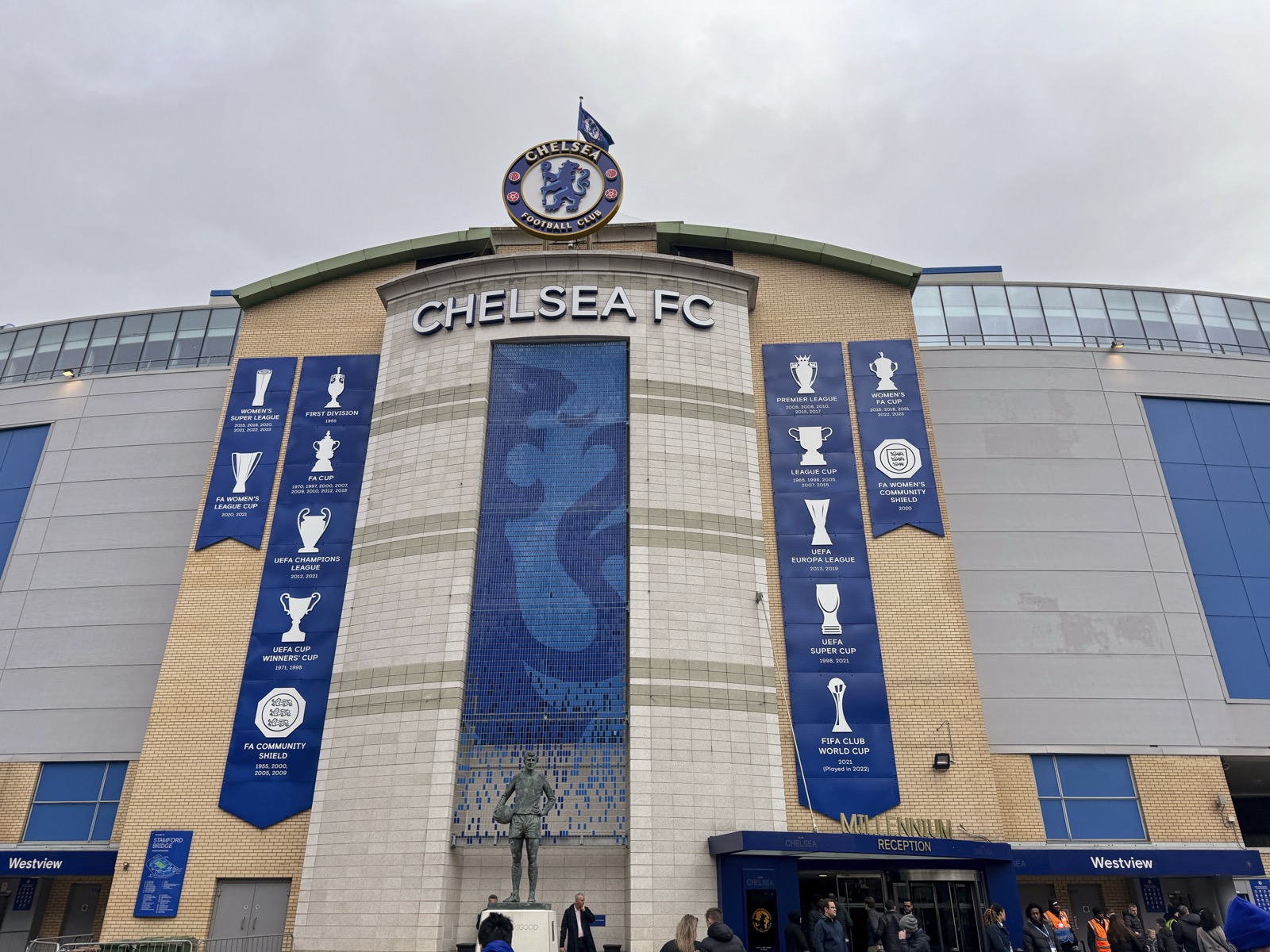
The nearest station is Fulham Broadway on the District line, which sits right by the ground, so getting in is easy; getting out is the usual big-London crush, with everyone funnelling back through one station after the whistle. The trick to leaving smoothly is to spread the load: West Brompton, a short walk away and served by the District line and the Overground, is a calmer exit, and Imperial Wharf on the Overground is another option that also has a river-boat pier if you fancy the scenic route back. Fulham Road itself is closed to traffic for a couple of hours either side of the match, so plan your walking, not a taxi to the door.
The pub scene right by the ground is home turf and territorial, especially for a big fixture. The Butcher's Hook, opposite the main entrance, is the club's founding pub and shows every game, home-oriented; the streets immediately around the Bridge fill with Chelsea support and aren't the place to turn up in rival colours.
If you want somewhere more relaxed, or you're following the away team, the sensible move is to drift north toward Earls Court, where pubs like The Blackbird on Earls Court Road are used to a mixed crowd and less coded to one club. It's a short walk that takes you out of the home-heavy blocks right around the stadium.
Be honest with yourself about the atmosphere: for a club of Chelsea's size and spending, Stamford Bridge is often criticised as quiet, particularly the pricier, more corporate West and East stands, which pull a tourist-and-hospitality crowd. The noise, such as it is, comes from the Matthew Harding Stand lower tier behind the north goal, the loudest home section today, and that's the end to aim for if you want atmosphere. The Shed End behind the other goal, once the loud heart of the ground, is now the away end, so a lot of what noise there is comes from the back-and-forth between the two.
There's history in the geography here. The Shed End, behind the south goal, was Chelsea's famous old terrace, the loud and notorious heart of the support in the 1970s and 80s, before all-seater rules shrank it. The club even ran a "Back to the Shed" campaign years ago to try to reorganise vocal support and claw the atmosphere back, with mixed results. Today the Shed End is one of the smaller stands. That old terrace culture had a genuinely dark side too, the Chelsea hooligan firm of that era was tied up with far-right groups and racism, including abuse of the club's own players; it's history now, marginal to a modern matchday, but it's part of the honest story of this ground rather than something to pretend away.
This is the Liquidator before kickoff, the Bridge at its loudest:
The anthem is "Blue Is the Colour," a genuinely retro one: it was recorded by the Chelsea squad for a cup final in 1972, was a genuine chart hit at the time, and is still played before every home game, all cheerful, dated singalong. The terrace song to know is "Carefree," sung to the tune of the hymn "Lord of the Dance," which came out of a Chelsea away trip in the 1980s and is the defiant, chest-out anthem you'll hear travelling and at home. Between the two you get both sides of the club, the showbiz and the hard edge.
The Chelsea Megastore is at the ground on the Fulham Road side, by the West Stand, and carries the full range; hours shift on matchdays, so if you want a quiet browse, go on a non-match day. There's no need to hunt elsewhere in the city; the club retail is concentrated at the Bridge.
Plan ahead, because Chelsea is membership-gated. Everyone attending a game, unless they hold a season ticket, needs a paid Chelsea membership first. The tiers that let you buy your own ticket run from around forty-five pounds up to eighty, and the higher ones get the earlier and better buying windows. Below those sits a forwarding-only tier at around fifteen pounds, which does not let you buy but does let a member or season-ticket holder pass a seat to you, and that is the cheap route in if someone at the club is handling it. General sale, when it happens, only opens after members have had their go and costs a few pounds more, and for the bigger fixtures it often never reaches general sale at all. So the realistic route for a visitor is to take out a membership in advance and buy in a members' window, or use the club's official Ticket Exchange, where season-ticket holders resell unused seats at face value. Members first, then an official exchange for the seats they hand back, is the shape of the process at most big clubs in Europe; Chelsea's twist is that the membership is compulsory rather than just an advantage.
If you want a guaranteed seat without the membership grind, official hospitality, booked through the club or its named partners, does the job at a premium. What you should avoid is the open resale market: reselling football tickets without authorisation is a criminal offence in England, Chelsea's tickets are named and digital, and the club will invalidate a ticket it identifies as touted, which means a purchase from a stranger or a third-party site can leave you turned away at the turnstile after paying well over the odds.
Paying for a tier before you can buy anything is the English norm rather than a Chelsea quirk, and the England trip guide sets out what that costs across the league.
Take Stamford Bridge for what it is: an old, cramped, atmospheric-in-parts ground carrying a club that has been remade by money twice over and is still working out what it wants to be under new owners. See the Butcher's Hook where the whole thing started, get yourself into the Matthew Harding end for the noise, set up a membership before you travel, and don't put too much faith in the new-stadium talk, because the Bridge, for all its threats to leave, is where Chelsea will be for a good while yet.
Membership tiers, prices and the on-again-off-again stadium plans all change; check anything time-sensitive the week you travel, and only buy tickets through the club or its official Ticket Exchange.
Chelsea play at Stamford Bridge in Fulham, west London. It's one of the oldest and most boxed-in grounds in the English top flight, hemmed in by roads, railway and houses, which is why the club has talked for years about a new stadium without ever building one.
Not easily without planning ahead. Everyone attending, unless they hold a season ticket, needs a paid Chelsea membership first, with the tiers that let you buy your own ticket running from around forty-five to eighty pounds, and the higher ones getting earlier buying windows. There is also a cheaper tier, around fifteen pounds, that only lets a member or season-ticket holder forward you a seat, which is the one to get if a friend at the club is sorting your ticket. General sale only opens after members have had a chance, and many games never reach it at all.
The club runs an official Ticket Exchange where season-ticket holders resell unused seats at face value, which is the legitimate route once membership windows have passed. Official hospitality, booked through the club or its named partners, guarantees a seat at a premium without needing a membership. Avoid third-party resale sites: Chelsea's tickets are named and digital, and the club voids ones it identifies as touted.
The nearest station is Fulham Broadway on the District line, right by the ground, though getting out afterward is a crush as everyone funnels through one station. West Brompton and Imperial Wharf, both a short walk away, are calmer exits on the District line and Overground. Fulham Road itself closes to traffic for a couple of hours around kickoff, so plan to walk rather than taxi to the door.
Stamford Bridge is often criticised as quiet for a club Chelsea's size, especially in the pricier West and East stands that draw a tourist and hospitality crowd. The Matthew Harding Stand's lower tier, behind the north goal, is the loudest home section today. The Shed End behind the other goal, once Chelsea's famous loud terrace, is now used as the away end.
Dates more than a few weeks out show as “date & time TBC”. When do fixtures get confirmed? →