Wed 28 Oct · 20:00 GMT
Liverpool FC v Chelsea FC
Anfield · Liverpool
England & Wales
EFL CupPlan a trip around this →
The Kop, six European Cups and You'll Never Walk Alone, at a ground with no station and a ticket system built to keep you out. Shankly, Hillsborough handled with the care it demands, and the one realistic route in for an overseas fan.
By Carlos O. · Last updated 7 Aug 2026
One of the hardest tickets in England for a visitor. You need a membership or season ticket to buy at all, and tickets now run on a multi-year credit system rather than an open sale, so a first-time member with no attendance history sits behind everyone who's already been going. Season tickets are closed to new applicants with a waiting list widely reported in the tens of thousands, and the members' ballot itself gives no guarantee. The genuinely realistic route for an overseas fan is an Official Liverpool Supporters Club branch, which gets its own separate ticket allocation members can apply for: join one in your own city, apply months ahead of the twice-yearly windows, and real odds follow (one long-running U.S. branch reports filling around six in ten of its members' requests). The Merseyside derby against Everton and the North West derby against Manchester United are harder again, selling out fastest of all and squeezing branch allocations tightest, so build in a backup date if either is the target game. Hospitality guarantees a seat at a steep price. Resale is illegal in England, the club hands out life bans for touting and voids touted tickets, so the grey market risks being turned away at the gate.
Anfield trades on feeling, more than almost any ground in the sport, and the feeling is real. But it comes with a set of things a first-timer really should understand before they go, because this is a club where the history is not decoration; it is the point, and some of it is grief.
The club was born out of a row. In 1892 the landlord of the Anfield ground, John Houlding, fell out with the Everton committee who played there; Everton walked across Stanley Park to build Goodison, and Houlding started a new club to keep his stadium full. That new club was Liverpool. The identity that matters, though, arrived with Bill Shankly in 1959, a Scottish socialist who took a second-division team with a crumbling ground and rebuilt it, its training and its self-belief, into a champion. He put up the "THIS IS ANFIELD" sign over the tunnel to remind opponents where they were, ran his famous Boot Room where the coaching staff plotted over tea, and framed the club as a holy trinity of players, manager and supporters, with the directors nowhere in it. Everything Anfield feels like traces back to him. His statue stands in front of the Kop.
What followed was the most successful era in English football: six European Cups, an English record, from the 1977 win over Mönchengladbach through the miracle of Istanbul in 2005, when Liverpool came back from three down against Milan, to the 2019 final. Under Jürgen Klopp the club won that 2019 European Cup and then, in 2020, a first league title in thirty years. It has stayed near the top since; Arne Slot won the title in 2025 before a poor season cost him his job in 2026, with Andoni Iraola taking over. But at Anfield the trophies are almost the easy part of the story.
The hard part is Hillsborough, and it needs stating plainly rather than skirting. On 15 April 1989, at an FA Cup semi-final in Sheffield, 97 Liverpool supporters were crushed to death in a disaster caused, as the courts finally ruled, by police failure, not by fans. In the immediate aftermath South Yorkshire Police altered witness statements and briefed lies blaming the supporters, and one national newspaper printed those lies on its front page under the headline "The Truth." That paper is still boycotted across Merseyside to this day; a great many local shops will not sell it, and you should understand this is not a grudge but a live matter of justice and dignity. Fresh inquests in 2016 ruled the dead were unlawfully killed. The Shankly Gates by the Anfield Road end, inscribed "You'll Never Walk Alone," sit beside the Hillsborough memorial, and "Justice for the 97" is the phrase you'll see. Treat all of it with respect; it is the most important thing about this club, more than any cup.
Be ready for the one genuine practical hurdle here: there is no train station at Anfield. It sits in a tight residential grid, and unlike most big grounds you cannot just get off a train outside it. The option most regulars steer visitors to is the 917 express shuttle bus from Commutation Row in the city centre, which runs every ten minutes or so on matchdays, costs a couple of pounds, and is the most reliable way in, partly because taxis are hard to find around kickoff and the normal buses get swamped. The alternative is a Merseyrail train to Sandhills or Kirkdale, both a signposted walk of under thirty minutes, with a dedicated Soccerbus shuttle running from Sandhills. Plenty of people simply walk the couple of miles out from the centre, and there is no stadium car park, so driving in is not the plan.
The pubs around Anfield are a genuine part of the day, and most of them are firmly home turf. The current go-to for a lot of regulars is Taggy's and the Hotel Anfield bar right next door on Anfield Road, with outdoor drinking and live music before a game. The Sandon on Oakfield Road, the pub where the club was actually founded in 1892, is the historic stop, though being huge it can feel spread out rather than raucous. The Albert, right by the Kop, is the classic packed-and-singing home pub. If you're an away or neutral fan, The Arkles by the Anfield Road end has traditionally been the away-leaning pub, though it's more of a mix these days, and the big Thomas Frost Wetherspoons out on Walton Road, open from early, is a reliable travelling-fan choice.
The area is residential and ordinary, not a tourist strip, so the day is about the walk in, the pub and the ground rather than a scene. If you want a longer session first, the city centre around Lime Street has plenty of pubs and is an easy shuttle or walk from the ground. For matchday food, the local dish is scouse itself, the slow-cooked stew the city takes its nickname from; the community-owned Homebaked bakery on Oakfield Road, yards from the ground, does an award-winning Scouse pie and is a matchday institution in its own right.
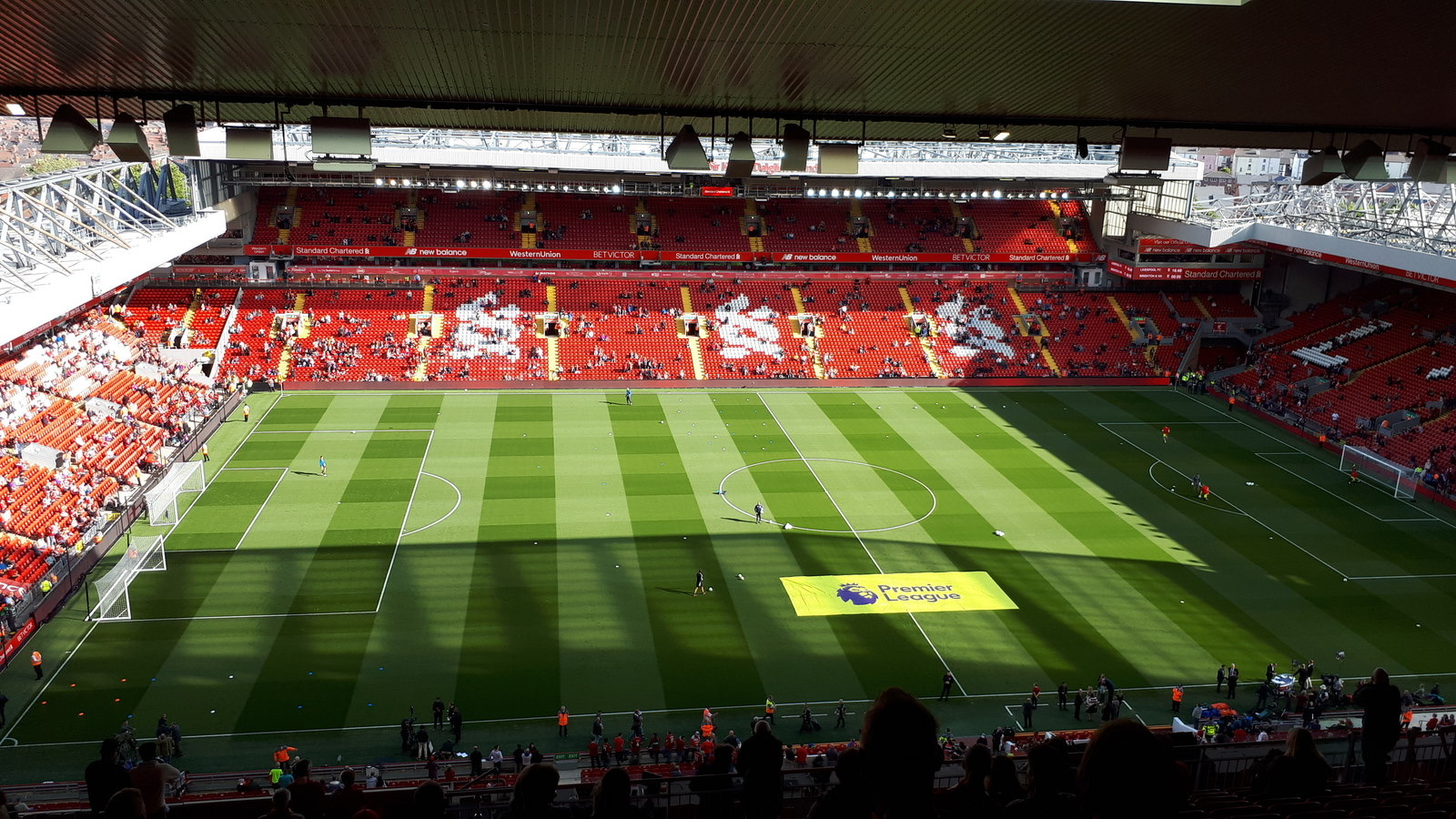
Here's the honest version, because Anfield's reputation is so large it needs calibrating. The one thing that is close to guaranteed, every single home game, whatever the opposition, is the pre-match ritual: the lights, the scarves held aloft across the Kop, and the whole ground singing "You'll Never Walk Alone." For a first-time visitor that is the moment, the thing you came for, and it delivers regardless of whether it's a Champions League night or a dead-rubber Tuesday. This is that moment, a packed Anfield before kickoff:
The sustained noise across the ninety minutes is more honest to admit is fixture-dependent. On the big European nights, or a title decider, or against a real rival, Anfield becomes the cauldron of the legend, and the 2019 comeback against Barcelona is the modern proof. Against mid-table opposition on a cold midweek, it can be as flat as any modern Premier League ground, and visitors do sometimes come away surprised by the quiet. The Kop, the single-tier home end behind the south goal, is where whatever noise there is comes from; if you have a choice, that's the end to be near.
"You'll Never Walk Alone" is the definitive one, and it's older than you'd think: a show tune from a 1945 musical, made a hit by the Liverpool band Gerry and the Pacemakers in 1963, and adopted by the Kop as its pre-match anthem by 1964. The same recording, with Gerry Marsden's voice, still plays before every home game, and the scarves-up singalong is the single most filmed moment of a Liverpool matchday.
Two others are worth knowing. "Allez Allez Allez," the bouncing anthem of the Klopp-era European runs, was born among travelling fans in a Porto bar in 2018. And "The Fields of Anfield Road," set to an Irish famine song, carries a verse written for the anniversary of Hillsborough, so it lands with more weight than an ordinary terrace tune; know that when you hear it.
The club store is the Anfield Store at the ground on Walton Breck Road, and there's a large flagship in the city centre in the Liverpool ONE shopping district on South John Street, plus a long-standing store at Williamson Square. If you're in town anyway, the city-centre stores save you a trip out to the ground just to shop.
This is the part to be honest and slightly discouraging about, because Anfield is one of the hardest tickets in England for a visitor with no history at the club. You cannot simply buy a Premier League ticket; you need a season ticket or a membership even to be eligible, season tickets are effectively closed with a waiting list in the thousands and no new applications, and membership only gets you into the members' sale windows and the ballots for the biggest games, none of which guarantees a seat. A separate slice of tickets is ring-fenced for local residents by postcode, which by design a tourist can't touch. If you've got into grounds abroad before, the step where you watch for the club's own general sale is the one that doesn't exist at Anfield.
The genuinely realistic route for an overseas fan, and the one worth planning around, is the Official Liverpool Supporters Club network: hundreds of branches in a hundred-plus countries, each allocated a number of tickets for chosen home games that only their paid members can apply for. Join the branch in your country, well in advance, and that's your best honest shot through the front door. Beyond that, official hospitality will guarantee you a seat at a real premium, from a few hundred pounds up past a thousand for the marquee games.
What you should not do is treat the open resale market as a normal option. Selling a football ticket without the club's say-so is a criminal offence in England, Liverpool hands out life bans for touting and voids tickets it identifies as touted, and a ticket bought from a stranger or a third-party site can leave you turned away at the turnstile with no way to get your money back. Plan the OLSC route months ahead instead.
If Anfield turns out to be closed for your dates, an English trip is usually rescued one division down rather than by another Premier League club.
Come for the anthem, and come knowing what you're walking into. Anfield on a European night, with the Kop in full voice, is one of the genuine experiences in the sport, and even a quiet league game gives you the scarves and the song before kickoff. Take in the Shankly Gates and the Hillsborough memorial with the seriousness they're owed, don't go looking for that newspaper anywhere near the place, get your ticket the slow honest way through a supporters' branch, and you'll have done Anfield properly.
Ticket rules, the membership and loyalty systems and the matchday transport are all in flux, and the club's on-field situation is moving fast. Check anything time-sensitive the week you travel, and only ever buy a ticket through the club or an official supporters' branch.
Liverpool play at Anfield, tucked into a residential corner of the city with the single-tier Kop stand behind one goal. The ground has hosted six European Cup wins, an English record, and every home game starts with the crowd singing You'll Never Walk Alone before kickoff.
It's genuinely difficult. You can't just buy a Premier League ticket; you need a season ticket or membership even to be eligible, season tickets are effectively closed with a waiting list in the thousands, and membership only gets you into ballots for the biggest games with no guarantee of a seat.
The realistic route for an overseas fan is the Official Liverpool Supporters Club network, hundreds of branches worldwide that each get their own ticket allocation for members to apply for. Join your country's branch well in advance. Reselling is a criminal offence in England and Liverpool voids touted tickets and hands out life bans, so avoid the grey market.
There's no train station at Anfield. The most reliable option is the 917 express shuttle bus from Commutation Row in the city center, running every ten minutes or so on matchdays. Alternatively, take Merseyrail to Sandhills or Kirkdale and walk, or catch the dedicated Soccerbus from Sandhills.
The one guaranteed moment is the pre-match ritual: scarves held aloft across the Kop as the whole ground sings You'll Never Walk Alone, every single home game regardless of opponent. Sustained noise through the ninety minutes is more fixture-dependent. Big European nights and real rivals bring the cauldron; a quiet midweek game against mid-table opposition can be flat.
Dates more than a few weeks out show as “date & time TBC”. When do fixtures get confirmed? →