Tue 27 Oct · 20:45 CET
AS Roma v Cagliari Calcio
Stadio Olimpico · Rome
Italy
Serie APlan a trip around this →
The people's half of Rome, at a shared Olympic stadium with a running track and a ferocious home end. Getting out to the Foro Italico, the honest word on the derby, and the named-ticket rules.
By Carlos O. · Last updated 15 Sept 2026
For a normal Serie A game this is manageable: Roma sell single-match tickets online through the official club channel, and an ordinary fixture is usually available to a visitor with no membership needed. Keep the Italian rules in mind: every ticket is personal and named, digital only, and you need a valid ID matching the name to get in, and the cheaper sectors can carry extra conditions. The Curva ends are harder and can require an AS Roma fidelity card when season-ticket holders soak up the allocation, so arrange that well ahead. Even a marquee Champions League night reaches genuine general sale for the public after a short season-ticket-holder presale, and Roma's ties against clubs like Real Madrid have opened to the public this way, but demand can still empty it within hours, and a home game against Napoli, a fierce non-derby rival, has sold down to a handful of tickets within weeks of kickoff too. The Derby della Capitale against Lazio is the hardest ticket of the year: Roma's own end sells out around the members' presale, and an away ticket for Lazio's home derby requires the fidelity card and comes with heavy security and a post-match hold. Reselling above face value is illegal in Italy and tickets are named, so treat any third-party resale site as a turn-away risk; use official hospitality or an authorised package for a sold-out big one.
To understand a Roma matchday you have to understand that Rome is a divided city, and that Roma are the half that thinks of itself as the real one. The capital has two big clubs sharing one stadium, Roma and Lazio, and the split is social and geographic as much as sporting: Roma draw historically on the working-class centre and the old neighbourhoods, above all Testaccio, where the club was effectively born, and their support carries a fierce, romantic, us-against-everyone identity. The badge is the she-wolf of Rome itself, which tells you how completely the club and the city are fused in the fans' heads.
The figure who embodies all of it is Francesco Totti, the golden boy from the Roman suburbs who spent his entire twenty-five-year career at the club, turned down richer offers to stay, and is treated less like a former player than like a patron saint. That one-club devotion is the emotional core of Roma, a club that has won the league only three times and trades far more on passion and belonging than on trophies. The modern era is steadier: since 2020 the club has been owned by the American billionaire Dan Friedkin, and in 2022, under José Mourinho, Roma won the inaugural Europa Conference League, their first UEFA trophy and their first European silverware since the 1961 Fairs Cup, and the excuse for one of the great open-top-bus celebrations the city has seen. The dugout has churned since, but the Conference League night is the recent high the fans hold onto.
The ground itself is a complication you should know about going in. The Stadio Olimpico is a municipal athletics stadium in the Foro Italico complex north of the centre, shared with Lazio, and because it was built for the Olympics it has a running track that pushes every stand back from the pitch. It is big and it can be loud, but it is not a tight, purpose-built football box, and the distance from the action is a genuine and common complaint.
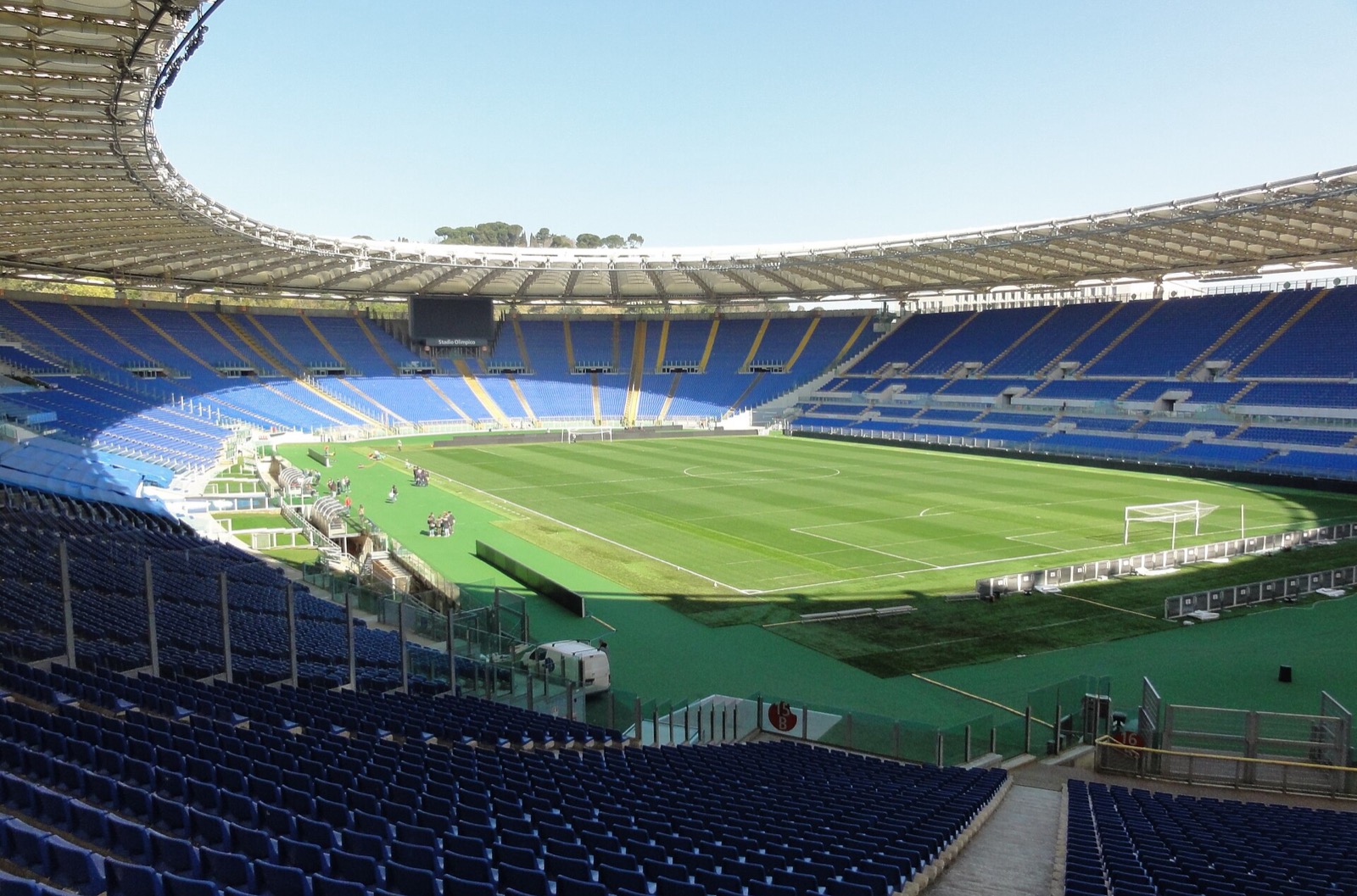
The stadium is a few kilometres north of the historic centre, across the Tiber in the Foro Italico, and there is no metro station at the door, so the trip takes a little planning. The route most people use is Metro line A to Flaminio, then tram 2 to its terminus at Piazza Mancini, then down to the river and across the Ponte Duca d'Aosta footbridge, which brings you out at the stadium's south side. Since July 2026 buses have replaced the tram on that stretch for roadworks, with Rome's trams returning line by line through the autumn, so take whichever is running from Piazzale Flaminio. Check your ticket before you choose a route, though, because it names your gate: the footbridge suits the south end and the Tevere side, while a Curva Nord seat means walking on from Piazza Mancini to Ponte Milvio and coming in from the north, which is fine on a non-derby day when you are only passing through. An alternative is Metro A to Ottaviano and then bus 32 up to the Piazzale della Farnesina near the ground. Give yourself margin, because the trams and buses are swamped around kickoff, and plan the ride home: the metro closes around 23:30 from Sunday to Thursday, so a late weeknight game means a night bus or a taxi.
Here the geography of the rivalry matters, and it is a useful thing to know. The obvious bar district by the stadium is around Ponte Milvio, the ancient Roman bridge a kilometre or so east-northeast of the ground, a lovely spot crammed with bars and restaurants. The catch is that Ponte Milvio is Lazio's pre-match haunt, so if you are going to a Roma game in Roma colours, it may not be the natural place to drink. Roma support gathers instead on the southern side of the complex, along Viale delle Olimpiadi, where spots like the Bar della Musica are where fans mass to greet the team bus before a big one.
The immediate stadium area is not where you want to spend your afternoon regardless. The far better plan is to make your pre-match in the city, and specifically in the neighbourhoods where Roma actually comes from. Testaccio, the old working-class quarter across the river to the south, is the club's spiritual home, the site of its early stadium and still full of genuine Roman trattorie and neighbourhood bars; Trastevere next door is the livelier, more crowded version of the same idea. Eat a plate of cacio e pepe or a Roman-Jewish fried artichoke where the locals do, then travel out to the Foro Italico closer to kickoff.
The heart of a Roma matchday is the Curva Sud, the home end behind the south goal, one of the celebrated ultra ends in European football and the source of the tifo, the flags and the singing. On a derby or a big European night the Curva Sud is a wall of colour and noise that lives up to every bit of the reputation, and it is the reason neutrals put the Olimpico on their list. The honest caveats are the two already mentioned: the running track holds you back from the pitch, and the tighter security and named-ticket regime of modern Italian football have taken some of the raw edge off the old ultra scene. For a routine league game against lesser opposition, expect a big stadium ticking over rather than the full cauldron; for the derby, expect the cauldron. If you have a choice and you want the atmosphere, aim for the Curva Sud end; the Distinti Sud, the section right beside it, lets you sit next to that wall of noise. Away fans go in the Distinti Nord-Ovest, the corner between the north curve and the Tribuna Monte Mario. Roma sell the Curva Nord to their own fans; the exception is a Roma home derby, when Lazio's supporters get the north end.
This is the whole Olimpico singing Roma Roma Roma before kickoff:
The Derby della Capitale, Roma against Lazio, is one of the most intense and most fraught fixtures in the sport. This is not a friendly cross-town rivalry; it carries a real edge and a long, heated history. The practical point for a visitor is simple: if your trip happens to fall on a derby, treat it as a serious occasion, keep colours and opinions to yourself around the wrong end, and understand that the edge you are feeling is real and not for an outsider to make light of.
The anthem is "Roma Roma Roma," co-written and sung by the Roman singer-songwriter and lifelong fan Antonello Venditti, and belted out before every home game; hearing the whole Curva Sud sing it as the teams come out is the moment to arrive early for. His other Roma song, "Grazie Roma," plays at the final whistle after every home win. Between them they capture the particular thing about this club, which is that supporting Roma is treated less as a sporting choice than as a fact of birth.
The official AS Roma Store has a big presence in the centre of Rome, most usefully on the main shopping streets around the Corso, which is far more convenient than the ground for a browse, plus retail at the stadium on a matchday. The city-centre store is the easy option if you are sightseeing anyway.
For an ordinary league game this is manageable. Roma sell single-match tickets online through the official club channel, and a normal fixture against mid-table opposition is usually available to a visitor. Keep the standard Italian rules in mind: every ticket is personal and named, and Roma's own stadium rules say you need a valid ID to get in, so travel with a passport that matches the name on each seat. Tickets are digital only, loaded into your phone's wallet or the club's Il Mio Posto app, and a screenshot won't get you through; the club advises arriving 90 minutes before kickoff. The first sale window for a big game goes to season-ticket holders and AS Roma Card holders, so if the Curva Sud is the goal, an AS Roma Card and its presale window are your best shot; otherwise be ready the moment general sale opens, knowing the curva may already be gone for a big game. Because tickets are named, you enter each friend's name and details when you buy, so collect them before the sale.
The derby and the marquee European nights are another matter, selling out fast and sometimes carrying sales restrictions. Reselling above face value is illegal in Italy, and because the tickets are named, one bought off a stranger or a third-party resale site can simply fail the check at the turnstile. So buy through the club for a league game, use official hospitality or an authorised package for a sold-out big one, and treat the grey market as both a legal and a practical risk rather than a shortcut. None of that is Roma being awkward: club channel first, official resale after that, nothing else is the standard advice for a ticket anywhere abroad, and the derby is exactly the sort of night it exists for.
Sharing the Olimpico gives Rome the same two-club advantage Milan has, and planning an Italian trip explains the named-ticket system behind both.
Take Roma for the passion, not the polish. The Olimpico is a big, slightly compromised bowl with a running track, but the Curva Sud on song, under the she-wolf, singing Venditti as the teams walk out, is one of the genuine experiences in Italian football, and it comes wrapped in a club that treats itself as the soul of the city. Eat in Testaccio where it all started, get out to the Foro Italico by tram or its replacement bus, keep a sensible distance from the politics of the derby, and let the south end carry you.
Ticket rules, fan-card requirements and the club's fortunes all change; check anything time-sensitive the week you travel, and only buy through the club or an authorised seller.
AS Roma play at the Stadio Olimpico, a municipal athletics stadium in the Foro Italico complex north of the centre of Rome, shared with city rivals Lazio. Because it was built for the Olympics it has a running track that pushes every stand back from the pitch. The badge is the she-wolf of Rome, reflecting how fused the club is with the city's identity.
For an ordinary league game, yes. Roma sell single-match tickets online through the official club channel, and a normal fixture against mid-table opposition is usually available to a visitor. Every ticket is personal and named, tickets are digital only, and you need an ID that matches the name to get in, so bring your passport.
The Derby della Capitale against Lazio and marquee European nights sell out fast and can carry sales restrictions. Season-ticket holders and AS Roma Card holders get the first sale window, so the Curva Sud can be gone before general sale for a big game. Reselling above face value is illegal in Italy, and since tickets are named, one bought from a stranger can simply fail the check at the gate.
There's no metro station at the door, so the trip takes a little planning. Most people take Metro line A to Flaminio, then tram 2 (or the replacement bus that has run on the line since July 2026) to its terminus at Piazza Mancini, then walk down and cross the Ponte Duca d'Aosta footbridge to the stadium. An alternative is Metro A to Ottaviano, then bus 32 up to Piazzale della Farnesina.
The Curva Sud behind the south goal is the heart of it, one of the celebrated ultra ends in European football and the source of the tifo and the singing. On a derby or big European night it's a wall of colour and noise; for a routine league game, expect a big stadium ticking over rather than the full cauldron. The Distinti Sud, the section beside it, puts you next to the noise.
Dates more than a few weeks out show as “date & time TBC”. When do fixtures get confirmed? →