Sun 08 Nov · 12:30 CET
SSC Napoli v SS Lazio
Stadio Diego Armando Maradona · Naples
Italy
Serie APlan a trip around this →
Maradona's city and its quasi-religious club, at the ground that bears his name. The southern-Italy identity, one of Europe's fiercest atmospheres, the pizza, and the Fan Card hoop you'll need to clear to get in.
By Carlos O. · Last updated 7 Aug 2026
Gettable, but plan a couple of weeks ahead rather than buying on short notice. Napoli sells through its own paid Fidelity Card (the old Fan Stadium Card, about 20 euros, mailed out over roughly two weeks) rather than a fully open general sale. Cardholders get first access in the presale phase, and for many fixtures the later free-sale window that skips the card is reserved for residents of the Campania region, a restriction confirmed on the club's own sale notices for matches including Napoli-Juventus. A visiting tourist's reliable route is to order the card ahead of the trip rather than count on walking up card-free. Juventus and Roma, Napoli's two real rivalries, are the fixtures where that planning still might not be enough: both have sold the Maradona out completely, Napoli-Roma in February 2026 and Napoli-Juventus in January 2025 with an announced crowd near 52,000, frequently before free sale even opens. Milan, Inter and Champions League knockout nights draw a similar crush. Tickets are personal and ID is checked against the name at the gate; reselling above face value is illegal in Italy and risks a ticket that fails the name check, so buy through the club, its Fidelity Card system, or an official partner. The upside: when the Maradona is full and singing, this is one of the most intense grounds in Europe.
No club in Europe loves the way Napoli loves, and to understand a matchday you have to understand that the love is bound up with one man. Diego Maradona played here from 1984 to 1991 and did the impossible: he took a club from the poor, looked-down-on south of Italy and won it two league titles, in 1987 and 1990, the only times a southern side broke the grip of the rich northern clubs in that era. In a city that felt the rest of Italy despised it, he became something close to a saint, and he still is. The ground was renamed the Stadio Diego Armando Maradona when he died, there is a shrine to him in the old town with a genuine relic-like reverence, and the whole club runs on the memory of what he proved: that Naples could beat the north.
For decades after he left it was mostly heartbreak and, at one low point, bankruptcy; the film producer Aurelio De Laurentiis bought the bankrupt club out of the courts in 2004 and rebuilt it from the third division up. Then, in 2023, Napoli finally won the league again, their first title since Maradona, and the city did not sleep for days, the whole of it draped in blue, flares and murals and altars in every alley. They did it again in 2025 under Antonio Conte. That is the emotional charge you are walking into: a club that spent thirty-three years grieving a golden age and has just, twice, stopped grieving.
None of this is quiet or corporate. Naples is intense, chaotic, proud and a little dangerous around the edges, and the football is the loudest expression of the city's character. Come for that, not for comfort.
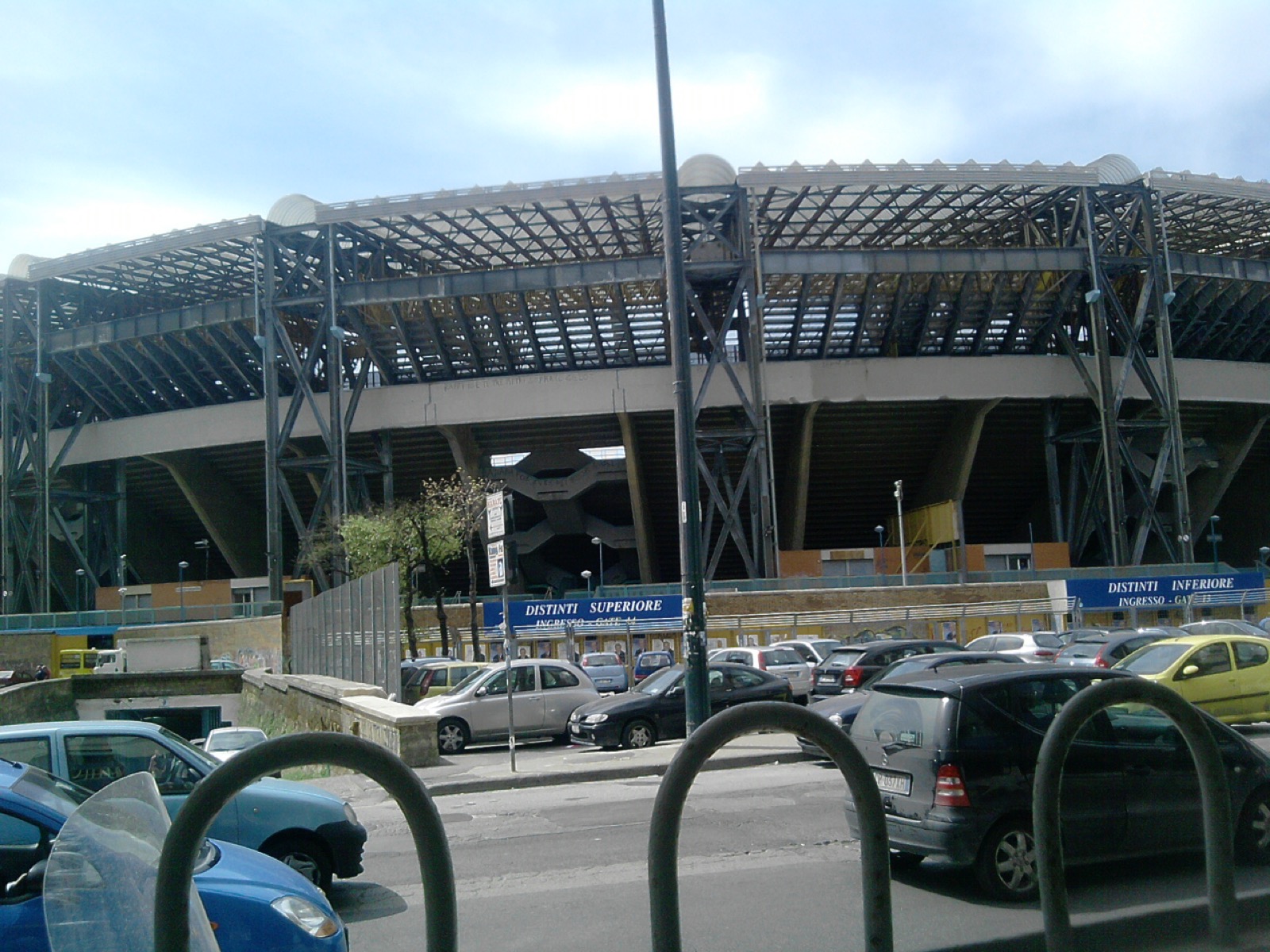
The ground is in Fuorigrotta, a district out to the west of the historic centre, so this is a short journey from your hotel. The two useful rail options both drop you close: Metro Line 2 to Campi Flegrei, a ten-minute walk to the stadium, and the Cumana line to Mostra, which is the closest stop to the entrance. On matchdays the city adds extra buses on the main routes. Coming out, the return crush at the interchange stations is the usual bottleneck, so give it time.
An Italian matchday is no pub crawl, and Naples is emphatically a food city, so build your day around eating. The pizza was invented here and the city takes it as seriously as the football; the famous names like Gino Sorbillo on Via dei Tribunali, in the packed historic centre, run a wait-your-turn system on a matchday, and there are countless smaller places that are just as good. Eat in the centre, then head out to Fuorigrotta for the game. If you want something at the ground itself, the local matchday bite is a panino with salsiccia e friarielli, sausage and bitter turnip greens, from the food trucks outside.
The one pilgrimage worth making is the giant Maradona mural in the Quartieri Spagnoli, in a little square now unofficially called Largo Maradona, a genuinely moving, slightly overwhelming shrine of scarves, photos and offerings. It's in the centre, a fair way from the ground, so do it as its own thing. On alcohol, expect Italian stadium rules: any beer inside is limited and served in plastic, and for higher-risk fixtures the city can ban strong-alcohol sales in a zone around the ground entirely.
This is one of the great atmospheres in world football, and it's worth being clear-eyed about why. The intensity comes from a fractured, fierce ultras culture, and not one tidy singing end: the two Curve behind the goals, Curva A and Curva B, are the ultras' territory, historically split into rival groups who don't always sing in unison, which somehow produces more noise rather than less. When the ground is full, for a big European night or a title run-in, the sound and the colour, the flares, the flags, the sheer devotional weight of it, are on a level very few grounds reach. The best-value neutral seat, if you want to watch it all without being in the middle of it, is the Distinti along the side.
Two honest notes. Napoli fixtures run at a high security level, with heavy policing and, often, restrictions on away fans, so it can feel tense as well as thrilling. And the atmosphere is genuinely fixture-dependent here as everywhere; a dead-rubber game against weak opposition won't be the cauldron of the highlight reels. But on the right night, this is as intense as football gets. Here's the ground in full voice:
The one that will move you is "'O surdato 'nnammurato," an old Neapolitan love song, melancholy and beautiful, that the crowd adopted organically decades ago and sings as its true anthem, in good times and bad; it's the sound of the city as much as the club. The other one, sung by the Curve for years before the recent titles and not born of them, is "Un giorno all'improvviso," which translates as "one day, out of nowhere," the matchday anthem that then became the soundtrack of the celebrations when the long wait finally ended. Between the two you get all of Napoli, the longing and the release.
The club's flagship store is in the historic centre on Piazza San Domenico, inside a grand old palazzo, and there's an official store on the ground floor of the main Napoli Centrale railway station, handy on the way in or out. As with the mural, do this in the centre.
For a normal game this is doable, but there's a hoop you should know about before you travel. Napoli sells single-match tickets online, but it routes those online sales through its own paid Fan Stadium Card, a fan-ID card you have to hold and load the ticket onto. One card buys one ticket, so a group of four needs four cards, which is the detail that catches people arranging a trip for friends. It also arrives as a digital version by email, so you are not waiting on physical post, which is a genuine hassle for a visitor buying a single game and needs arranging well in advance rather than on the night. On the day, carry the physical card and your passport: the card number is tied to the ticket and checked against both at the gate. On top of that, tickets are named and your ID can be checked against the name at the gate, the club and the Italian authorities treat Napoli fixtures as high-risk with tighter enforcement than most, and away sales in particular are frequently restricted.
Reselling above face value is illegal in Italy, and because the tickets are named, one bought off a stranger can simply fail the check at the turnstile. So the honest advice is to buy through the club's official channels, arrange the Fan Card early, and if the process defeats you for a specific big game, look at official hospitality or an authorised tourist package rather than a third-party resale site. The Fan Card is Napoli's own hoop; everything else here, buying from the club and leaving resale alone, is what getting a ticket abroad normally asks of you. It's more bureaucratic than most, but the reward at the other end is one of the experiences of European football.
The fan card is a real Italian complication that the whole league shares, and the Italy trip guide explains how the card system varies elsewhere in the league.
Come to Naples for the whole thing, not just the ninety minutes: the pizza, the mural, the noise, the sense of a city that pours its entire sense of itself into a football club and an immortal number ten. Arrange the Fan Card ahead of time, eat in the centre, make the pilgrimage to Largo Maradona, and get to your seat early for the colour and the songs. Few places in the sport will make you feel this much.
Ticket rules, the Fan Card process and security arrangements shift, and away-sale restrictions change fixture to fixture. Check anything time-sensitive the week you travel, and buy every ticket through the club.
Napoli play at the Stadio Diego Armando Maradona in the Fuorigrotta district of Naples, renamed for Maradona after he died in 2020. He played for the club from 1984 to 1991 and won two league titles there, in 1987 and 1990, the only times a southern Italian side broke the grip of the rich northern clubs in that era.
It's doable but there's a real hoop. Anyone can buy single-match tickets online, but Napoli routes those sales through its own paid Fan Stadium Card, which you have to hold and load the ticket onto, a genuine hassle for a visitor buying just one game. Arrange the card well before you travel, not the week of the match.
Not safely. Reselling above face value is illegal in Italy, and tickets are named with ID checked against them at the gate, so a ticket bought from a stranger can simply fail the check. Napoli fixtures also sit at a high security level with frequent restrictions on away sales, so buy through the club or its official partners, never a resale site.
The stadium is out in Fuorigrotta, a district west of the historic center, so plan a short ride. Metro Line 2 to Campi Flegrei is a ten-minute walk to the stadium, and the Cumana line to Mostra is the closest stop to the entrance; the city adds extra buses on matchdays.
It comes from the two Curve behind the goals, Curva A and Curva B, historically split into rival ultra groups who don't always sing in unison, which somehow produces more noise rather than less. When the ground is full for a big European night or a title run-in, the sound, flares and flags are on a level very few grounds reach; the Distinti along the side is the best-value seat if you'd rather watch than be in the middle of it.
Dates more than a few weeks out show as “date & time TBC”. When do fixtures get confirmed? →