Sun 22 Nov* · TBC
Real Madrid CF v RC Celta de Vigo
Bernabéu · Madrid
Spain
La LigaPlan a trip around this →
The most decorated club in football, at a Bernabéu rebuilt into a spaceship. The honest truth about the tourist-quiet crowd, and the metro closure and ticket maze you have to plan around.
By Carlos O. · Last updated 7 Aug 2026
Rationed by tiers and timing rather than a hard membership wall. Real Madrid sell in three waves: socios first, roughly ten to twelve days out; a Madridista Premium membership next (around 30 to 35 euros a year, open to anyone worldwide) for early access; then whatever's left reaches general sale, typically three to six days before kickoff. For an ordinary league fixture, or a lesser Champions League opponent, that general-sale window is real and needs no membership at all, though it rewards checking daily rather than assuming a ticket will last. A marquee European visitor is a different story: even a league-phase night can sell out to members before the public sale opens, so the competition stage alone isn't a reliable signal, the opponent's name is. The real exceptions are El Clásico against Barcelona, the Madrid derby against Atlético, and the knockout rounds, which sell out to members and go for multiples of face on resale. One snag specific to American visitors: the official site has a track record of rejecting US-issued cards, which pushes some visiting fans onto StubHub or similar even for a routine game. Tickets are named and non-transferable and there is a live trade in fakes, so buy through the club, or through a resale platform that guarantees entry rather than a stranger's screenshot. One planning note: the Line 10 metro station at the ground is shut for a rebuild until 2027, so use the free SE10 shuttle bus.
Real Madrid do not really do humility, and the Santiago Bernabéu is built to make sure you know it. This is the most successful club in the sport's history, and it stages itself as exactly that: a trophy cathedral where fifteen European Cups, more than double anyone else has ever won, are the whole point of the building. Understand that going in and the matchday makes sense, because you are not visiting a football ground so much as the headquarters of an institution that expects to win and treats a night when it doesn't as an aberration.
The history is a straight line of dominance. Real Madrid won the first five European Cups in a row in the late 1950s with Alfredo Di Stéfano and Ferenc Puskás, then reinvented the same idea for the modern era with the galácticos, the deliberate policy of buying the single best and most glamorous player available, year after year, from Figo and Zidane and Ronaldo through to the more recent cycles. The club's own museum sums itself up in trophy counts, and that is the honest register of the place: this is a club that measures itself in silverware and expects you to be impressed. It usually is worth being impressed.
The building matches the ambition. The Bernabéu has just come out the far side of a vast rebuild that turned it into a covered, retractable-roof, retractable-pitch arena wrapped in a 360-degree video screen, with the grass stored underground when it's not in use. It is genuinely one of the most futuristic stadiums in the world now, and the tour of it is a real attraction in its own right.
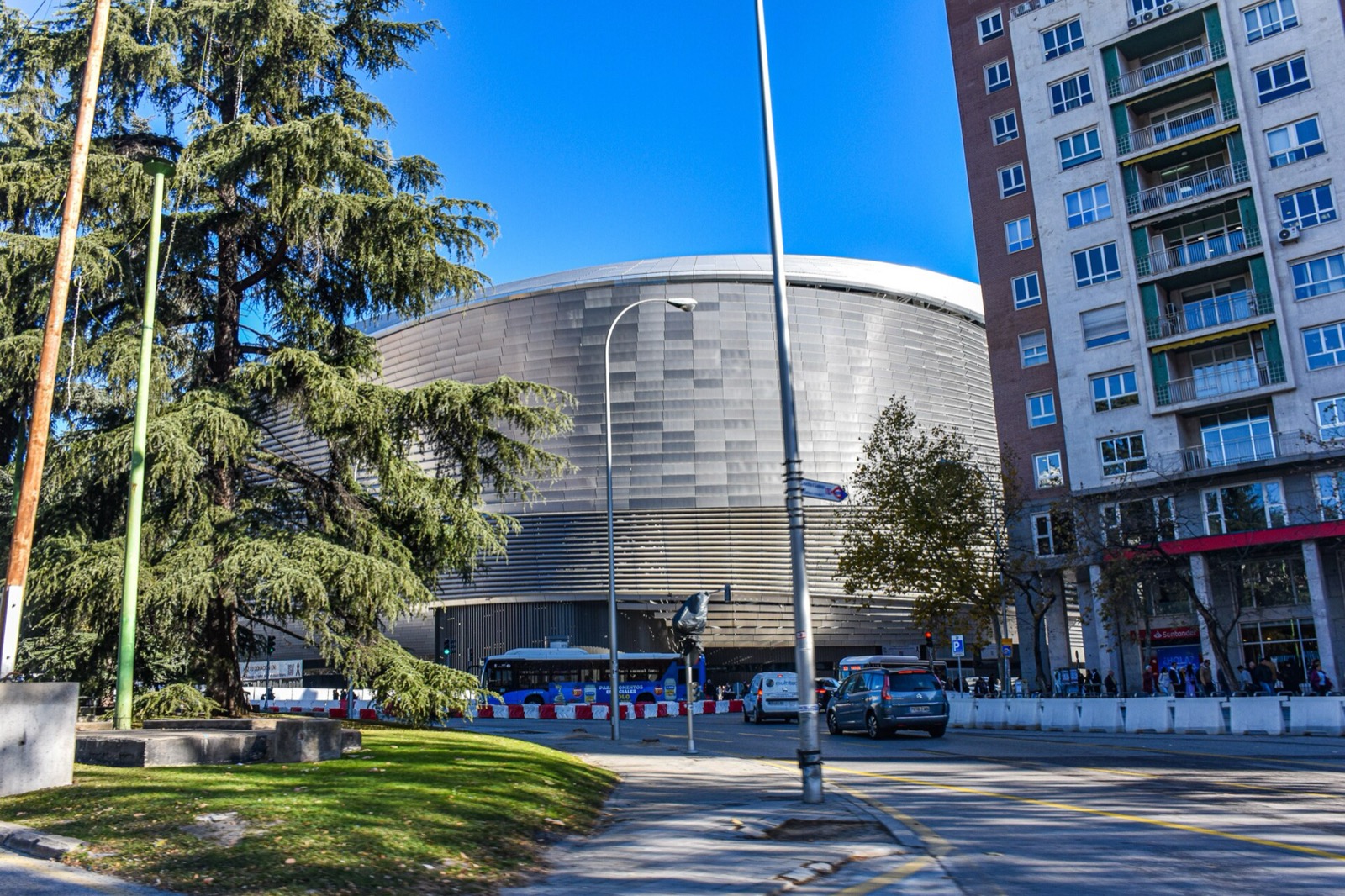
Read this first, because it's the thing most guides haven't caught up with. The metro station right outside the ground, Santiago Bernabéu on Line 10, is closed for a full rebuild and won't reopen until some time in 2027. If you plan your journey around it, you'll be planning around a shut station.
While it's closed, the city runs a free replacement shuttle bus, the SE10, up and down the Paseo de la Castellana connecting Nuevos Ministerios, Cuzco and the stadium, and you don't need a ticket for it. The other easy option is to get to Nuevos Ministerios, which is still open and well served, and walk the fifteen minutes north up the Castellana to the ground. Build the closure into your plans, so you don't discover it on the night.
The single best piece of local advice for leaving is blunt and specific: if you're relying on public transport, leave around the 85th minute. The Bernabéu empties eighty-plus thousand people into a stretch of the Castellana that is already running on a bus bridge instead of a train line, and if you wait for the final whistle you can lose an hour to the crush. A slightly early exit is the price of a smooth journey home.
Be honest about the neighbourhood: the Bernabéu sits in a business district, not a bar quarter, and the reliable near-ground spots are thin on the ground rather than a scene. Cervecería Tasco, a casual tapas bar a couple of minutes from the stadium, is a solid, verifiable pre-match stop; beyond that the streets close to the ground fill with pop-up stalls and tent bars on matchday rather than famous pubs. The consolation is that you're in the best-connected football city in Spain: Atlético are across town at the Metropolitano, and the AVE reaches Seville, Valencia and Barcelona in a few hours, so a second match needn't mean a second hotel as long as the kickoff is early enough. Check the last train back before you count on it: for a 21:00 start in Seville or Barcelona the last AVE to Madrid has usually gone before full time.
Two practical notes for inside. Full-strength alcohol isn't sold to general admission at the Bernabéu, only alcohol-free beer, so this isn't a drink-in-your-seat kind of day unless you're in a VIP area. And the club lets you carry food and drink in from the stalls outside, with one quirk that trips people up: you have to take the caps off any bottles at the gate, so don't fill your bag with sealed drinks. If you have a spare morning and the game isn't until late, the stadium tour and museum are genuinely worth doing, and given how the club presents itself, they're arguably the purest expression of what Real Madrid is.
Here's the part the highlight reels hide: for a club this size and this successful, the Bernabéu on a normal night can be strikingly quiet, and its own supporters are the ones who complain about it loudest.
The reputation is real and it has causes. A large share of any given crowd is tourists, there to see the stadium and the stars, not to sing, and long-standing members have been vocal that rising prices and legal resale are pushing the traditional local support out. One socio, quoted in a recent Spanish investigation into the changing crowd, put it as bluntly as you can: people used to come to cheer, now many come to record. The organised singing that does happen comes from the Grada Fans, a younger, club-sanctioned section in the lower tier of the Fondo Sur behind the south goal; the old Ultras Sur were banned years ago and haven't been replaced with anything as loud. There's even been an organised protest, in 2025, from members furious that the club keeps the new retractable roof closed for matches, on acoustic grounds, turning the bowl into a greenhouse on warm evenings.
None of this means the Bernabéu can't roar; it absolutely can, for a Clásico or a Champions League knockout, when the whole building leans in and you understand the reputation. It just means that for a routine LaLiga fixture against mid-table opposition, you should expect a stadium full of admirers rather than a wall of noise, and if you want to sit near what singing there is, aim for the Fondo Sur end. This is the Bernabéu on one of the big nights, the atmosphere the reputation is built on:
The anthem is "Hala Madrid… y nada más," Go Madrid and nothing more, written in 2014 to mark the club's tenth European Cup, La Décima, with the players of the time singing on the recording. It's played and sung before kickoff and again after every goal, and on the big nights, when the whole ground actually joins in rather than leaving it to the Fondo Sur, it's the moment that tells you what this club means to the people who really do live and die by it. Learn the "Hala Madrid" refrain and you can be one of them for a few seconds.
The main club store is at the stadium itself, on Avenida de Concha Espina by gate 30, with a personalisation lab if you want a name and number stitched on. There's a large second store on the Gran Vía, the city's main shopping boulevard, at number 31, which is handy if you're in the centre and don't want to make a separate trip out to the ground. Fans warn, only half joking, that the Gran Vía store is an expensive place to walk into.
This is where the Bernabéu is genuinely hard, and the structure is worth understanding. Real Madrid do sell single-match tickets to the general public, which is more than some giants offer, but general sale is the bottom of a tiered ladder. Members, the socios, get first access; then Madridista cardholders, a paid fan tier that buys you an earlier window; then the official supporters' clubs, the peñas; and only then the general public, usually just a week or a few days before an ordinary league game, with the smallest allocation of all. Becoming a full socio is effectively closed to outsiders, tied to family lines, but the paid Madridista Card is open to anyone and buys you priority over the general public if you're planning ahead.
Prices for an ordinary LaLiga game run from roughly the mid-double-figures up into the hundreds for the best seats. The Clásico against Barcelona is a different universe: it barely reaches general sale at all, and on resale the cheapest seats run into the many hundreds. That's the honest ceiling, so be realistic about which fixture you're chasing.
Everything on the secondary market carries real risk here, not just markup. A lot of European ticketing now runs on named tickets and club-controlled resale; the Bernabéu is just a ground where the fake trade is worth enough to be organised, with Madrid police seizing counterfeit and resold passes in batches before the biggest nights. Tickets are named and non-transferable, resale routinely runs at two to three times face value, and there is a documented, active trade in fake and duplicated tickets around this club; one fan's account of buying online months ahead and receiving tickets that turned out to be already assigned to someone else is depressingly typical. If you want a guaranteed seat and have the budget, the rebuilt stadium carries a large stock of VIP and hospitality seats sold through a separate premium channel that doesn't run in the timed member windows and rarely sells out, which is the reliable if costly way around the whole queue. Otherwise use the club's official channels, consider a Madridista Card if you're planning far enough ahead, and treat any third-party resale site as a place you might pay a fortune to be turned away at the gate.
Go for what this place actually is. The Bernabéu is not a cosy, singing English-style ground and it never will be; it's a gleaming monument to a century of winning, run by a club that assumes its own superiority and mostly gets to. See the rebuilt stadium, book your ticket well ahead through the club, plan around the shut metro station, leave a few minutes early, and let the Fondo Sur carry the noise. On the right night, when the whole ground finally sings Hala Madrid, you'll get why it's built the way it is.
The stadium works, the metro closure, ticket tiers and prices are all in flux. Check anything time-sensitive the week you travel, and buy every ticket through the club.
Real Madrid play at the Estadio Santiago Bernabéu, which has just come out the far side of a vast rebuild into a covered, retractable-roof arena with a retractable pitch and a 360-degree wraparound video screen. Real Madrid are the most successful club in the sport's history, with fifteen European Cups, more than double what any other club has won.
In theory yes, but general sale is the last and smallest tier. Real Madrid do sell single-match tickets to the general public, but only after members, Madridista cardholders and the official supporters' clubs have had their windows, so public sale often opens just a week or a few days before an ordinary LaLiga game.
Extremely hard. The Clásico against Barcelona barely reaches general sale at all, and Champions League knockout games are similar, with resale running two to three times face value or more. Tickets are named and non-transferable, and there's a documented, active trade in fake and duplicated tickets, so any third-party resale site carries real risk beyond just markup.
Plan around this: the Line 10 metro station right outside the ground is closed for a full rebuild until some time in 2027. While it's shut, a free replacement shuttle bus, the SE10, runs up the Paseo de la Castellana connecting Nuevos Ministerios, Cuzco and the stadium. The other easy option is Nuevos Ministerios, still open, followed by a fifteen-minute walk north.
It can be strikingly quiet for a club this size, since a large share of any crowd is tourists there to see the stadium and the stars, not to sing. The organised singing comes from the Grada Fans, a younger, club-sanctioned section in the lower tier of the Fondo Sur behind the south goal. For a Clásico or a Champions League knockout, though, the whole building leans in and roars.
Dates more than a few weeks out show as “date & time TBC”. When do fixtures get confirmed? →