Tue 03 Nov · 21:00 CET
Atletico Madrid v Bayern München
Metropolitano Stadium · Madrid
Spain
Champions LeaguePlan a trip around this →
Madrid's other club, the working-class one that turned suffering into an identity, at a big new stadium out east. The metro-in-metro-out reality, the honest word on the atmosphere, and why a league ticket is gettable.
By Carlos O. · Last updated 7 Aug 2026
One of the more gettable big-club tickets. Atlético have far more socios than seats, so marquee games are squeezed, but for a normal league fixture the club sell single-match tickets directly on the official website, often around €30, and a visitor planning ahead can usually get in with no membership or connections. The exceptions are the Derby Madrileño against Real and the Champions League knockout nights, which sell out and run expensive. For a sold-out game use the club's official channels and hospitality rather than the open resale market, where a ticket from a stranger risks markup and a refusal at the gate.
Atlético de Madrid only makes sense as the opposite of Real Madrid, and their fans would have it no other way. Where Real are the establishment club of kings and galácticos, Atlético are the self-styled club of the workers and the strugglers, the ones who define themselves by hardship and loyalty rather than by winning. Supporters wear the nickname "los pupas," the jinxed ones, almost as a badge, and the club's own marketing has leaned into a famous line about a father passing his son the burden of supporting Atlético as an act of honesty rather than a gift. This is a fanbase that expects to suffer and shows up anyway, and that is the emotional key to the whole matchday.
The modern identity was forged by one man: Diego Simeone, "El Cholo," the Argentine who took over in 2011 and turned a mid-table team into a permanent heavyweight through sheer intensity. Cholismo is a whole footballing philosophy, all defensive ferocity, effort and taking it "partido a partido," game by game, and it made Atlético champions of Spain in 2014 and 2021 and runners-up in the Champions League twice, both times losing to Real Madrid in gut-wrenching finals in 2014 and 2016. That near-miss history is very much part of the pupas story.
The one big change is the ground, and it matters. Until 2017 Atlético played at the Vicente Calderón, a tight, steep, beloved old stadium on the river in the working-class south of the city, and plenty of fans still ache for it. They now play at the Metropolitano, a big, modern, 70,000-seat bowl out to the east of Madrid, currently carrying the Riyadh Air naming sponsorship. It is an impressive stadium, but like a lot of new-builds it started life with less atmosphere than the cramped old place it replaced, and the fans know it and talk about it.
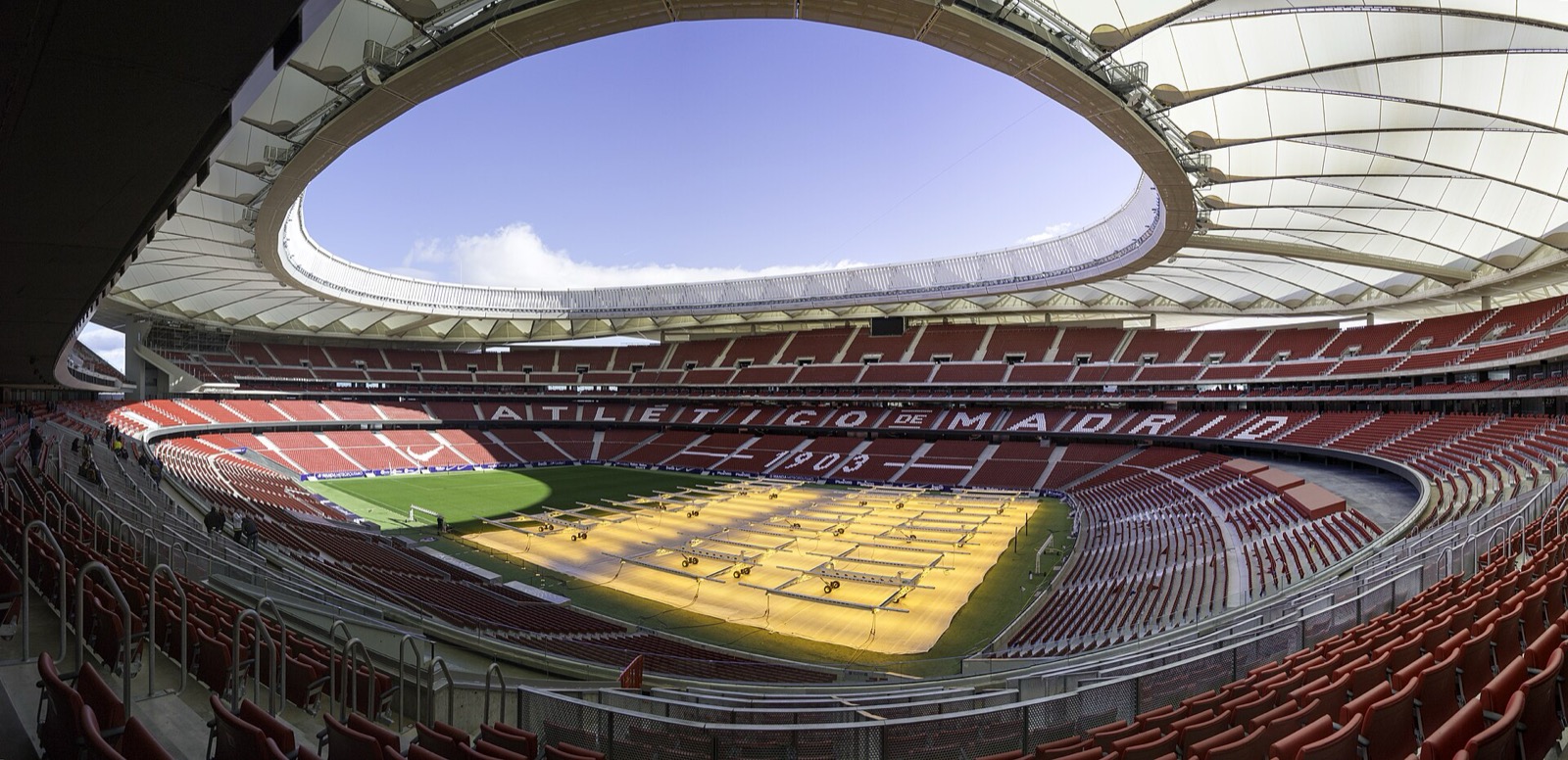
The single most useful fact about a Metropolitano matchday is that the metro takes you to the door. The stadium has its own station, Estadio Metropolitano on Line 7, right at the ground, so the plan is simple: base yourself anywhere central, ride Line 7 out, and join the stream of shirts and flags walking in from the station. Coming out afterwards is the usual big-stadium crush at one station, so expect a queue.
The flip side is that the ground is genuinely far from the centre and the middle of the city, in an eastern district of new development and ring road, with little of old Madrid, so there is no reason to head out early. Do your sightseeing and your eating in town and treat the trip out as a quick metro hop close to kickoff. Staying central pays off twice, because both Madrid clubs are inside the ring road: a Saturday night out here and a Sunday at the Bernabéu is a weekend you can run out of one hotel, with the rest of the city in between.
Be honest about the area, because it saves disappointment: the Metropolitano sits in a modern business-and-residential zone with none of the dense, characterful pub scene of a city-centre ground. The two spots regulars point visitors to are right at the stadium, on the outer perimeter outside the security line: Brindis, a beer bar by Gate 30, and El Bonnano by Gate 22, both open and serving from the middle of the day on a matchday. Beyond those, there is not much in the way of bars, but that does not mean turning up late. Regulars who do this ground say get there around two hours before kickoff for the team-bus arrival and the scene that builds outside, with street vendors selling cans around the outdoor bus parking. There is no alcohol on sale inside, so whatever drinking happens, happens out there. Give yourself the time for it and skip the sit-down afternoon session, which the area genuinely cannot support.
The far better plan is to make Madrid itself your pre-match. The city has one of the great bar and food cultures in Europe, and the sensible ritual is to eat and drink properly in the centre, around somewhere like La Latina for tapas or the streets near Sol, then ride Line 7 out with time to spare. If you are a football romantic, the site of the old Vicente Calderón down on the river is worth a respectful look for what it meant to this club, though it is being redeveloped and the stadium itself is gone.
The heart of the noise is the Fondo Sur, the home end behind the south goal, where the club's organised support runs the singing, the flags and the tifo. At its best, and especially for the Derby Madrileño against Real Madrid, the Metropolitano generates an atmosphere that is among the most hostile and intense in world football; visitors who have been to the calmer, more tourist-heavy grounds of Real and Barcelona often remark that Atlético sound like they have come to fight rather than to watch. If you want the atmosphere, the Fondo Sur end is where to aim.
The honest calibration is that this is a big-occasion thing. For a routine league game against mid-table opposition, the Metropolitano can be as flat as any large modern bowl, and the loss of the old Calderón intimacy is a running fan complaint. Away fans are put in a corner up the other end. So come for a derby or a European knockout if the noise is what you are chasing, and adjust your expectations for a Tuesday-night league fixture.
This is the himno ringing round the Metropolitano before a Champions League night:
One piece of context a visitor should carry in, not stumble into. The most militant part of the old Fondo Sur was the Frente Atlético, an ultra group with a documented history of far-right politics and violence, and in 2014 a supporter of Deportivo La Coruña, Francisco Javier Romero Taboada, known as Jimmy, was killed in a pre-arranged brawl with members of that scene near the old Calderón. The club moved to distance itself from and ban the group in the aftermath, though its presence in the Fondo Sur has not entirely gone away. It is largely marginal to an ordinary matchday, but it is part of the honest story of this end and worth stating plainly, and it is not an atmosphere to romanticise uncritically.
The anthem is the "Himno del Atlético de Madrid," an old, swelling club hymn that plays before kickoff and that the whole ground knows, full of the language of struggle and pride that suits the club so well. Beyond it you will hear relentless, drum-driven chanting from the Fondo Sur, and the culture around Simeone means that effort and fight are cheered as loudly as goals; a crunching tackle or a last-ditch block gets a roar here that it would not get elsewhere. This is a crowd that celebrates suffering well.
The official club store is at the stadium, on the Metropolitano concourse, with the full range and long matchday hours, and there is club retail in the centre of the city too if you would rather not make the trip out just to shop. The stadium store pairs naturally with the ground tour on a non-match day.
Here is the good news among the Spanish giants: an ordinary Atlético league game is one of the more gettable big-club tickets. The club runs a huge membership base, with far more socios than seats, so the marquee games are squeezed, but for a normal league fixture Atlético sell single-match tickets directly through the official website, often for around thirty euros, and a visitor planning ahead can usually get in without any membership or connections. That is not something you can reliably say about Real Madrid or Barcelona.
The exceptions are the ones you would expect. The Derby Madrileño against Real and the Champions League knockout nights sell out and are hard to get and expensive. For a sold-out game, use the club's official channels and hospitality, never the open resale market, where tickets bought from a stranger or a third-party site carry the usual risks of markup and of being refused at the gate. Buying direct and letting the club be your only secondary seller is the one habit that keeps visiting fans out of trouble anywhere, and it bites hardest on a derby that half of Madrid wants. But for a standard fixture, buy early and direct, and Atlético is one of the easier great atmospheres in Europe to walk into.
Take Atlético for the feeling, not the stadium. The Metropolitano is a big modern bowl that is still growing into itself, but the Fondo Sur on a derby night, singing the himno, celebrating a block like a goal, is one of the most intense experiences in Spanish football, and it comes attached to a club that has made an identity out of loyalty and hardship. Buy a league ticket direct, eat and drink in the real Madrid and metro out, aim for the south end, and take the club on its own terms as the stubborn, suffering, unglamorous other half of the city.
Ticket prices, the stadium sponsor name and the membership rules all change; check anything time-sensitive the week you travel, and buy through the club rather than a resale site.
Atlético play at the Riyadh Air Metropolitano, a 70,000-seat bowl in eastern Madrid that opened in 2017 to replace the old Vicente Calderón. It has its own metro stop, Estadio Metropolitano on Line 7, right at the door. It's a big modern ground that started out quieter than the cramped old stadium it replaced, and fans still talk about it.
Yes, for a normal league game. Atlético have far more socios than seats, but the club sells single-match tickets directly on its official website, often around 30 euros, and a visitor planning ahead can usually get in without any membership or connections.
The Derby Madrileño against Real Madrid and the Champions League knockout nights are the exception to an otherwise easy ticket. Both sell out and run expensive. For those games, use the club's official channels and hospitality, never the open resale market, where a ticket from a stranger risks a markup or a refusal at the gate.
The metro takes you right to the door. The stadium has its own station, Estadio Metropolitano on Line 7, so the plan is simple: base yourself anywhere central in Madrid, ride Line 7 out, and walk in with the crowd. Leaving is the usual crush at one station, so expect a queue afterward.
The noise comes from the Fondo Sur, the home end behind the south goal, where the club's organized support runs the singing and the flags. It's loudest for the Madrid derby and Champions League nights; for a routine league game the big modern bowl can be as flat as any large stadium, so temper your expectations for a midweek fixture.
Dates more than a few weeks out show as “date & time TBC”. When do fixtures get confirmed? →