Wed 28 Oct · 20:45 CET
Bayern München v 1. FC Magdeburg
Allianz Arena · Munich
Germany
DFB PokalPlan a trip around this →
Bavaria's club and Germany's giant, at the glowing Allianz Arena. The Südkurve that carries the noise, the honest truth about the quiet 60,000 around it, the beer, and why the good tickets are a lottery.
By Carlos O. · Last updated 7 Aug 2026
Cheap once you land one, and landing one takes real planning rather than a walk-up. Bayern crossed 432,500 members at its November 2025 AGM, up from 382,000 the year before, making it the world's largest sports club by membership, but a solo, first-time request for a popular match still almost never wins the club's lottery-style Ticket Request Portal. Real advance planning changes the odds: basic membership is open enrollment, not a years-long waitlist (apply anytime, you're formally in as of the next January 1 or July 1, card follows a few weeks later), and joining one of Bayern's official fan clubs, searchable at fanclub.fcbayern.com, gets you into a bulk allocation that members say makes tickets genuinely workable. A lower-demand Bundesliga fixture can still reach open general sale on a plain website account with no membership needed; Der Klassiker against Borussia Dortmund and Champions League knockout nights are the real exceptions, staying members-only ballot games that sell out before any public sale opens. The club's own resale exchange, the Zweitmarkt, needs no membership and by member accounts floods with returned tickets in the final two or three days before kickoff, often the easiest route of all for a visitor who didn't plan months ahead. The Südkurve standing terrace is the one exception that doesn't loosen: it goes almost entirely to season-ticket holders, the hardest single ticket in the ground.
Bayern are so dominant now, so relentlessly the biggest thing in German football, that it's easy to miss they carry one of the sport's most serious histories under all the winning. Worth two minutes before you go, because it changes what the badge means.
The club was founded in 1900, but the person to know about is Kurt Landauer. He was Bayern's president across four spells and the man who built the club into a champion, winning its first national title in 1932. He was also Jewish. When the Nazis came to power he was forced out, and in 1938 he was sent to Dachau; he survived, got out, fled to Switzerland, and lost family in the Holocaust. He came back to Munich after the war and led Bayern again. That history is not a footnote here. It is the reason the club's ultras, the Schickeria in the Südkurve, are one of the most openly anti-fascist supporter groups in Europe, with Landauer's name on their banners. When you read about the noise coming from that one end of the ground, this is what sits underneath it.
The football is the easy part. Franz Beckenbauer and Gerd Müller drove the side that won three straight European Cups in the mid-1970s, the spine of West Germany's 1974 World Cup win. Decades later Bayern won the treble twice, in 2013 and again in 2020, one of only two clubs ever to do it more than once. In between and since, they have won the Bundesliga so often that the domestic title can feel less like a trophy than a formality. "Mia san mia," we are who we are, is the phrase for all of it, and it's older and more Bavarian than the club itself; Bayern are as much Bavaria's team as Munich's.
One honest wrinkle, because the club trades hard on being fan-owned. Bayern, like every German club, sits under the 50+1 rule that keeps members in control and outside investors out, and it has over 400,000 of those members, more than any sports club on earth. But its own senior figures have publicly argued for scrapping 50+1, which sits awkwardly against the members-first image. Keep both facts in your head and the place reads more truthfully.
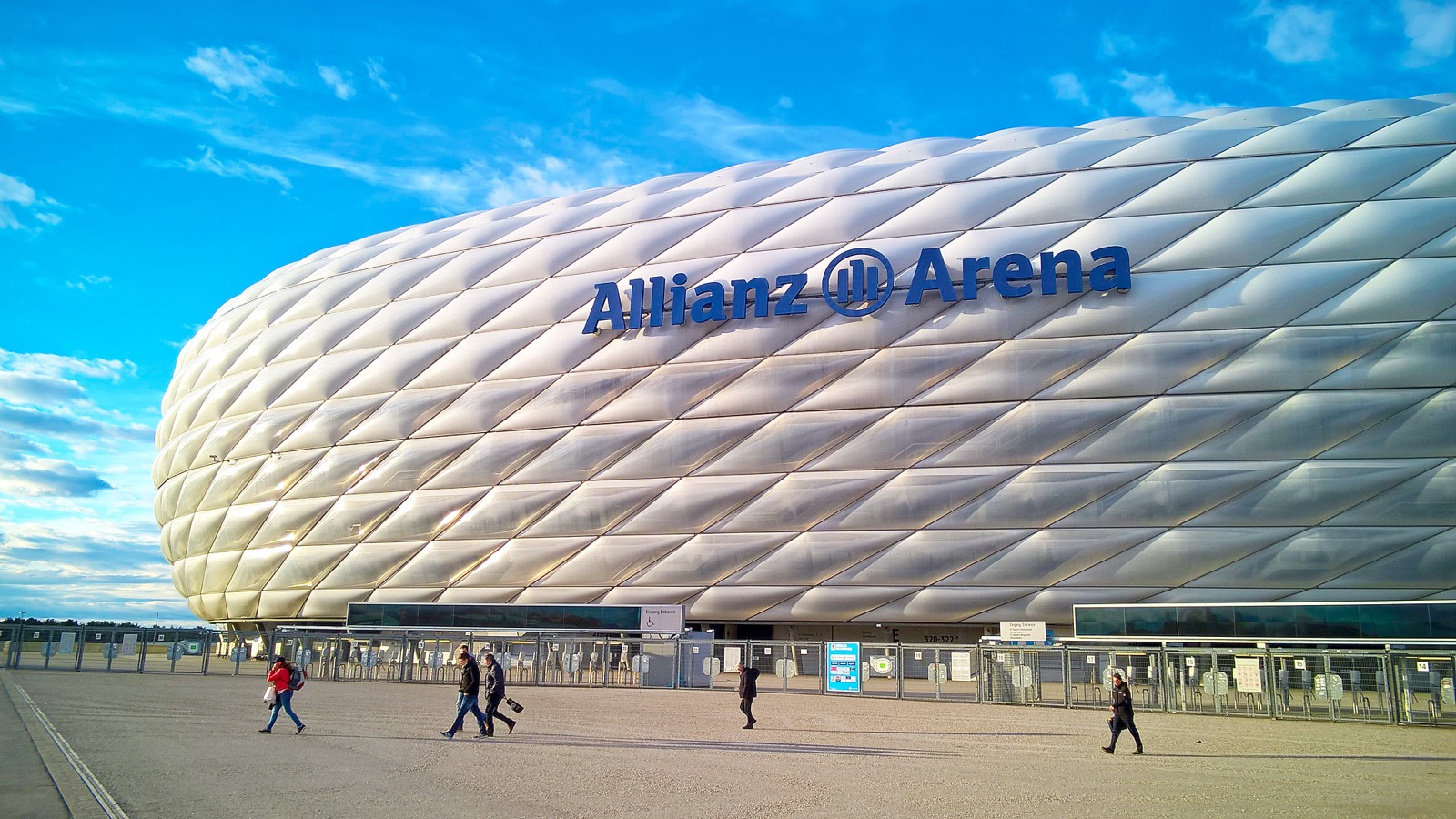
The Allianz Arena is out at Fröttmaning, on the northern edge of the city, and getting there is simple: the U6 underground line runs straight to the Fröttmaning stop in about fifteen minutes from Marienplatz in the centre. From the station you walk the Esplanade, a wide, food-stall-lined pedestrian ramp that you genuinely cannot get lost on when there's a crowd. Unlike at Dortmund, your match ticket does not include transit, so buy a normal MVV ticket for the ride.
The way out is the catch. Emptying a 75,000-seat stadium through one U-Bahn station takes a while, and the honest local advice is to not sprint for the exit. The museum, the club shop and the Paulaner fan bars inside the ground all stay open after the whistle, so a lot of regulars hang back twenty or thirty minutes, watch the crush thin on the platforms, and leave when it's civilised rather than fighting it at full time.
Don't build your day around the ground. Fröttmaning is a transit interchange and a car park, not a neighbourhood, so there's no real pub scene at the stadium; what you'll see instead is fans drinking their own beers in the U-Bahn car park before heading in. The actual pre-match culture happens where you'd expect it in a beer city: in the centre.
The pattern is to drink in town and ride the U6 out. The Hofbräuhaus just off Marienplatz is the obvious, tourist-heavy gathering point; the Augustiner-Keller near the main station is the bigger, more local beer garden and shows the marquee games on screens. Have your litre and your Weisswurst there, then roll north with an hour to spare.
Inside the ground the beer is Paulaner, in half-litres, and unlike at English stadiums you can drink it in your seat throughout the match. The food is standard Bavarian stadium fare and fine; don't overthink it.
One timing warning specific to Munich. Oktoberfest runs from mid-September into early October, and the fixture list usually drops a home game right into that window. It's a wonderful time to be in the city and a brutal one to find a hotel room at a sane price; if your match lands on a Wiesn weekend, book far, far ahead, expect the centre and the U6 to be heaving with two crowds at once, and know that the matchday crowd itself skews even more toward tourists than usual.
This is the part worth being straight about, because the Allianz Arena's reputation and its reality don't fully match. For a ground this big and this successful, it can be strangely quiet, and Bayern fans will tell you so themselves.
Almost all of the atmosphere lives in one place: the Südkurve, the standing home end behind the south goal, where the Schickeria and the other organised groups run the singing, the flags and the choreography. It is genuinely one of the most respected ends in Germany. The problem is that the transformation stopped at the edge of that terrace. The other 60,000 seats around it are heavy with tourists and casual attendees, and on a normal league night large parts of the ground barely make a sound until the Südkurve drags them into it. Fans describe roughly three-quarters of the crowd on a big day as visitors rather than regulars, and you don't really notice it on television. You notice it live, when the stadium is near-silent and one end is carrying the entire show.
There's a political edge to that end too. The Südkurve has staged repeated protests, most visibly a wall of silence for the opening minutes of matches, over ticket prices and over government proposals to make ID-linked tickets mandatory nationwide and add facial recognition at German grounds. If the loudest part of the stadium goes deliberately, pointedly quiet at kickoff, that's what you're seeing, not a flat crowd. If you have any say over where you sit and you want the real thing, aim for the Südkurve, get there early because it's standing and unassigned, and hold your spot. This is what that end looks like when it goes:
For years the anthem was "Stern des Südens," Star of the South, the one that swears the club will never go under and that everyone belts out. In February 2025, for the club's 125th anniversary, the Südkurve and the club's fan organisation introduced a new stadium song, "Immer vorwärts FC Bayern," always forward, built up from an existing terrace chant and premiered with the opera tenor Jonas Kaufmann singing alongside eight thousand fans. It's now the last song played before the teams walk out at every home game, so it's the one you'll hear as the sound builds toward kickoff. Learn to spot both and you've got the old and the new of the place.
The big FC Bayern store is at the arena, and there's a second one on Neuhauser Straße on the main pedestrian shopping street in the centre, handy if you're spending your pre-match hours in town anyway. One genuinely useful tip from regulars: if you want a shirt with a name and number on it and you care about the quality, get it personalised in person at the store rather than ordering the printing online, where the work is outsourced and comes back rougher. The stitched-on-site version is the one to have.
Be realistic before you fall in love with a fixture, because this is the hard part of a Bayern trip, not the cheap part. The panel at the top has the short version; here's the honest long one.
Bayern tickets are inexpensive by big-club standards, but most of the ground is already spoken for by season-ticket holders and members before anything reaches the public. What's left is handed out through a request lottery, not a first-come sale, and with over 400,000 members chasing it, even they aren't guaranteed a seat. For an ordinary Bundesliga game against unglamorous opposition, a request can come through and the ticket is a bargain. For the Südkurve standing terrace, or for anything with stakes, Der Klassiker against Dortmund or a Champions League knockout, your realistic odds as an unconnected visitor are close to zero through official channels. Membership won't save you either; it takes months to be approved.
If a game is sold out, the safe route to a returned ticket is the club's own official resale exchange, where members who can't attend put their seats back on sale at face value plus a fee. Know the catch before you rely on it: buying there is normally reserved for FC Bayern members, and it opens to everyone else only in the week of the match, if it opens at all. The biggest nights stay members-only throughout, as the Champions League quarter-final against Real Madrid did in 2026. That's the clean way in. One thing to plan for from this season: entry to the Allianz Arena is smartphone only, through the FC Bayern app or the Allianz Arena app, and PDF printouts, Apple Wallet and Google Wallet no longer get you through the turnstile. The club first, its own exchange and its other official routes next, anything unofficial a distant last is the order most clubs abroad expect you to follow; Bayern just start further back than most, because so little of the ground ever reaches an open sale. Two other legitimate routes are worth knowing for an unconnected visitor: you can contact one of Bayern's official fan clubs directly, and Bayern's own travel arm sells room-and-ticket packages that bundle a guaranteed seat with a hotel stay. Bayern tickets carry the buyer's name, and while you are unlikely to be asked for ID at the turnstile, buying through an ordinary resale site risks a ticket that gets voided and won't scan; German fans are blunt about treating those sites as a real risk rather than a convenience, even if plenty of people do use them and get in. Keep it as a genuine last resort, don't overpay, and exhaust the official routes first.
The request round is a German habit, not a Bayern one, and how a German trip is actually sequenced covers the allocation problem across the league.
Two things to take away. First, the Südkurve is the reason to come and the rest of the ground is along for the ride. You almost certainly won't land a standing place in it as an unconnected visitor, so aim instead for a seat facing that end, where the noise comes at you. Second, watch the calendar: a match on an Oktoberfest weekend is a spectacular way to see the city and a nightmare to book, so decide early which one you're optimising for. Get there for the new anthem, have your beer in your seat, and take the club's history in on the way, because at Bayern the winning is the least interesting thing about it.
Ticket rules, prices and the beer-hall scene all shift, and Oktoberfest dates move the whole city around each autumn. Check anything time-sensitive the week you travel, and book your ticket through the club well before you go.
Bayern play at the Allianz Arena in Fröttmaning, on the northern edge of Munich. It was the first stadium in the world with a colour-changing exterior skin, which glows red on Bayern match nights, and the ground holds around 75,000.
It's difficult. Most of the ground is already spoken for by season-ticket holders and members before anything reaches the public, and what's left is handed out through a request lottery, not a first-come sale, so even Bayern's 400,000-plus members aren't guaranteed a seat. An ordinary Bundesliga game against unglamorous opposition is your best shot at a bargain.
The club's own official resale exchange is the clean route: members who can't attend put their seats back on sale at face value plus a booking fee, and buying there is normally members-only until the week of the match. You can also contact one of Bayern's official fan clubs directly, or book through the club's own travel arm, which bundles a guaranteed seat with a hotel stay. Ordinary resale sites risk a ticket that gets voided at the gate.
The U6 underground line runs straight to the Fröttmaning stop, about fifteen minutes from Marienplatz in the city center. From the station you walk the Esplanade, a wide, food-stall-lined pedestrian ramp you can't get lost on. Your match ticket doesn't include transit here, so buy a normal MVV ticket for the ride.
Almost all of it lives in the Südkurve, the standing home end behind the south goal, where the Schickeria and other organized groups run the singing and choreography. The rest of the 75,000-seat bowl is heavy with tourists and casual attendees, and on a normal league night it can stay strangely quiet until the Südkurve drags it in.
Dates more than a few weeks out show as “date & time TBC”. When do fixtures get confirmed? →