Tue 27 Oct · 20:45 CET
Borussia Dortmund v SV Werder Bremen
Signal Iduna Park · Dortmund
Germany
DFB PokalPlan a trip around this →
One of the great terraces in football that a visitor can actually get on, no membership needed. Here's the Yellow Wall, the beer, and how to do a Dortmund matchday like a local.
By Carlos O. · Last updated 7 Aug 2026
Cheap once you land one, genuinely hard to walk into cold. BVB caps season tickets around 55,000 of the 81,365-capacity Signal Iduna Park, so an ordinary fixture's general sale splits what's left among roughly 230,000 club members and the public, and it can clear out within minutes. Real advance planning helps: basic BVB membership is open, inexpensive, and active in about three weeks, a different, far faster process than the Dauerkarte season-ticket line, which BVB closed to new names in 2017 with nearly 50,000 fans already waiting. The Yellow Wall standing is under €20 if you land it, though nearly all of it goes to season-ticket holders. Der Klassiker against Bayern Munich and the Revierderby against Schalke are the real exceptions: both move to a members' ballot before general sale opens, so hospitality or a verified resale marketplace are the realistic routes for those two matches.
Most of this guide is about how to enjoy the day, because the ticket is the one part that's refreshingly cheap even if it takes a bit of effort to land. A standing spot on the Yellow Wall costs less than three pints in London, and you don't need to be a member to buy one. What you do need is to be quick and to know how the sale works, which is the last section here. Do that, and the rest of the day looks after itself.
Dortmund wear their story out in the open, and it's a good one, so give it two minutes before you go.
The club was founded in 1909 in a pub called the Zum Wildschütz, by the Borsigplatz roundabout in the industrial north of the city, by eighteen young men who'd broken away from a church youth group. The parish priest had banned them from playing football and tried to physically block the door of the meeting. They went ahead anyway, and named the club Borussia after a defunct local brewery whose old advert happened to be hanging on the wall above their table. A working-class Ruhr club, born out of telling a priest no. That's the origin, and it still fits.
The two things worth knowing after that. First, Dortmund were good early and good again late: the first German club to win a European trophy, in 1966, and Champions League winners in 1997. Second, and this is the part that shapes the whole club today, they nearly died. After the 1997 win the board spent wildly chasing more, floated on the stock exchange, and by 2005 the club was around €120 million in debt and days from bankruptcy, which would have meant dropping out of professional football entirely. It survived on a bailout, a stadium sale-and-leaseback, and a pay cut. In the strangest footnote, hated rivals Bayern Munich had quietly lent Dortmund €2 million with no collateral a couple of years earlier to help cover wages, a fact only made public in 2012. The club came out of it with a rule it still lives by: only spend what you earn.
That near-death is why the tickets are cheap. Dortmund is fan-owned under Germany's 50+1 rule, roughly 220,000 members, no outside owner able to take control, and the standing terrace is the cheapest tier on purpose. "Echte Liebe," true love, is the club's phrase for all of it. It reads like a slogan and it started as one, but locals use it, unprompted, to explain why they follow this club and not a bigger one.
The local rhythm is simple: drink in the Kreuzviertel, then walk to the ground.
The Kreuzviertel is Dortmund's bar quarter, west of the centre, about a 30-minute walk from the stadium, and it's where locals actually start a matchday rather than the stadium forecourt. It's a district full of neighbourhood Kneipen with no single famous pub, so the move is to pick a bar, have a couple, and drift toward the ground on foot, which is genuinely faster than fighting the U-Bahn crush on a big day. If you want a fitting one, Mit Schmackes is run by Kevin Großkreutz, a Dortmund local who came off the Yellow Wall to win the World Cup with Germany in 2014. If the sun's out, people start even earlier with a beer in the Westpark on the edge of the quarter.
Closer to kickoff, the staging post right by the stadium is Strobels on Strobelallee, the BVB matchday bar and beer garden, and it's exactly what you want: packed, loud, good bratwurst, and thirty seconds from the gates. It fills up, so get there early if you want to sit. Next door, the Biergarten im Stadion Rote Erde, the beer garden inside the club's old ground, does the same job with a bit more room.
Two things about the beer will surprise anyone coming from England. The first is that this is a brewing city, historically Germany's beer capital, and the beer you'll be handed inside the ground is Brinkhoff's, in half-litres. The second is bigger: you can drink it in your seat, or on the terrace, throughout the match. There's no rule keeping alcohol out of sight of the pitch. A full standing terrace, 25,000 people on their feet, singing, beer in hand, is a genuinely different thing from a Premier League away day.
Food is stalls and Wurst. A Brinkhoff's and a bratwurst from a vendor on the walk in is the standard, and it's fine. The one insider upgrade locals point to is a Spießbraten stand among the last stalls before the south entrance, a step up from the standard currywurst. You won't go hungry and you shouldn't overthink it.
Getting out is just slow, and no trick fixes it. The U45 keeps running every few minutes for about an hour and a half after full time, but it's a crush either way. Your options are patience, or walking back toward the Kreuzviertel for one more beer while the first wave clears.
From Dortmund Hauptbahnhof, take the U45 tram, which runs to the matchday "Stadion" stop right by the ground in about ten minutes, every five minutes or so on a matchday. U42 and U46 are the backups if the U45 is jammed.
Here's the German perk English fans never quite believe: your match ticket includes free public transport across the regional network on matchday, so the tram to and from the ground costs you nothing. Keep your ticket on you. And as above, if you're starting in the Kreuzviertel, the 30-minute walk is often the smarter call than the packed tram.
The whole point of Signal Iduna Park is one stand.
The Südtribüne, the south stand, is die Gelbe Wand, the Yellow Wall: a single standing terrace holding around 25,000 people, the largest in Europe, and on a good night the reason people fly in. It's safe standing, it's cheap, and, unlike some famous ends, it isn't gated behind membership. Anyone who buys a standing ticket can be on it. The one catch is that it fills on a first-come basis, so if you want a proper spot, standing regulars get there 90 minutes to two hours before kickoff, straight from the pub. Get in early and stand for the whole match. Sitting down or leaving early on the Südtribüne is a genuine social breach, not a preference.
Honesty, because it matters: the singing core of the Wall has, by locals' own account, thinned a little in recent years as more casual and tourist tickets land in the mix, so the whole terrace doesn't roar as one for ninety minutes the way the legend suggests. It's still the best atmosphere you'll stand in at a major club, and the choreography on a European night is on another level, but go in expecting a real crowd rather than a myth and you won't be let down. Here's the Wall at full tilt:
The rest of the ground, for orientation: the Nordtribüne opposite is the away end, the West stand holds the dugouts and the hospitality, and the East is general home seating. If you can only get a seat rather than a standing spot, aim for something facing or beside the Südtribüne so you're looking at the Wall, not sitting in it.
Get there for the anthem. Before every single home game, not just the big ones, the whole stadium sings "You'll Never Walk Alone." It's older than most of the club's modern story: it caught on in 1996 after a local band's cover took off, well before the near-bankruptcy and the Klopp years, and it stuck. Don't be the one filming it instead of joining in.
Two more are worth clocking. "Am Borsigplatz geboren" ("Born at Borsigplatz") is the identity song, and its lyrics openly reference the club nearly dying ("we looked into the abyss"), so when the ground sings it during a rough patch, that's what it's about. And "Heja BVB", the older walk-on chant, has a line that BVB will never go under, which lands very differently now than when it was written in the 1970s.
The BVB FanWelt, the club megastore, is built into the northwest corner of the stadium: a big place with a scaled-down replica of the Yellow Wall inside it and, the one thing worth doing in person rather than online, an embroidery station that'll stitch a name and number onto a shirt while you wait. The scarf, black and yellow, is the standard first buy, from the store or the street vendors on the walk in. If you want the tasteful pick over the tourist one, ask about the Borsigplatz shirt, a restrained design that nods to where the club was founded.
Here's the honest version, because "cheap" is true but "easy" isn't quite. Visitors turn up assuming we're the soft landing among European tickets, and on price they're right; on how quickly a decent fixture goes, they're not.
Dortmund tickets are genuinely cheap, a Yellow Wall standing place for well under €20 and everything below English prices. What they aren't is a walk-up. Most of the ground is spoken for by season-ticket holders and members before general sale even opens, so for a decent game the public sale is a quick scramble, and it tends to open only a few weeks out. Your realistic windows are the less glamorous fixtures: a midweek game, weaker opposition, an awkward kickoff time. Membership, before you ask, takes a couple of months to approve, so it won't rescue a short-notice trip.
The part people fear and needn't is the checkout itself. The BVB shop runs in English, takes overseas cards and PayPal, and emails you a print-at-home ticket with no German address required. The one wrinkle is that the ticket carries your name, so travel with matching ID. The hard part is landing one before it's gone, not the buying.
So the realistic order for a visitor: watch for the timed general sale and be ready the minute it opens; if that's gone, the club's own official Ticket-Börse is a face-value exchange where season-ticket holders release seats they can't use, which is the clean way to buy a spare; and if you want a guarantee, the club's official hospitality, its Adrenalin hotel-and-ticket packages, is bookable by anyone without membership, at a price. Der Klassiker against Bayern and the Revierderby against Schalke are another tier again, gone to members long before any general sale.
Two things fans swear by if you miss the timed sale. The club sometimes releases a big batch of extra tickets close to matchday, so keep checking the official site and don't give up early. And the authentic fallback, the one the fans' own forums point visitors to, is the standing-ticket spares market: make a cardboard sign reading "Suche 2 Steher" (looking for two standing tickets), get to the ground around three hours before kickoff, and hold it out by the southeast parking areas where the fan-club coaches pull in, not at the turnstiles. Spares change hands at face value, roughly thirty euros for the pair, and put you on the Yellow Wall.
Then there's the grey market, honestly. The big third-party resale sites are against the rules here: tickets are personalised, reselling above face value is actually illegal in Germany, and the club can and sometimes does void tickets bought that way, so there's a genuine risk of a closed turnstile you should know about. That said, plenty of visitors use them and get in without a hitch, so treat it as a real last resort if you're set on a game you can't get otherwise, not the guaranteed dead end it's sometimes made out to be. Go in knowing it's a rule-break with a small chance of trouble, don't pay a fortune for it, and have the official routes exhausted first.
The terrace being the hardest ticket in the ground is the German pattern in miniature, and the Germany trip guide has the rest of it.
If you've got a spare morning, Borsigplatz is the pilgrimage. It's the roundabout where the club was founded in 1909, where every title gets celebrated, and the fry shop in the actual founding building serves currywurst under a plaque. Be straight about it though: it's across town from the stadium, the surrounding Nordstadt is rough in patches, and it's a daytime history stop, not part of the matchday. Locals will tell you the same.
Born poor, nearly gone, kept alive and kept cheap by the people who stand on that terrace: the club really is the terrace. Turn up in something yellow, get there early enough to sing the anthem, and drink your beer where you're standing. For the least money in Europe, it's the most fun you'll have at a club this size, and they know it.
Bars turn over, especially in the Kreuzviertel, and ticket rules and prices shift each season. Check anything time-sensitive the week you travel, and buy your ticket through the club.
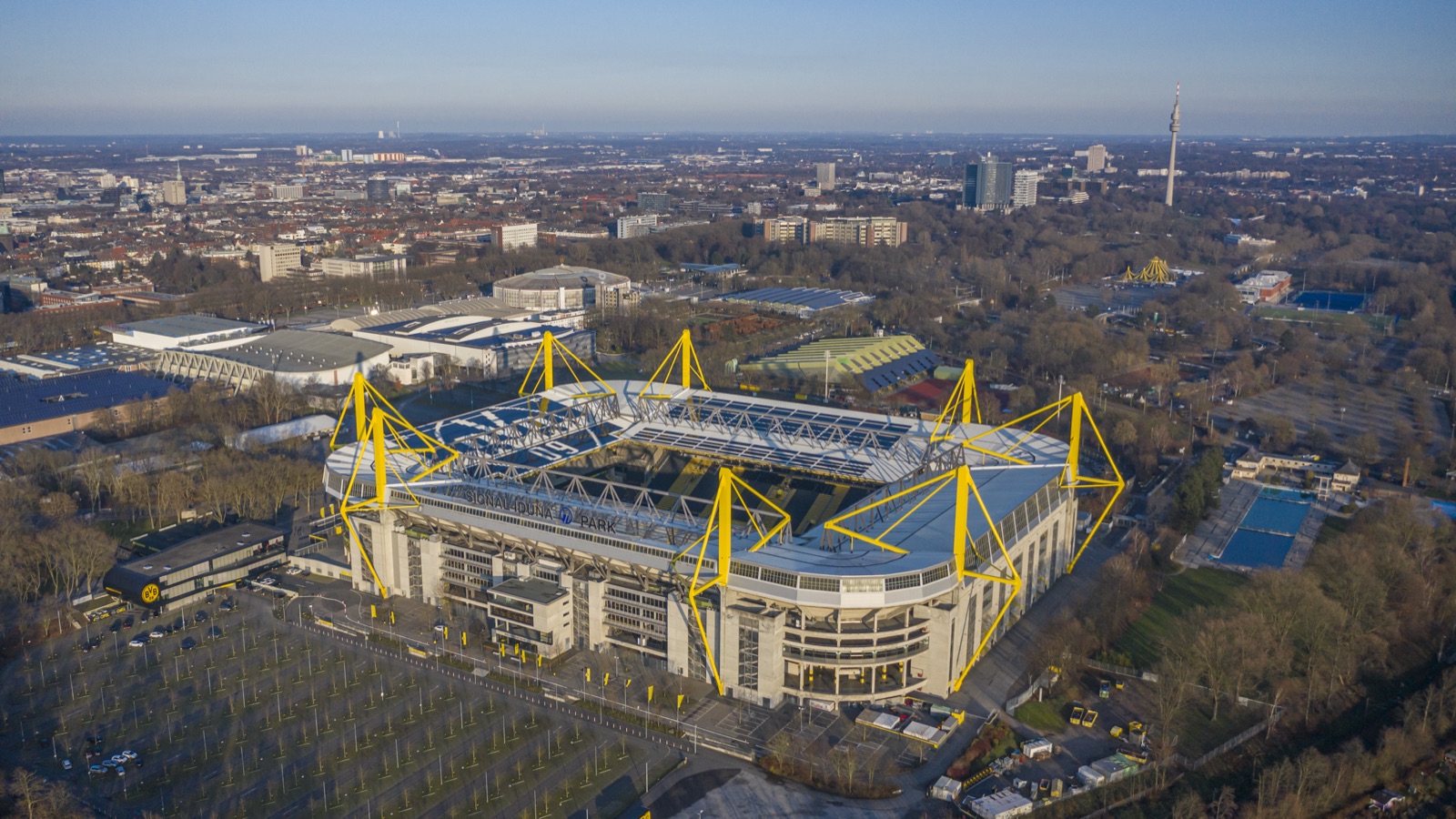
Borussia Dortmund play at Signal Iduna Park, still called the Westfalenstadion by locals, in the city of Dortmund. It's the biggest stadium in Germany and home to the Südtribüne, the Yellow Wall, the largest standing terrace in Europe at around 25,000 people.
Tickets are genuinely cheap, a Yellow Wall standing spot goes for well under twenty euros, and you don't need to be a member to buy one. The catch is that most of the ground is already spoken for by season-ticket holders before general sale opens, so public sale is a quick scramble that tends to open only a few weeks before the game. Your best odds are a midweek fixture, weaker opposition or an awkward kickoff time.
If general sale is gone, the club runs an official Ticket-Börse, a face-value exchange where season-ticket holders release seats they can't use. Der Klassiker against Bayern and the Revierderby against Schalke are a tier harder again, absorbed by members long before any general sale. Membership itself takes a couple of months to approve, so it won't help a short-notice trip.
From Dortmund Hauptbahnhof, the U45 tram runs to the matchday "Stadion" stop right by the ground in about ten minutes, running every five minutes or so on matchday. Your match ticket includes free public transport across the regional network on matchday, so the ride costs nothing extra. Many locals start instead in the Kreuzviertel bar quarter, about a thirty-minute walk away, and walk in from there.
The noise comes from the Südtribüne, the Yellow Wall, a single standing terrace holding around 25,000 people, the largest in Europe. It's safe standing and open to anyone with a standing ticket, no membership required, though regulars arrive ninety minutes to two hours early to claim a proper spot. Locals say the singing core has thinned a little as tourist tickets land in the mix, but it's still the best atmosphere at a major club.
Dates more than a few weeks out show as “date & time TBC”. When do fixtures get confirmed? →