Fri 16 Oct · 20:30 CEST
Eintracht Frankfurt v 1. FC Köln
Deutsche Bank Park · Frankfurt
Germany
BundesligaPlan a trip around this →
The club whose fans took over Barcelona, at a ground in the middle of a forest. Standing in the Nordwestkurve, apple wine in Sachsenhausen, and the honest word on which games a visitor can actually get into.
By Carlos O. · Last updated 17 Sept 2026
Fixture-by-fixture, and the split is unusually clean. Every home game goes to Eintracht's members first, first come first served, capped at two to four tickets per member depending on the match; if stock is left, a genuine public sale opens the next day and needs no membership. For 2026/27 the home games against Freiburg, Hoffenheim and Bremen reached that open sale, while Koeln, Hamburg and Schalke stopped at the member phase and the Bayern game sold out in the member sale without ever reaching the public. When a game is gone, the club's own Ticketboerse is the real route in: members list tickets they cannot use, buyers pay no fee, and returns reappear inside the normal seating plan at any hour, so checking often in the last week is what works. Tickets are mobile only, a free Eintracht account is required to hold or receive one, and the ticket doubles as an RMV KombiTicket covering regional transport on matchday once you activate it with your name and date of birth. Deutsche Bank Park holds 60,100 from September 2026, with 20,000 standing places, nearly all in the Nordwestkurve; entry to that terrace's lower tier runs on a traffic-light system that closes it once full.
Eintracht Frankfurt are the club that turns up. That is the thing to understand before anything else, because it explains the mood in the ground and it explains why neutrals have spent the last few years adding this fixture to their lists. In April 2022 Eintracht went to Barcelona for a Europa League quarter-final with an allocation of 5,000 tickets, and police estimated 25,000 to 30,000 Frankfurt supporters in the city, because Barcelona season-ticket holders had quietly resold their seats online. Enough of them got inside Camp Nou to turn a home quarter-final into something closer to an away one. Barcelona's president said afterwards that he felt ashamed. A month later the club won the thing, beating Rangers on penalties in Seville, and a city that had not won a European trophy since 1980 emptied itself into Spain.
The club is enormous in a way the league table does not capture. Eintracht counted 160,000 members in January 2026, spread across twenty sporting departments, and they make a decent claim to being the largest multi-sport club in the world with a professional football team attached. What that means for you, in the least romantic terms possible, is that a lot of people are ahead of you in the ticket queue.
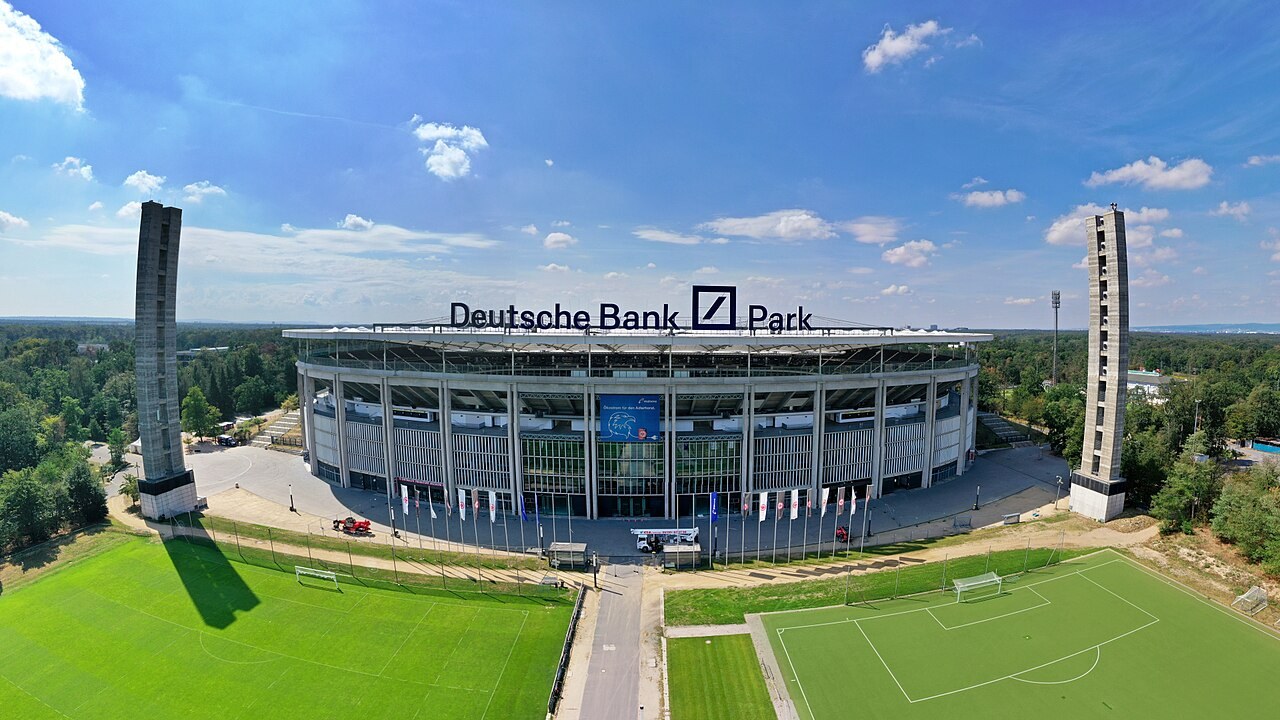
The ground is Deutsche Bank Park, renamed in 2020, but the name locals use is the Waldstadion, and it is accurate: the stadium sits inside Frankfurt's city forest, a few minutes' train ride from the banking towers, with trees on every side. It holds 60,100 after another expansion this season, and 20,000 of those are standing places.
This is one of the simpler trips in Germany. From Frankfurt Hauptbahnhof, take the S-Bahn lines S7, S8 or S9 to the stop called Stadion; the ride is about six minutes and the walk from the platform through the woods to the turnstiles is another ten to fifteen. Watch the platforms at the Hauptbahnhof, because the S7 leaves from the upper level while the S8 and S9 go from the lower one. On matchdays the city also runs special trams on line 20 from outside the Hauptbahnhof every three minutes, alongside the regular line 21, and the club's own advice is that the tram is the better choice if your ticket is for the main stand or the east end. If you are coming from the apple-wine quarter instead, bus 61 runs from Frankfurt Südbahnhof to stops called Stadionbad and Osttribüne. Coming straight from the airport, the S8 and S9 run through the same corridor, so you can reach the ground without going into the city at all.
The part visitors miss: your match ticket is also a travel ticket. Eintracht tickets carry the RMV KombiTicket, which covers second-class travel on the entire regional network on matchday, from five hours before kickoff until the end of service. It is not automatic, though. You have to activate it by adding your name and date of birth to the ticket, so do that at home and not at a machine in a crowd. It is valid from five hours before kickoff until the end of service, which is the clue about getting out: 60,000 people funnel back to one station in the woods, and there is no prize for joining the front of that queue.
Frankfurt's pre-match ritual is not beer, it is apple wine, and it happens in Sachsenhausen, the quarter across the river. The drink is Ebbelwei, or Äppler, or Stöffche depending on who is pouring, it is sharp and cloudy rather than sweet, and it arrives in a blue-grey ceramic jug called a Bembel that you share around the table. Eat with it: Handkäs mit Musik, a translucent sour-milk cheese marinated in vinegar, oil, onions and caraway, or Rippche mit Kraut, cured pork ribs with sauerkraut, or Frankfurt's green sauce, cold and herby, seven herbs, no substitutions.
Several of the best-known apple-wine houses are evening places, which can wreck an afternoon plan. Fichtekränzi on Wallstraße, for instance, opens at 17:00 most days, which is no help at all before a 15:30 Saturday kickoff. Apfelwein Wagner on Schweizer Straße, open since 1931 and the one the city's own tourist board points at, is the safer bet earlier in the day, and the Apfelweinkontor on Schellgasse makes its own.
Out at the ground itself, the walk in through the trees is the best part of the approach and there is almost nothing else out there. The one reliable spot is Fan Treff Waldstadion, a family-run marquee operation directly next door on Mörfelder Landstraße, heated in winter, doing grilled food and drinks before kickoff. Do not expect a bar district, because there isn't one.
The Nordwestkurve is the reason to come. It is the home end, it is standing from the front row to the back across three rings, and it holds nearly all of the ground's 20,000 standing places. Ultras Frankfurt stand in Block 40, in the middle of the lower tier, and the singing is led from there.
One rule catches visitors out. Since the 2025/26 season the club has run an Ampelsystem, a traffic-light system, on entry to the Nordwestkurve's lower tier: separate entrances, wristbands, and a light that turns red once the tier hits its limit. If you arrive late with a lower-tier ticket and the light has gone red, you are not getting in there for the rest of the game; you go to an upper ring instead. The club brought it in to stop people smuggling themselves into the front blocks, the ultras petitioned against it, and it is still running. Gates open two hours before kickoff, so if the lower tier is the point of your trip, be there when they do.
Away fans go in the Ostkurve at the opposite end, standing in blocks 18 and 20 with seats above in 19 and 21, and visiting clubs get ten per cent of the stadium for a league game, the standard German allocation, which at this capacity is about 6,000 people with part of them standing. The two long sides are the Bernd-Hölzenbein-Tribüne, the main stand, with the press box and the business seats, and the Jürgen-Grabowski-Tribüne opposite.
The ritual to arrive early for involves an eagle. Attila, a golden eagle hatched in 2004, is walked a full lap of the pitch on his falconer's arm about forty-five minutes before kickoff, and the players pet him on the way past for luck. He is one of very few live animal mascots in German football, the best-known alongside Cologne's goat. Unlike Benfica's eagle, he does not fly loose inside the stadium; he rides the glove.
This is the ground singing the anthem before kickoff:
The anthem is "Im Herzen von Europa," in the heart of Europe, and it is older and stranger than most club songs: written as a waltz in 1959 by members of the Frankfurt police choir, given its current words in 1974 by a Frankfurt police officer named Heinz Böcher for the club's 75th anniversary, and played before every home game since 1997. It opens by placing the city rather than the club, Im Herzen von Europa liegt mein Frankfurt am Main, and the whole ground sings it. There is now a street named after the song near the training ground.
The club store and the Eintracht Frankfurt Museum are both at the stadium, and the museum is a good hour on a non-matchday, with a ninety-minute tour option and a VR tour if you want the gimmick. Check the opening hours before you plan around it, because the stadium hosts concerts through the summer and the museum closes for long stretches when it does.
Be realistic here, because Frankfurt is the rare big club where the answer depends entirely on which game you pick.
Every home game goes to members first, first come first served, capped at two to four tickets per member depending on the fixture. What happens next is the whole story: if tickets are left, a public sale opens the following day and anyone can buy. For ordinary league fixtures that public sale is real and it stays open, sometimes right up to matchday. For the games with a big travelling support, it never arrives. As this season's schedule stands, the home games against Freiburg, Hoffenheim and Bremen reached open public sale, while Köln, Hamburg and Schalke stopped at the member phase, and the Bayern game sold out in the member sale without ever reaching the public at all.
If the game you want is in that second group, the route in is the club's own Ticketbörse, the official resale platform where members put back tickets they cannot use. Buyers pay no fee and returns simply reappear as available seats inside the normal seating plan, so the method is to install the club's app, make an account, and check that plan often rather than once. Regulars describe a pattern to it: a game can vanish within minutes of the member sale opening, more tickets tend to appear about a week out and move slowly, and then in the last day or two people realise they cannot go. Two seats together are harder than one, and the week-out window is the best chance of a pair.
One expectation to manage: what surfaces there is mostly seats. A standing place in the Nordwestkurve is the thing to hope for rather than the thing to plan on, because the terrace is where the members are. It is the same principle as buying direct from the club anywhere abroad, except that here the club's resale page is the front door rather than the fallback.
Two mechanical things that catch people out: tickets are mobile only, with no paper option at all, and you need a free Eintracht account to receive one, as does anyone you pass a ticket to. Sort both out before you travel.
One more thing worth knowing if you are planning a trip around a European night: there isn't one. Eintracht finished eighth last season and are in the Bundesliga and the DFB-Pokal only this time around, and the cup draw sent them away to Hamburg in round two. The women's team is in Europe, playing at their own smaller ground, so a search for "Eintracht European fixtures" will show you ties the men are not in. Germany's wider ticketing culture, standing terraces and cheap beer included, is the reason to come anyway.
Frankfurt is a city people pass through on the way somewhere else, a place of bank towers and an airport, and the football is the argument against that reading: 60,000 people in a stadium in a forest, 20,000 of them standing, an eagle doing a lap, and a support that once took 5,000 tickets to Barcelona and sent something like 30,000 people. Take the S-Bahn out through the trees, take whatever seat the Ticketbörse gives you, and drink your apple wine afterwards in Sachsenhausen with the rest of them.
Ticket sale stages, capacity figures and the club's fortunes all move; the member sale for a given game can close months ahead. Check anything time-sensitive the week you travel, and buy through the club or its own resale platform.
Eintracht play at Deutsche Bank Park, which almost everyone in the city still calls the Waldstadion, the forest stadium, because it sits in the middle of Frankfurt's Stadtwald south of the river. It holds 60,100 after a capacity increase this season, and 20,000 of those places are standing, nearly all of them behind one goal.
For some games, easily; for others, not at all. Every home game goes to the club's 160,000 members first, first come first served, with a cap of two to four tickets each depending on the fixture. Ordinary games then reach a genuine public sale that anyone can use, while the big ones stop at the member phase. Tickets are mobile only and you need a free Eintracht account to hold one.
Take the S-Bahn from Frankfurt Hauptbahnhof: lines S7, S8 or S9 to the stop called Stadion, about six minutes, then a walk of ten to fifteen minutes through the woods. Matchday trams on line 20 run from outside the Hauptbahnhof every three minutes, and the club itself says the tram suits main-stand and east-end tickets better. Your match ticket doubles as a free second-class travel pass across the whole RMV network, but you have to activate it first.
The Nordwestkurve behind one goal, which is standing from front to back across three tiers and holds most of the ground's 20,000 standing places. Ultras Frankfurt are in Block 40, in the middle of the lower tier. Be aware that since the 2025/26 season a traffic-light system has controlled entry to that lower tier: when it fills, the light turns red and you are sent to an upper ring instead.
Apple wine, called Ebbelwei or Äppler locally, poured from a ceramic jug called a Bembel, in the Sachsenhausen quarter south of the river. Eat Handkäs mit Musik, Rippche mit Kraut or Frankfurt's green sauce with it. Check opening times before you commit, though: some of the famous apple-wine houses do not open until late afternoon, which is no use before a 15:30 kickoff.
Dates more than a few weeks out show as “date & time TBC”. When do fixtures get confirmed? →