Wed 21 Oct · 20:00 WEST
Sporting Clube de Portugal v Lask Linz
Estádio José Alvalade * · Lisbon
Portugal
Champions LeaguePlan a trip around this →
The other half of Lisbon, in green-and-white hoops at the Estádio José Alvalade. The right metro stop, the food trucks, where the noise and the away fans are, and how a visitor gets a ticket.
By Carlos O. · Last updated 15 Sept 2026
Usually gettable for a league game, but the public is last in line. Sporting release tickets a few days before each match, members first, and the general public gets what is left, often only three or four days before kickoff, on the club website (up to four per order) or at the box office by Porta 6 and 7. Non-members pay more than members: four days before a September 2026 league game against Arouca, the seats left for the public were upper-tier and cost €27 to €32. The Lisbon derby against Benfica sells out, and Gamebox season-ticket holders release seats for games they'll miss through the club's Gameback service. Champions League nights open with members-only Early Lion phases before a regular sale the public can use. Reselling a ticket above face value is a crime in Portugal, so avoid third-party sellers.
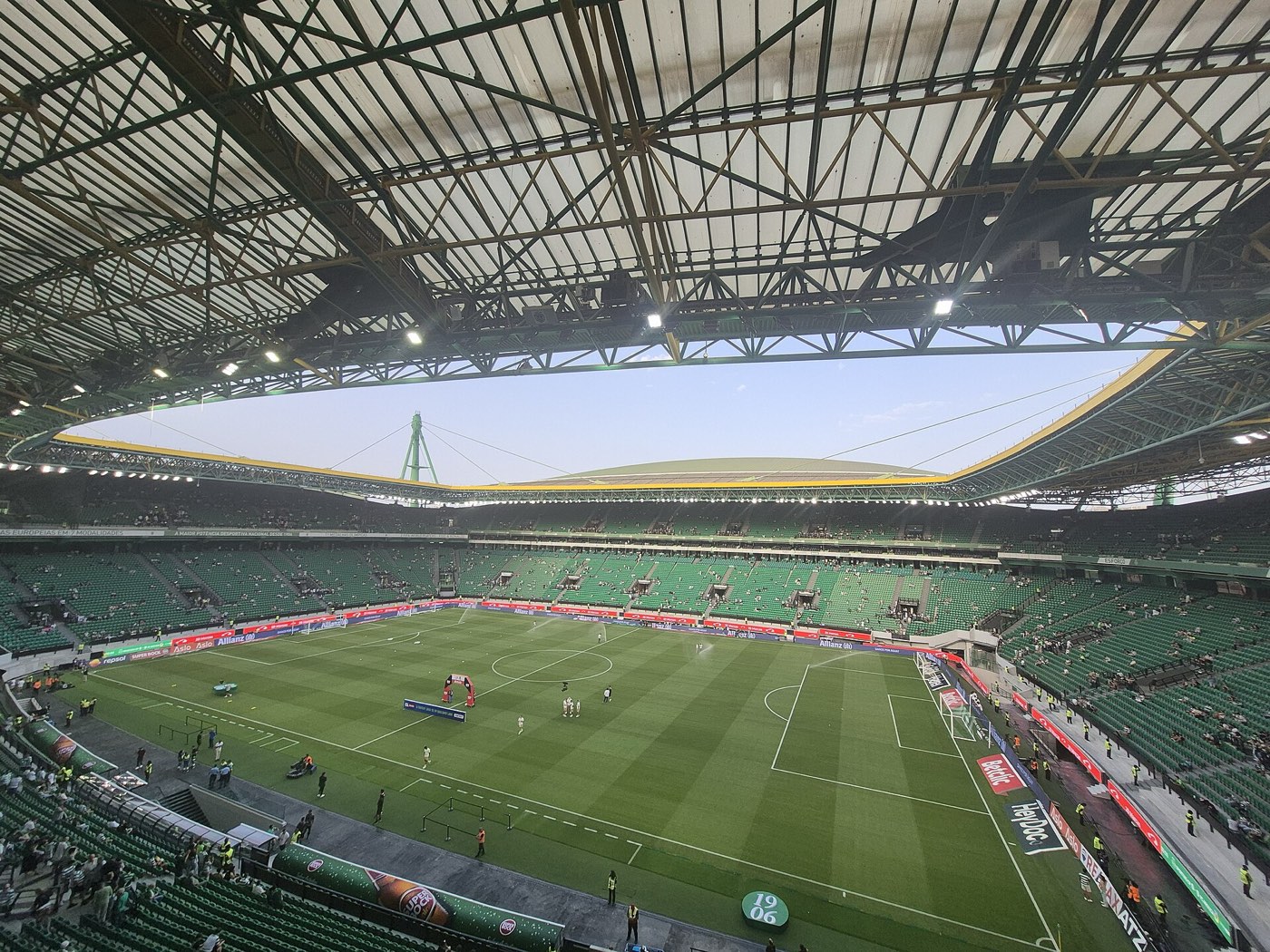
Sporting Clube de Portugal are Lisbon's other big club. In Portugal they're just Sporting, or the Leões, the Lions, after the animal on the crest, and they play in green-and-white hoops at the Estádio José Alvalade in the north of the city. If the name makes you think of Braga or Gijón, this is the Lisbon one, and its biggest rival is a little over two kilometers down the road at Benfica.
Founded in 1906, Sporting are one of the big three who between them win almost every Portuguese title, and they won the league in 2024 and 2025 before Porto took it back in 2026. Their one European trophy is the 1964 Cup Winners' Cup. The academy produced Luís Figo and Cristiano Ronaldo, and the stadium's own story starts with Ronaldo. Alvalade opened on 6 August 2003 with a friendly against Manchester United, the 18-year-old ran their defense ragged in a 3-1 win, and United signed him six days later.
The metro stops beside the ground, so getting there is the easy part. The ticket takes timing: a league ticket usually reaches the public only in the last few days before kickoff.
Take the metro to Campo Grande, on the Green and Yellow lines right beside the stadium. It's the station the club tells its own supporters to use. From Baixa-Chiado in the center it's ten stops up the Green Line; from Marquês de Pombal, take the Yellow. On the Green Line, the one mistake to avoid is getting off at the stop called Alvalade, the one before Campo Grande, which leaves you a long walk short of the ground.
Telheiras, one stop past Campo Grande on the Green Line, sits on the west side by the main stand. The club's fan guide sends away supporters there for every game and tells them not to use Campo Grande at all. Home fans can use either station, except at high-risk games, when they're asked to stick to Campo Grande so the two crowds stay apart. If you're a neutral, go with Campo Grande.
The stadium is built into a complex with the Alvaláxia shopping center and cinemas, so you can eat and find a toilet without leaving it. Streets around the ground close for high-risk games, so arrive and leave by taxi or ride-hailing car a few blocks away, which is what the club suggests. The airport is only about four kilometers off. Just don't book the flight before the kickoff is fixed: Liga Portugal confirms exact days and times progressively through the season, and a weekend game can land anywhere from Friday to Monday.
The pre-match happens outdoors at Campo Grande, where the roulottes, the food trucks, park in front of the Museu de Lisboa and sell bifanas, beer and the sandes de courato, a sandwich of grilled, chewy pork skin that even the regulars admit isn't for everyone. Ask a Sporting fan where to start and this is where they'll send you. There's smoke from the grills and the occasional firecracker, and the mood is friendly enough that a first-timer won't feel out of place.
Drink at the trucks. Portuguese law doesn't allow alcohol to be sold or drunk in the stands, and Alvalade's own fan guide repeats the rule, so what you have out here is your matchday beer.
You'll also hear about Cantinho do Sá, a Sporting-themed restaurant a short walk north of the ground, covered in old shirts. On matchdays it's a gathering point for the organized supporter groups, and it gets packed. Leave that one to the regulars.
The ground sits in a residential and office district, so spend the day down in the Baixa, Chiado or Cais do Sodré and ride the Green Line up in the hour or so before kickoff. On a non-match day the stadium tour and the Museu Sporting are in the same building.
Be in your seat a few minutes before kickoff. That's when the whole ground holds its scarves up and sings "O Mundo Sabe Que," Sporting's words to the tune of "My Way," and you don't want to hear it from the concourse.
For 2026/27, two of the club's main supporter groups, Juventude Leonina and Brigada Ultras Sporting, signed an agreement with the club and moved in together in the lower tier of the south end, the Curva Sul. Two others, Torcida Verde and Directivo Ultras XXI, turned the deal down; Directivo Ultras XXI keeps its base in the north lower tier, though some of its members have moved south.
That lower tier behind the south goal is a standing group zone, due to become formal safe standing, and a legally restricted one: tickets are nominative and can be checked against your ID, and the groups' members buy their own season package. It isn't somewhere a visitor walks into. Wherever you sit among home fans, wear green or something neutral, and never Benfica red or Porto blue. Four days before a September 2026 league game against Arouca, the seats left for non-members were all in the upper tier, along both sides and in the corners, including the two corners at the south end, the closest a visitor could get to the drums. If you want a calmer game, locals point you to the central side stands. The main stand is the West side, the Poente, with the VIP hall and the players' entrance.
Away fans get a block in the upper tier of the north end, reached through their own gate, Porta V (the letter, not Porta 5), with their own bars and toilets. Those tickets go through the visiting club.
There's no re-entry once you're through the turnstile, and children under three aren't allowed in at all. Umbrellas, food, glass, cans, and big flags on rigid poles are on the banned list. The club runs free bag drops by Porta 1 and Porta 5, but they won't hold umbrellas or food either.
This is "O Mundo Sabe Que" before a Europa League quarterfinal against Juventus, with the ground close to full:
The recording that turned "O Mundo Sabe Que" into a pre-match ritual is sung by the actor Pedro Pernas.
The older anthem is the "Marcha do Sporting," recorded in 1960 by the fado singer Maria José Valério, a devoted Sporting fan and a regular at Alvalade. When she died in 2021, the club played it at the stadium in her honor. You'll hear the stands sing it, and the line to join in on is "Viva o Sporting."
The club shop is the Loja Verde, on the north side of the stadium. On matchdays two extra merchandise kiosks open by Porta 4 and Porta 6, which saves you the line in the main store if all you want is a scarf for the song.
Most league games are gettable, but the public is last in line. Gamebox season seats take up a big share of Alvalade, so single tickets are what's left after those, released a few days before each match in a fixed order: members first, longest-serving earliest, then everyone else, who get whatever members leave. For the home game against Nacional in September 2026, members had the Tuesday and the public got the Wednesday, if seats remained, for a Saturday kickoff. Buy on the club's website, up to four tickets per order, or at the box office by Porta 6 and Porta 7, open daily from 11:00 to 20:00. You'll pay the non-member price: for the Arouca game later that month, the seats still on sale to the public cost €27 to €32, while members' prices started at €10.
A listing that shows nothing a week before kickoff usually means the public window hasn't opened yet. It's the members-first system most big European clubs run, squeezed into a few days.
The Lisbon derby against Benfica sold out in April 2026, and the club pointed fans to Gameback, where Gamebox holders who can't make it put their seat up for that game, which is how tickets can appear late in the week. Champions League nights run on a longer timetable: the club opens two discounted "Early Lion" phases for members before a regular sale that the public can use, so watch the club's site from the moment the European fixtures are published.
Stay off the resale sites. Selling a ticket for more than its face value is a crime in Portugal, punishable by prison, and Sporting fans warn visitors about buyers who paid a stranger and got nothing usable.
Skip Alvalade station, drink at the trucks because there's no alcohol inside, and pick a south corner for the noise or a central side seat for the football. Either way, be in it before the scarves go up.
Ticket rules, prices and supporter arrangements all change; check anything time-sensitive the week you travel, and only buy through the club or an official seller.
Sporting CP play at the Estádio José Alvalade in the north of Lisbon, a 52,700-seat ground opened in 2003 and a little over two kilometers from Benfica's Estádio da Luz. Campo Grande metro station, on the Green and Yellow lines, is a few minutes' walk from the gates.
Usually, for a league game. Tickets go on sale a few days before each match, to members first, and the general public gets what is left, often only three or four days before kickoff. Buy on the club website or at the stadium box office. Four days before a September 2026 league game against Arouca, the seats left for non-members cost €27 to €32, with members paying less. The Lisbon derby sells out, and reselling a ticket above face value is a crime in Portugal.
Visiting supporters get a block in the upper tier of the north end, reached through their own gate, Porta V (the letter, not Porta 5), with separate bars and toilets. Their tickets are sold by the visiting club, and the club tells them to use Telheiras metro station and never Campo Grande.
Take the Green Line from Baixa-Chiado or the Yellow Line from Marquês de Pombal to Campo Grande, which sits beside the stadium. On the Green Line, do not get off at Alvalade station, the stop before, which is a long walk short of the ground. Streets around the stadium close for high-risk games, so arrive and leave by taxi or ride-hailing car a few blocks from the ground.
In the south end. From the 2026/27 season two of the main supporter groups, Juventude Leonina and Brigada Ultras Sporting, are together in the lower tier there, the Curva Sul, a standing group zone with nominative tickets checked against ID. Another group, Directivo Ultras XXI, keeps its base in the north lower tier. The central side stands are the calm seats.
Dates more than a few weeks out show as “date & time TBC”. When do fixtures get confirmed? →