Thu 29 Oct · 20:45 WET
Sport Lisboa e Benfica v GIL Vicente
Estádio da Luz * · Lisbon
Portugal
Taça da LigaPlan a trip around this →
The biggest club in Portugal, with a real eagle, a famous curse and a fanbase in the hundreds of thousands, at a red stadium out in the north of Lisbon. The metro, the bifana stalls, and the honest word on the atmosphere.
By Carlos O. · Last updated 15 Sept 2026
For a normal league game this is manageable: Benfica sell single-match tickets online through the official channel, and a visitor can usually get one for a mid-table fixture without membership. Each home league game goes on sale to members first and to everyone else the next afternoon, usually eight to ten days before kickoff; for a September 2026 league game non-member seats ran from about €30 to €95. The huge sócio base fills much of the ground, so buy when the public sale opens and the popular sections go first. The derby against Sporting and the Clássico against Porto are a different order: at the Luz both have gone only to paid-up members in recent seasons, with no public phase at all, and even the club's resale for those games has been limited to members registered weeks earlier, so joining as a member well ahead is the realistic route for a visitor, though even that doesn't guarantee a seat; the club's corporate seats and official hospitality agents are the other legitimate door. Big European nights sell fast. Reselling a ticket above face value is a crime in Portugal.
Benfica are, by most measures, the biggest club in Portugal, and a matchday at the Estádio da Luz is built around a scale and a set of rituals that no other Portuguese club can match. The club claims one of the largest paid memberships in world football, hundreds of thousands of sócios, and that sense of a vast, city-defining institution is the backdrop to everything. The fans call themselves and the team "Os Gloriosos," the Glorious Ones, which tells you the register Benfica operate in: this is a club that carries itself as Portuguese football's aristocracy.
The history justifies a lot of it and also explains its great melancholy. In the early 1960s, inspired by the incomparable Eusébio, one of the true greats of the game whose statue stands outside the ground, Benfica won the European Cup twice, in 1961 and 1962. Then came the curse. As the story goes, the coach of those winning sides, Béla Guttmann, asked for a pay rise, was refused, and left declaring that Benfica would not be European champions again for a hundred years. Since then the club has reached eight European finals and lost every one, and Eusébio was famously photographed praying at Guttmann's grave before the 1990 final; Benfica lost that too. Whether or not you believe in curses, the fans half do, and it hangs over every European campaign.
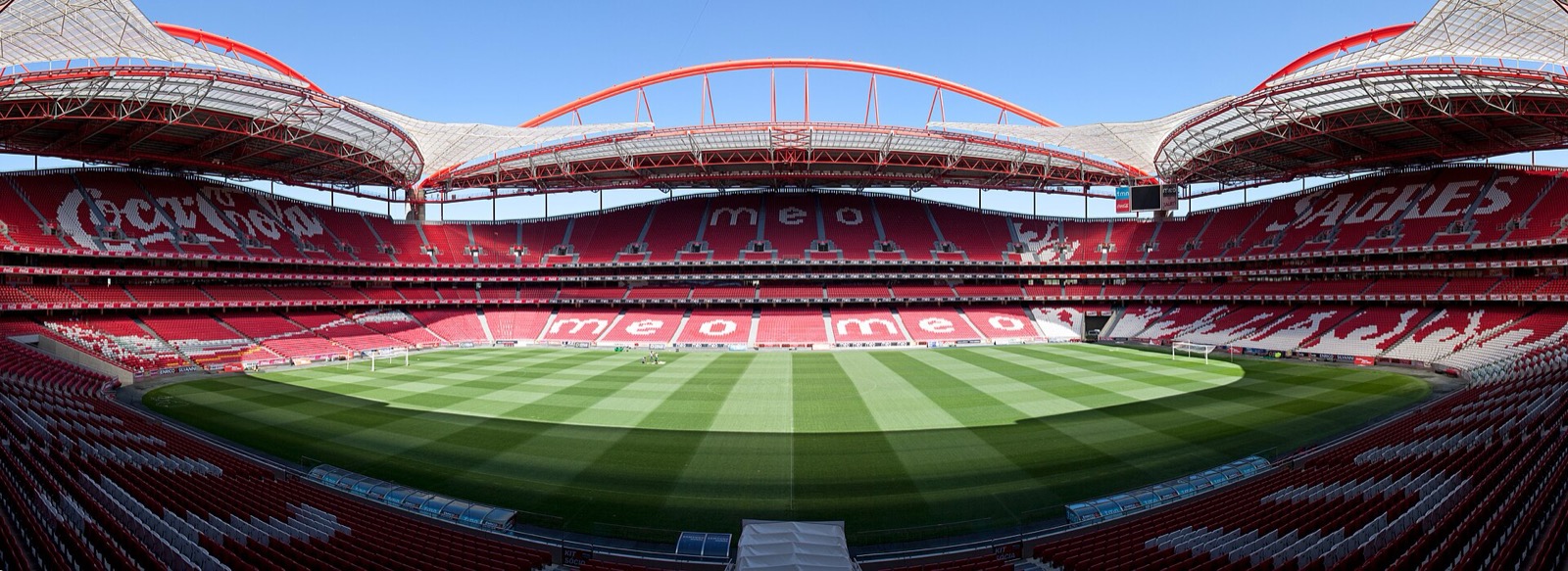
Domestically Benfica are one of the big three that share almost every Portuguese title between them, with the Lisbon rival Sporting CP, against whom the derby O Dérbi de Lisboa is fierce, and the northern giant FC Porto, against whom the fixture is simply O Clássico. The Estádio da Luz, the Cathedral, was rebuilt for Euro 2004 into a striking red bowl and expanded in 2025 to hold about 68,000. It is a genuinely good modern stadium, open and steep.
This is one of the easier big-club trips in Europe, because the metro drops you right by the ground. Take the Blue Line, the Linha Azul, out from central Lisbon, a ride of fifteen to twenty minutes, and get off at either Colégio Militar/Luz or Alto dos Moinhos; both are a short walk to the stadium, on opposite sides. Alto dos Moinhos is the one to pick if you want to walk in through the food stalls, which is half the fun (more on that below). Coming out afterwards is the usual crush at two stations, so allow time.
Right next to the ground sits the Centro Colombo, one of the largest shopping centres in the city, which is useful for shelter, food and toilets before a game and impossible to miss.
The pre-match ritual here is not a pub crawl, it is the walk in. The approach from Alto dos Moinhos toward the stadium is lined with food stalls and vendors grilling the Portuguese matchday staples: bifanas, the marinated pork sandwich that is the national football food, pregos of beef, pão com chouriço, and cold beer sold from crates and coolers. This is where the atmosphere gathers, out in the open air with the smell of grilled pork and thousands of red shirts, and it is a better and more characterful build-up than any bar. Eat here, and drink here too, because no alcohol is sold or allowed in the stands.
Because the ground sits in a business and shopping district in the north of the city rather than an old bar quarter, most visitors do their sightseeing and their proper eating and drinking down in central Lisbon, around the Baixa, Bairro Alto or Cais do Sodré, and ride the Blue Line up closer to kickoff. The stadium itself also has the club megastore and the Cosme Damião museum if you want to make a fuller day of it.
The single thing everyone should know about a Benfica matchday is the eagle. Just before kickoff, the club's live eagle, Vitória, is released to fly a slow lap of the stadium and land on the crest at the centre circle, and it is a genuine spine-tingler, one of the great pre-match rituals anywhere in the sport. Get to your seat in time for it.
For the noise across the ninety minutes, the source is the organised support, split between the two ends: the No Name Boys behind the south goal and the Diabos Vermelhos behind the north, and between them they run the singing, the flags and the tifos. The honest calibration is the familiar one for a big modern bowl: for a derby against Sporting, a Clássico against Porto or a big European night, the Luz is loud, red and genuinely intimidating; for a routine league game against weaker opposition, with a big share of members and neutrals in the seats, it can be more subdued. If you want the atmosphere, aim for a place near one of the ends rather than the main side stands, and pick your fixture if you can. Away fans are put high up in the northeast corner.
This is the Luz on a big night, red and full and loud:
The club anthem, the "Hino do Sport Lisboa e Benfica," is belted out before kickoff, and the phrase you will hear again and again is the roared response of the club's name, "Benfica, Benfica, Benfica," along with a deep book of terrace songs from the ultra groups at both ends. The whole soundscape is built around that self-image of glory and grandeur, and when the eagle lands and the anthem goes up together, you understand why the fans call themselves the Glorious Ones without embarrassment.
The official Benfica megastore is at the stadium and is a big one, and there is retail in central Lisbon too, so you can pick up a shirt without the trip north if you are staying in the centre. The stadium store pairs naturally with the museum and the ground tour on a non-match day.
For a normal league game this is manageable. Benfica sell single-match tickets online through the official club channel, and for a mid-table fixture a visitor can usually get one without membership or connections. The thing to plan around is the release, not the lead time: each ordinary home league game goes on sale to members first and then to registered fans and the general public the following afternoon, usually eight to ten days before kickoff, with up to five tickets per order. For a September 2026 league game, non-member prices ran from about €30 behind the goals to €95 in the best side seats. Looking a fortnight ahead and finding nothing does not mean the game is gone. The huge sócio base gets priority and fills much of the ground, so buy when the public sale opens, because the popular sections go first. That queue ahead of you is the members-first window most big European clubs run before anything reaches the public, except here it is enormous.
The Sporting derby and the Clássico against Porto are a different order. At the Luz they have gone only to paid-up members in recent seasons, with no public phase, and even the club's resale page for those games has been limited to members registered weeks before. For a visitor the realistic route is joining as a member well ahead, and even that doesn't guarantee a seat when the members' sale sells out. The club's corporate seats and its official hospitality agents are the other legitimate door, and they go quickly too. Big European nights are a step down from that but still sell fast. Stay off third-party resale sites: selling a ticket for more than face value is a crime in Portugal, and a ticket bought from a stranger may not get you through the gate. Buy direct the day the public sale opens and you will be fine for most games.
Come for the ritual and the scale. The Estádio da Luz is a fine modern stadium, but what you will remember is the walk in through the smoke of the bifana grills, the red of a full house, and the eagle turning its slow lap before kickoff, which is one of the genuine sights in the European game. Eat at the stalls, get in early for Vitória, aim near one of the ends for the noise, and take Benfica for what they are, the grand, glorious, faintly cursed giants of Portuguese football.
Ticket rules, prices and the club's fortunes all change; check anything time-sensitive the week you travel, and only buy through the club or an official seller.
Benfica play at the Estádio da Luz in northern Lisbon, a red bowl rebuilt for Euro 2004 that now holds about 68,000. Just before kickoff, the club's live eagle, Vitória, flies a slow lap of the stadium and lands on the crest at the center circle, one of the great pre-match rituals in the sport.
For a normal league game, yes. Benfica sell single-match tickets online through the official club channel, and for a mid-table fixture a visitor can usually get one without membership. Watch for the release rather than assuming stock: each ordinary home league game goes on sale to members first and to everyone else the next afternoon, usually eight to ten days before kickoff, so shopping a fortnight ahead often shows nothing yet. For a September 2026 league game, non-member seats ran from about €30 behind the goals to €95 in the best side seats.
At the Luz, the Sporting derby and the Clássico against Porto have gone only to paid-up members in recent seasons, with no public phase, and even the club's resale page has been limited to members registered weeks earlier. For a visitor, joining as a member well before the game is announced is the realistic route, and even then a new member isn't guaranteed a seat. Reselling a ticket above face value is a crime in Portugal, so stay off third-party resale sites.
Take the Blue Line out from central Lisbon, a ride of fifteen to twenty minutes, and get off at Colégio Militar/Luz or Alto dos Moinhos, both a short walk to the stadium on opposite sides. Alto dos Moinhos is the one to pick if you want to walk in through the food stalls grilling bifanas along the way.
The noise comes from the organized support at both ends: the No Name Boys behind the south goal and the Diabos Vermelhos behind the north. For a derby against Sporting, a Clássico against Porto, or a big European night, the Luz is loud and genuinely intimidating; for a routine league game it can be more subdued, with a lot of members and neutrals in the seats.
Dates more than a few weeks out show as “date & time TBC”. When do fixtures get confirmed? →