Sat 31 Oct · 18:45 CET
PSV v Willem II Tilburg
Philips Stadion · Eindhoven
Netherlands · ~78 km from Antwerp
EredivisiePlan a trip around this →
The Philips works team that became a European champion and a talent factory, at a stadium in the middle of Eindhoven. The 1988 peak, the Oost, and how the Dutch Club Card works for visitors.
By Carlos O. · Last updated 7 Aug 2026
PSV's Club Card is free, but applying for one requires iDIN, the Dutch online-banking identity check, and PSV's own site is explicit that anyone who can't use iDIN cannot apply: there is no passport or ID-upload workaround right now. That locks most foreign tourists out of the club's own ticket portal, even for a big European night; PSV has told shut-out fans by email that once member demand covers a match, it never reaches general sale at all. The workable route for a visitor is a direct email to PSV's FANdesk (fandesk.psv.nl, staffed in English), which can release a pricier package built for tourists once members are served, official hospitality through PSV Business, or a verified resale platform. The Philips Stadion runs close to full most weeks, averaging over 33,500 of its roughly 35,000 seats last season, and most of that capacity sits on Season Club Cards, so treat a walk-up as unrealistic and sort a ticket before you travel. De Topper against Ajax is the sharp edge of the same problem: it clears out in member and season-card windows before any outside channel opens, so hospitality or verified resale booked well ahead is the real path to that fixture. Tickets are personal, and Dutch football fights black-market resale hard on safety grounds, so a resold ticket that doesn't match your ID risks a failed gate. The ground is unusually central, a short walk from Eindhoven's main station, which makes the trip itself easy even when the ticket isn't.
PSV are a company town's football club, and that's not a throwaway line, it's the whole identity. The initials stand for Philips Sport Vereniging, and the club was founded in 1913 as the works team for the Philips electronics company in Eindhoven, the city Philips more or less built. That industrial, provincial, slightly outsider self-image, PSV are the club from Brabant in the south, not from the fancier cities of the Randstad, still runs through the place. The fans even embrace the nickname "Boeren," the farmers, thrown at them by rivals.
The football has punched well above the city's size. The peak was 1988, when PSV won the European Cup, beating Benfica on penalties, as part of a treble, joining the small club of sides to do that. And beyond the trophies, PSV have been one of the great talent factories in the game: Ronaldo, the Brazilian, and Romário both passed through here on their way to superstardom, and Ruud van Nistelrooy played and later managed here. The pattern holds to this day, PSV buy young, develop, sell high, and win at home, having taken the Dutch title three seasons running. It's a club that consistently produces more than its budget should allow.
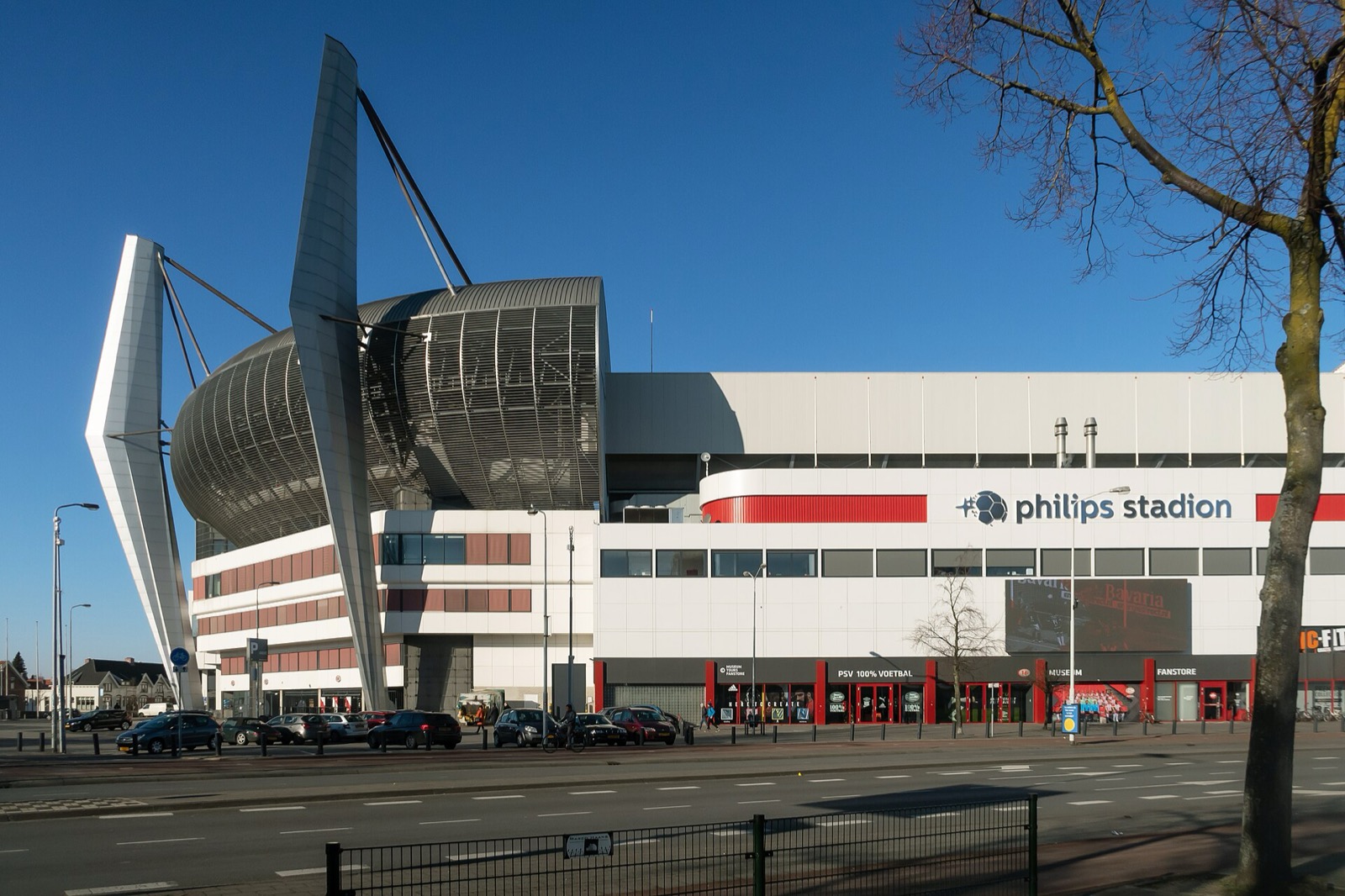
This is one of the easiest trips of any big European club, because the ground is genuinely in the city. The Philips Stadion is about a ten-minute walk from Eindhoven Centraal, the main railway station, which itself is well connected by fast trains from across the Netherlands and from Amsterdam. There's no need to work out a metro or a shuttle; you walk out of the station and stroll to the ground. Leaving is just as simple, which for a stadium of this size is a rare luxury.
Because the ground is central, so is the pre-match scene, and you don't have to choose between the two. Eindhoven's main square, the Markt, is ringed with cafés and bars a few minutes from the stadium, and the long bar street, Stratumseind, is the city's nightlife strip; either makes an easy pre-match base, and you're never far from the turnstiles. There are also bar-restaurants right at the ground itself if you want to stay put.
Inside, expect Dutch stadium norms: it's a cashless, non-smoking ground, alcohol is sold but managed, and PSV is often noted as having some of the cheaper stadium beer in the Dutch league, a small mercy after Amsterdam prices. For food it is the Dutch snackbar canon, a cone of friet with mayo, bitterballen and a frikandel, before or after the game.
The atmosphere comes from the East stand, the "Oost," where the club's tifo groups sit and drive the singing and the displays; that's the loud end for a diagram and where the noise lives, with away fans tucked into the northwest corner. What's slightly different about PSV is that the atmosphere culture is institutionalised and club-friendly rather than an outlaw-ultras scene: the main supporter groups coordinate their tifos with the club, through a long-established supporters' association. It's a passionate, organised crowd, and not a hostile one, which fits the tidy, well-run character of the club. One thing visitors always mention: win or lose, the crowd sings its way out of the ground and down to Eindhoven Centraal and the bars afterward, and since the station is a short walk from the stadium it makes for one of the friendlier away-days in Europe.
This is the Philips Stadion with a big tifo up:
PSV have a grand old club song, dating to 1950, with the club motto "Eendracht maakt macht," unity creates strength, in the lyrics. The number 1913, the founding year, is a point of pride the fans carry through everything from banners to the badge, the kind of quiet, thoughtful touch that suits a club named after an electronics firm.
The PSV FANstore is at the stadium, carrying the full range, and there's a city-centre store on Marktstraat near the Markt square, which is convenient given how central everything already is here.
The Dutch club-card system applies here just as it does at Ajax. PSV route their ticket sales through priority tiers and a free Club Card, and the card is normally tied to verification through the Dutch online-banking system. But PSV publish a separate Club Card application for people who cannot use it, taking an uploaded identity document instead, and that is the route for a visitor with no Dutch account. Be realistic about supply, though. The Philips Stadion runs close to full, around 96% occupancy in recent seasons, and most of the supporter seating is held on Season Club Cards, so a walk-up on the day is not the plan. The club does run a dedicated contact for overseas buyers who can't navigate the Club Card system. It's worth emailing them ahead of a trip. Be ready for the answer to be a hospitality package rather than a regular seat: with a long season-ticket waiting list, the club leans on packages for people outside the card-and-season-ticket base, and visitors report paying roughly €75 for a package where the equivalent regular seat is nearer €40. For a couple of adults that gap is bearable; for a family it is the difference that decides the trip. Buying straight from the club is the right instinct here as anywhere; in Eindhoven the Club Card sits in front of it, and it is a form to fill in rather than a barrier.
The exclusivity works differently here than at the clubs that simply refuse the application: PSV's line is that a season or supporters card at another Dutch professional club leaves you without buying rights at PSV. Either way the effect on a longer Dutch trip is the same, so decide early which club gets your card.
Tickets are personal, and Dutch football takes black-market resale seriously as a crowd-safety issue, keeping home and away fans properly segregated, so a ticket bought off a stranger that doesn't match your details is a real risk of a refusal at the gate. Go through the club or its overseas ticket contact, never a resale site.
PSV are an easy, rewarding club to visit: a European champion and a factory of superstars, playing in a real stadium you can walk to from the train, in a friendly, well-organised, genuinely central setting. Settle the ticket question ahead of time, since the Club Card is the one hurdle, then enjoy how simple the rest of it is, a short walk from the station to one of the great understated grounds in the game.
Ticket rules, the Club Card process and prices all shift. Check anything time-sensitive the week you travel, and buy every ticket through the club.
PSV play at the Philips Stadion, built by the Philips electronics company for its works team and still sitting right in the middle of Eindhoven, about a ten-minute walk from Eindhoven Centraal station. PSV won the European Cup here in 1988, beating Benfica on penalties as part of a treble.
Usually yes. PSV route sales through priority tiers and a free Club Card, and they publish a separate Club Card application for people who cannot use Dutch online banking, which takes an uploaded identity document instead. Be realistic about supply though: the Philips Stadion runs close to full, so sort the card and the ticket ahead; a walk-up is not something to count on.
Email the club's dedicated contact for overseas buyers who can't navigate the Club Card system, ideally well ahead of your trip. Go through the club or that contact, never a resale site, since tickets are personal and Dutch football takes black-market resale seriously as a crowd-safety issue.
This is one of the easiest trips of any big European club. The stadium is about a ten-minute walk from Eindhoven Centraal, the main railway station, which has fast train connections across the Netherlands and from Amsterdam, so there's no metro or shuttle to work out.
It comes from the East stand, the "Oost," where the club's tifo groups sit and drive the singing and displays, with away fans tucked into the northwest corner. PSV's atmosphere culture is institutionalized and club-friendly, with no outlaw-ultras scene, coordinated through a long-established supporters' association, and fans famously sing their way out of the ground and down to the station afterward.
Dates more than a few weeks out show as “date & time TBC”. When do fixtures get confirmed? →