Sat 10 Oct · 18:45 CEST
Feyenoord Rotterdam v AZ
De Kuip · Rotterdam
Netherlands
EredivisiePlan a trip around this →
A 1937 bowl on the south bank of the Maas, a working-class city's football club, and a membership rule that decides whether you get in. Where the noise is, what to eat, and which games are closed to you.
By Carlos O. · Last updated 17 Sept 2026
Two different answers depending on the fixture, and the club states the rule plainly. For an ordinary Eredivisie home game a visitor is fine: tickets sit on the club's site for weeks rather than vanishing, and fans report buying three to four weeks out for a midweek game and as late as two days before the last match of a season. But Feyenoord designate six to ten topwedstrijden a season - Ajax, PSV and the Champions League nights - for which only paying members of Het Legioen and Kameraadjes Junioren can buy, with the club writing that supporters without a membership cannot buy at any stage, including later phases. That closes all four 2026/27 Champions League home games at De Kuip, against Inter, Porto, Leipzig and Como. Het Legioen costs about EUR 54 a year on a twelve-month minimum and also brings two priority windows for ordinary games. The club runs its own resale site where season-card holders put seats back, which is the route locals point visitors at rather than any third-party marketplace. De Kuip holds about 47,500 for football; the away section, Vak GG with Vak FF opened alongside it for a big following, is around 1,600 and the largest in the Eredivisie, though the Klassieker against Ajax has carried no away fans since a mutual city ban in 2009.
Feyenoord are a port city's football club: hard-edged, proud of the work and not the polish, and permanently annoyed about Amsterdam. The city was flattened by bombing in 1940 and rebuilt as something modern and functional, and the club carries that same chip. Supporters call themselves Het Legioen, the legion, and the shirt number 12 is retired and given to them.
The honours sit oddly against the club's self-image as underdogs. Feyenoord won the European Cup in 1970, the first Dutch club to do it, and the Intercontinental Cup that same year. They won the UEFA Cup in 1974 and again in 2002, the second of those in this very stadium, a 3–2 win over Borussia Dortmund settled by Pierre van Hooijdonk's free kick and penalty. That night is still the last time a Dutch club won a major European trophy. Last season they finished second behind PSV, which put them straight into the Champions League league phase, and Giovanni van Bronckhorst returned as coach in the summer.
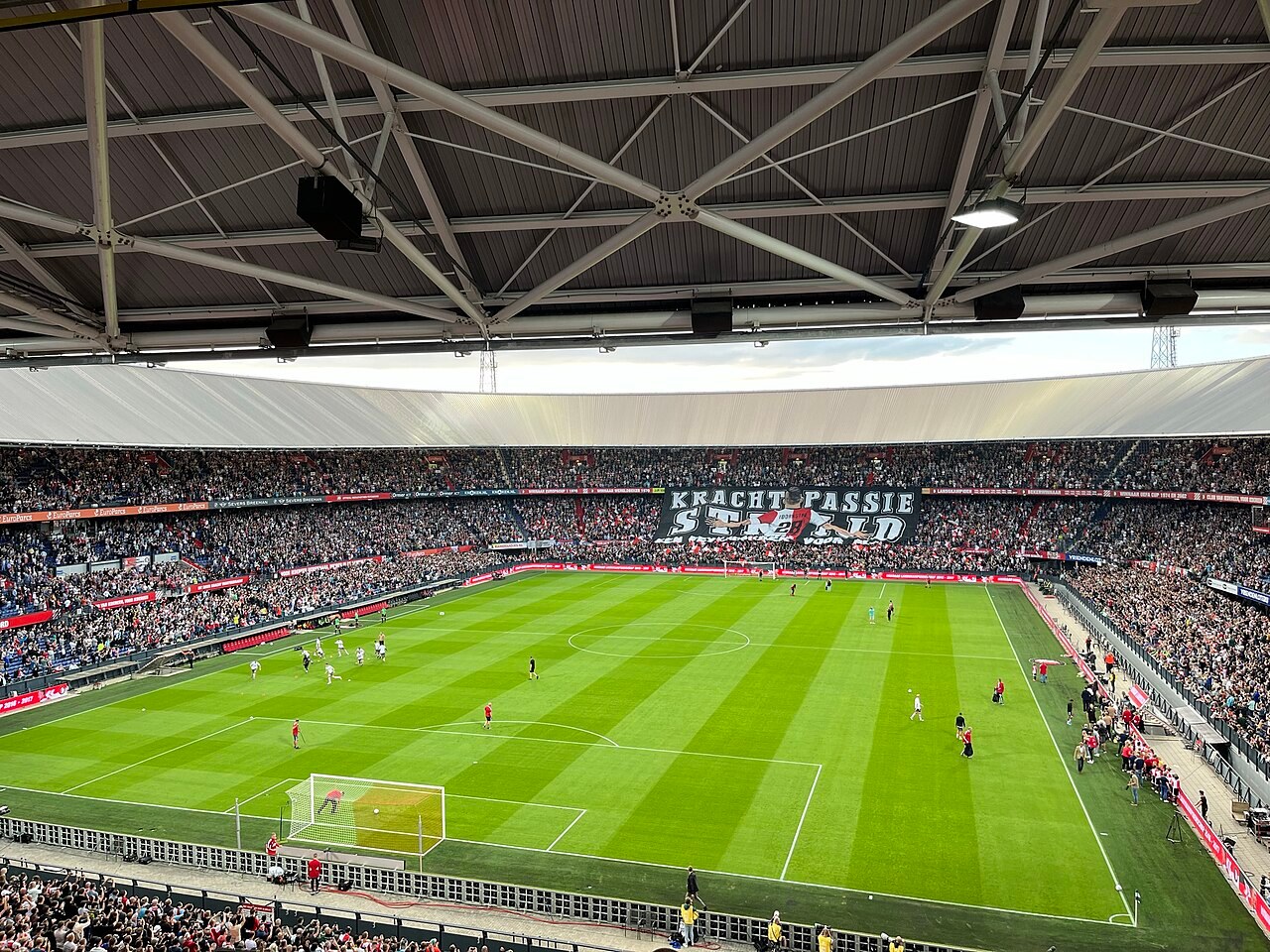
The ground is the draw. De Kuip opened in 1937 with a design that was radical then and is still unusual now: two steep rings hung on an external steel frame, so the crowd sits almost on top of the pitch with nothing in the way. It is a protected monument and it sounds extraordinary when full. In June 2026 Feyenoord bought it, taking 95 per cent of the shares in the stadium company. What comes next is still being argued over, with a renovation that would lower the pitch and add a premium ring under study alongside a proposal for a third tier, but the club has committed to staying here. Feyenoord City, the new-stadium project that consumed a decade of Rotterdam politics, is dead.
The train is the quiet trick. Rotterdam Stadion is a station that exists only for events: Sprinters from Rotterdam Centraal call there on matchdays, the ride is six to eight minutes, and you step off about two hundred metres from the ground on the Olympia side. When it is not open, Rotterdam Zuid and Rotterdam Lombardijen are each a fifteen-minute walk away.
Otherwise it is the tram. Tram 3 toward Beverwaard runs from Rotterdam Centraal to the Stadion Feyenoord stop in about twenty minutes, and on matchdays an extra tram 12 runs the same way. One warning, because the club's own pages have not caught up: Rotterdam renumbered its trams in January 2025 and the old line 23 is now line 3. If a page tells you to take the 23, it is out of date.
Whichever you pick, your match ticket is also a travel ticket, with one catch worth reading twice: it covers RET trams, metro and buses free from three hours before kickoff until three hours afterwards, and the NS train is not RET, so the Sprinter is not included. Getting out again is the slower half of the day, because an event station and a tram stop have to absorb a whole stadium; the three-hour window after the whistle exists for exactly that, so there is no hurry. Driving is the bad option, since the parking around the ground is for business permits and the club sends everyone else to park-and-ride sites out of town.
The pre-match drinking is not at the stadium, it is along Beijerlandselaan and Groene Hilledijk, a ten to fifteen minute walk west in the Hillesluis neighbourhood, where the old-school Feyenoord cafés are and where people drink and then walk to the ground together. Café 't Kruispunt, at the top of Beijerlandselaan, is the best known of them. This is a working-class part of south Rotterdam, and it is worth taking on its own terms.
If you want something tamer, the Cor Kieboomplein parade by the tram stop on the Maas side has grill houses and chain places two minutes from the turnstiles, which is where families and neutrals tend to end up.
Eat a kapsalon at some point on the trip, because it is Rotterdam's own invention and this is the city that gets to claim it: fries in a foil tray under shawarma, melted cheese, salad and garlic sauce with sambal. It was put together in 2003 in Delfshaven for a Cape Verdean hairdresser who ordered the same combination often enough that the shawarma place next door named it after his salon. The word means hairdressing salon.
De Kuip is colour-coded by stand rather than by tier, which makes reading a ticket easy once you know the trick: yellow is the Gerard Meijer end, green the Willem van Hanegem end opposite, orange the Maas side, which is the main stand with the directors and the press, and blue the Olympia side, the oldest part of the ground. Letters tell you the level: single letters are the lower ring, doubled letters the upper, and numbered sections are the pitch-level parterre.
The singing comes from the yellow end. Vak S, in the middle of the lower ring there, is where the organised support gathers, with the parterre sections X1 to X4 packed in below it. The ultras umbrella is De Noordzijde, the north side, formed in 2017 when the old Vak S and Vak W groups merged, and their tifo displays are the reason people put this ground on a list. Be realistic about getting near it, though: Vak S and the parterre below it are season-card territory and rarely reach open sale, so what a visitor can actually buy at that end is usually further around the yellow arc or up in the second ring above it. That is still the right half of the ground.
Away fans go to the far end, upper tier, in Vak GG, with the neighbouring Vak FF opened up when a visiting club brings a big following. At around 1,600 it is the biggest away allocation in the Eredivisie, which matters for the atmosphere: most Dutch grounds barely give the visitors a corner.
Two caveats. The first is that the Klassieker against Ajax has had no away fans at all since a mutual ban between the two cities in 2009, and the empty section is simply given to Feyenoord supporters, so if you were hoping for the full two-sided derby experience, that no longer exists in this fixture. The second is current: after fireworks were fired from the Feyenoord away section at Cambuur in August 2026, injuring seven home supporters, the club issued 47 stadium bans and referred them to the Dutch FA, and the FA's own sanction was still pending as this guide went up. Pyro rules and section closures can move quickly in the Netherlands, so check the week you travel.
This is the Legioen singing Hand in Hand as the teams come out:
The anthem is "Hand in Hand," sung since 1961, and it is the one to know: Dutch words written by the Rotterdam songwriter Jaap Valkhoff to a nineteenth-century German melody, and it is bawled rather than sung. Around it sits a deep terrace songbook, Wij zijn Feyenoord Rotterdam, Dat is Feyenoord with its line about the red and white glittering on the Maas, and an unembarrassed Dutch rendition of I'm Feyenoord till I die.
The club's Fanshop and the museum are both at the stadium on the Olympia side, and the stadium tour is a genuinely good non-matchday hour in a building this old. Members of Het Legioen get a discount on both, which is a small thing, but if you have joined for a ticket anyway you may as well use it.
This is the section that decides your trip, so take it in two halves.
For an ordinary Eredivisie home game, a visitor is fine. Tickets go on sale on the club's site well ahead and they do not vanish in a day: people have picked up seats three or four weeks out for a midweek fixture, and two days out for the last game of a season. If the game you want shows nothing, the club's own ticket exchange, where season-card holders put back seats they cannot use, is the second door, and regulars in Rotterdam steer visitors to it instead of a third-party site, where the risk is a ticket that does not work.
For a topwedstrijd, the answer is no. Feyenoord designate six to ten of these a season, and they are precisely the games a visitor would pick: Ajax, PSV, and the Champions League nights. Only paying members of Het Legioen and the junior scheme can buy for them, and the club states that supporters without a membership cannot buy at any stage, later phases included. The exchange is inside that same gate, so it is not a way around it. That covers all four Champions League home games this season, against Inter, Porto, Leipzig and Como.
If you do join, know what you are buying. Membership costs about 54 euros a year on a twelve-month minimum and gets you into the members' sale, but that sale is first come, first served rather than seniority-ranked, so a new member is in the same scramble as everyone else and is not guaranteed a seat for the game they joined for. Members say league tickets are a formality and Champions League nights are still hard. Official hospitality is the other legitimate route, at hospitality prices. The general principle holds either way, which is that buying through the club and not a marketplace is what keeps you out of trouble abroad.
One thing to weigh before you sign up, if this is a Dutch tour rather than a Rotterdam trip: the big Dutch clubs each run their own card, and a twelve-month commitment to one of them does nothing for you at the others. The Netherlands guide sets out how Ajax and PSV run the same system, and the practical answer is usually to pick one club and build the week around it.
Take the ordinary league game. The marquee nights are shut to you unless you join, while a Sunday afternoon against mid-table opposition puts you inside a 1937 monument with the Legioen in full voice for a reasonable price. Get the Sprinter from Centraal, sit at the yellow end, and eat a kapsalon afterwards.
Membership rules, the list of designated big games and the Dutch FA's pending sanction over the Cambuur fireworks can all change. Check anything time-sensitive the week you travel, and buy through the club or its own exchange.
Feyenoord play at Stadion Feijenoord, which nobody calls that. It is De Kuip, the tub, a steep oval bowl on the south bank of the Maas in Rotterdam that opened in 1937 and is now a protected municipal monument. It holds about 47,500 for football, and since June 2026 the club owns the stadium outright.
For an ordinary Eredivisie game, yes, and it is easier than its reputation suggests: tickets for mid-table home fixtures sit on the club's site for weeks, and visitors report buying a few days out. The catch is the exception. Feyenoord designate a handful of games a season as topwedstrijden, and for those only paying members of Het Legioen can buy, at any stage.
The club names six to ten topwedstrijden a season, and they are the ones you would most want: Ajax, PSV, and the Champions League nights. The official wording is that supporters without a membership have no way to buy a ticket for those games, not even in later sale phases, and the club's own resale site sits behind the same gate. Paid membership of Het Legioen costs about 54 euros a year, on a twelve-month minimum, and the junior scheme counts too. Official hospitality is the other way in, at a price.
The fastest way is the train: a Sprinter from Rotterdam Centraal takes six to eight minutes to the Rotterdam Stadion stop, which opens only for matches and events and leaves you a three-minute walk away. Otherwise take tram 3 toward Beverwaard, about twenty minutes, with an extra matchday tram 12 on the same route. Your ticket covers RET trams, metro and buses free from three hours before kickoff until three hours after, though not the NS train.
Vak S, in the middle of the lower ring at the yellow Gerard Meijer end, is where the organised support stands and sings, with the pitch-level sections X1 to X4 directly in front. The ultras umbrella there is called De Noordzijde, the north side. The away section is at the opposite end, upper tier, and at about 1,600 seats it is the biggest away allocation in the Eredivisie.
Dates more than a few weeks out show as “date & time TBC”. When do fixtures get confirmed? →