Wed 28 Oct* · TBC
Celtic v Dundee United
Celtic Park · Glasgow
Scotland
Scottish PremiershipPlan a trip around this →
Glasgow's Irish-Catholic institution and one of the great atmospheres in Europe. Brother Walfrid, the Lisbon Lions, the Green Brigade, and the honest, careful truth about the Old Firm and what you'll hear sung.
By Carlos O. · Last updated 7 Aug 2026
A free Celtic FC Digital Account is enough to enter general sale, no paid membership scheme required, but that's the only easy part. Season tickets sold out again for 2026/27 on a 99.5% renewal rate, so they absorb almost all of the 60,000-capacity ground before general sale even opens; what's left is only a few thousand seats, released roughly two weeks out, and gone within hours, not days, even for a routine midweek league game. Getting one takes real advance planning: set up the account ahead of time, know the release date, and be online the moment sale opens. The Old Firm against Rangers and Champions League knockout nights go further still, season-ticket holders and long-standing members take virtually every seat, general sale is effectively nonexistent, and hospitality is the only realistic paid route for a visitor. Tickets are named and Celtic can void one bought outside official channels, so treat any third-party resale site as a turn-away risk.
Celtic are not really understood until you know they were founded as a charity. In 1887 a Marist brother called Walfrid set the club up in Glasgow's poor, largely Irish-Catholic East End, explicitly to raise money to feed the children of immigrant families who had come over in the aftermath of the Irish famine. That origin is not a historical footnote; it is the whole identity. Celtic remain, to this day, a club bound up with Irish and Irish-Scottish, mostly Catholic, identity, the Irish tricolour flies over the ground, and for a large part of the support that heritage is the point of following them. A visitor should walk in understanding that this is a club with a cause woven through it, not just a football team.
The football has been glorious too. The defining moment is 1967, when Celtic became the first British club to win the European Cup, beating Inter Milan in Lisbon with a team, the Lisbon Lions, every one of whom was born within about thirty miles of Celtic Park. No club has ever won Europe with a more local side, and it remains the proudest day in the club's history. The other permanent fixture of Celtic's world is the Old Firm, the rivalry with Rangers, which is one of the most intense and, historically, one of the most bitterly sectarian derbies anywhere in football, splitting along Catholic and Protestant, Irish and Unionist lines. It's worth understanding as context, and not romanticising.
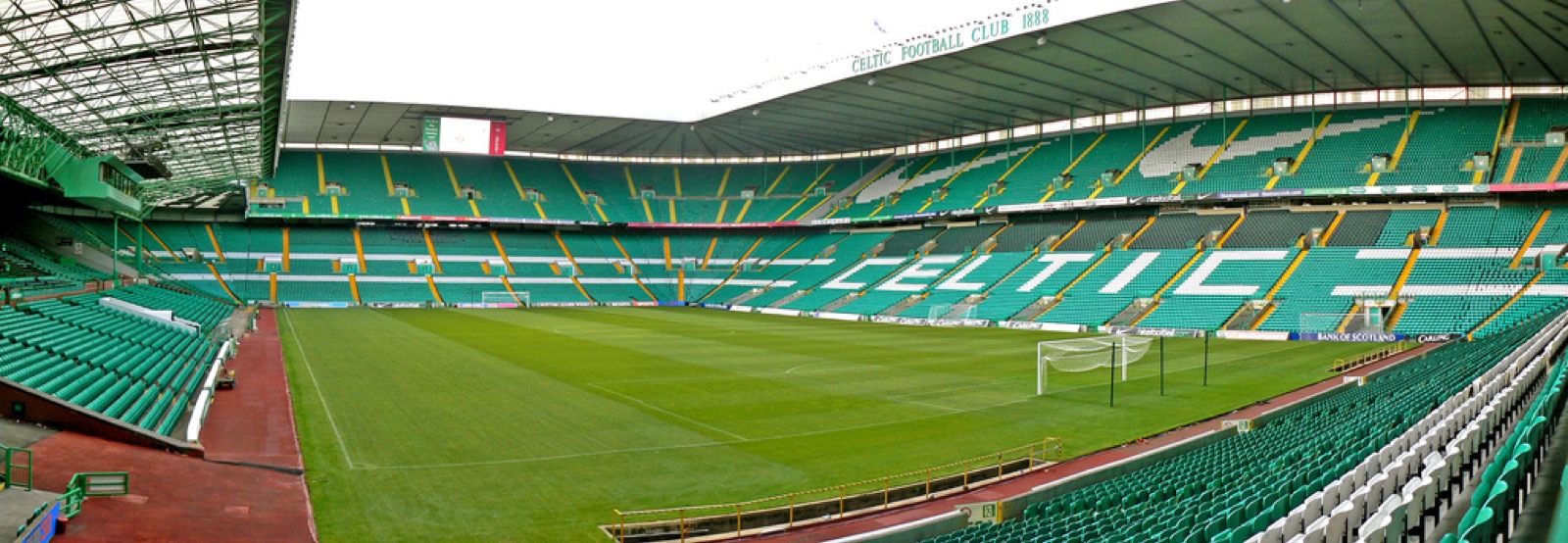
There's no station right at Celtic Park, but the walk from the nearest ones is short. The recommended option is the train to Dalmarnock, about ten minutes away, which runs a crowd-control queue system on its street on matchdays. Bridgeton is another nearby station, but a repeated, genuine local warning is that the immediate Bridgeton area is not Celtic-friendly, so fans are advised to travel in groups and keep colours covered around there. From the city centre plenty of people walk out, roughly half an hour, via the Gallowgate, which is both the safer route and the one lined with the traditional pubs. Driving is discouraged; leaving, head back toward Dalmarnock and don't linger.
The Gallowgate is the traditional pre-match walk and pub run, with old Celtic pubs like Bar 67 and the Tolbooth Bar along it; these are home-support venues and full of songs. A little further out, in the Gorbals across the river, The Brazen Head is the famous Celtic memorabilia pub, walls covered in club history, and it runs its own supporters' bus to the ground.
An honest, repeated piece of advice: away and neutral fans are steered away from the pubs immediately around Celtic Park, which are coded home support, and toward the city centre or the Merchant City, which are neutral ground, before heading out to the game. Keep that in proportion, though: locals will tell you the wider matchday area is heavily policed and the chance of a non-partisan visitor getting caught up in anything is very low, so the away-pub steer and the colours-covered advice around Bridgeton are both sensible precautions rather than reasons to feel unsafe. And a Scotland-wide rule to know: alcohol is banned inside Scottish football grounds, a law in place since 1980, so there's no drinking once you're through the turnstiles. The matchday fuel instead is the Scottish ground staple, a Scotch pie and a Bovril, the hot beef drink that stands in for the pint you can't have inside; it's as much a part of the day as the singing.
This is one of the reasons to come. Celtic Park is regularly ranked among the best atmospheres in European football, and it earns it. The engine is the Green Brigade, an ultras group in a rail-standing, safe-standing section of the North Stand, who produce elaborate tifos and relentless singing and lead the whole ground. Before the big European nights, the pre-match ritual of the entire stadium singing "You'll Never Walk Alone" with scarves held up, often over a card mosaic across the stands, is a genuinely spine-tingling thing that TV never quite captures. Away fans go in the southeast corner, deliberately far from all this.
One honest note of context: the Green Brigade's displays are often explicitly political, from Palestinian solidarity to anti-monarchy banners, and the club has been fined by UEFA more than once over supporter displays and, separately, over Irish-republican song content. That's part of the real texture of a Celtic matchday, stated plainly, and it feeds into the songs below. Here's the ground on a European night:
"You'll Never Walk Alone" is Celtic's pre-match anthem, sung with the scarves up, a tradition here since the 1960s that predates any confusion with Liverpool's use of the same song. "The Celtic Song," better known by its refrain "hail hail, the Celts are here," and the club's own "Grand Old Team," are the everyday terrace staples.
The one to understand rather than judge is "The Fields of Athenry," an Irish famine ballad that a large part of the support sings. It is, to its defenders including the songwriter, simply a song about the famine; to some critics it is heard as political when sung at a football match, and Celtic's wider Irish-republican song culture has drawn real disciplinary action from UEFA. Both readings are on the record. As a visitor, the useful stance is the same as with any contested chant: understand the history, enjoy the ones that are simply football, and leave the political and sectarian material to the locals rather than joining in with words whose weight isn't yours to carry.
The Celtic Superstore is at the ground on Kerrydale Street, and the club also has a city-centre store. If you want a scarf or a shirt, the stadium store on a non-matchday is the easy option.
Here's the good news and the catch. Unlike many big clubs, Celtic don't gate general sale behind a paid membership; a free Celtic account is enough to be eligible. The catch is that season-ticket holders take up most of the ground, season tickets themselves are sold out with a long waiting list, and the few thousand tickets that reach general sale for a given game sell out within hours. If you have read that European clubs sell to season-ticket holders and members first and to the public with whatever is left, Celtic Park is that arrangement at close to its limit, except the queue costs nothing to join and the whole thing is over in an afternoon. For an ordinary league fixture or an early cup round, a visitor can realistically get in with a bit of speed and planning. When general sale is gone, the fallback fans actually use is the "Celtic Spares" accounts on social media, where season-ticket holders pass on seats they can't use; that, or a friend with a season ticket, is the realistic route into a busier game. The Old Firm against Rangers and the Champions League knockout nights are effectively impossible through general sale, absorbed by season-ticket holders, and hospitality in the home sections is the only realistic paid route into those. The away end is its own long saga, and for this season it has ended in the simplest possible place: there is no away end. For 2026/27 the SPFL has barred away supporters from Old Firm matches in the league and the League Cup outright, after Rangers offered around 300 tickets following a risk assessment, Celtic turned the offer down, and the two clubs and the league agreed a full ban in the wake of clashes on the pitch at Ibrox after a cup tie. The league describes the arrangement as temporary and subject to review. It applies only to SPFL competitions, so a Scottish Cup meeting, run by the SFA, is the one version that could still carry an allocation.
Tickets are named, and Celtic can void one bought outside official channels. Treat any third-party resale site as a risk of being turned away at the gate.
Come to Celtic for the whole of it: a club founded to feed the poor, carrying an Irish identity with real depth and real controversy, that plays in front of one of the great crowds in the sport. Book a ticket early for a league game, walk out via the Gallowgate, keep the away-colours advice in mind around Bridgeton, and get to your seat in time for the scarves and the song. On a European night, few grounds in the world are louder.
Ticket availability, the Old Firm allocation and the Scottish alcohol rules can all change; check anything time-sensitive the week you travel, and buy every ticket through the club.
Celtic play at Celtic Park, known locally as Parkhead, in the East End of Glasgow. It's the biggest football ground in Scotland, and the Green Brigade section in the North Stand helps make it one of the loudest atmospheres in European football, especially on Champions League nights.
Yes, and it's actually easier than at many big clubs, since Celtic don't gate general sale behind a paid membership, just a free Celtic account. The catch is that season-ticket holders take up most of the ground and season tickets are sold out, so the few thousand tickets in general sale for an ordinary league game sell out within hours. Move fast when sales open and you have a real shot.
The Old Firm against Rangers and Champions League knockout games are close to impossible through general sale, since season-ticket holders absorb almost the entire allocation, and hospitality in the home sections is the only realistic paid route in. Following the away side is not a route at all this season: for 2026/27 there are no away supporters at Old Firm matches under SPFL jurisdiction, which covers the league and the League Cup. Rangers offered around 300 tickets after a risk assessment, Celtic declined, and the clubs and the league settled on a full ban. The SPFL calls it temporary and says it will be reviewed, and it does not cover the Scottish Cup, which the SFA runs. For everyday league games and early cup rounds, general sale is a genuine option.
The nearest station is Dalmarnock, about a ten-minute walk from Celtic Park, which runs a queue system on matchdays. Bridgeton is another nearby station, but locals steer visitors away from that immediate area and suggest travelling in groups with colours covered. Many fans just walk the roughly thirty minutes from the city centre via the Gallowgate, which is lined with traditional pubs.
The noise comes from the Green Brigade, an ultras group in the rail-standing safe-standing section of the North Stand, who lead tifos and singing for the whole ground. Before big European nights, the entire stadium sings "You'll Never Walk Alone" with scarves held up, often over a card mosaic, which is one of the sport's great pre-match rituals.
Dates more than a few weeks out show as “date & time TBC”. When do fixtures get confirmed? →