Sat 31 Oct · 17:30 GMTAberdeen–Rangers
Rangers v Aberdeen
Hampden Park · Glasgow
Scotland
Scottish League CupPlan a trip around this →
Glasgow's blue half, back from the dead and back in the Old Firm, at the grand old Ibrox. The 2012 collapse, the Old Firm handled with care, and the honest word on the songs and the disasters.
By Carlos O. · Last updated 7 Aug 2026
A free Rangers account is enough for general sale, no paid membership required, and general sale genuinely runs: an ordinary league game typically goes live four to six days before kickoff and stays gettable, even for lower-league Scottish Cup opponents. That holds even though over 41,000 season ticket holders occupy most of the 50,800-capacity Ibrox and renewal came in above 98% for 2026/27. Rangers still releases a real general-sale tranche match to match rather than letting the ground close on season books alone. A MyGers membership (around £50) buys priority for the handful of fixtures that do run hot, Aberdeen (the 'New Firm,' Scottish football's next-biggest domestic rivalry after Old Firm) among them, though fan reports still put Aberdeen fixtures reaching general sale rather than selling out through membership channels. The Old Firm against Celtic is the real exception: home tickets go by ballot to long-standing MyGers members only, general sale is effectively nonexistent, and hospitality is the only realistic paid route for a visitor. Tickets are named and the club voids anything bought through touts, so treat third-party resale as a turn-away risk: Scotland has no football-specific touting offence, so the club's own sanction is the deterrent, not the law.
Rangers are one of the most successful clubs in the world by trophies, one of the two halves of the fiercest rivalry in British football, and, uniquely among the giants, a club that died and came back. All three of those things shape a matchday at Ibrox, so it's worth taking them in turn before you go.
Founded in 1872, Rangers have won the Scottish league 55 times, which was for a long time a world record for domestic titles, though it should be said plainly that Celtic drew level in 2024-25 and passed them the following season, so the outright record is no longer Rangers'. The club is the traditionally Protestant, Unionist side of Glasgow, and the Old Firm rivalry with the Catholic-and-Irish-coded Celtic runs along those religious and political lines. It is one of the most intense derbies anywhere, and, historically, one of the most sectarian; a visitor should understand that as context, reported neutrally, rather than as something to celebrate.
The modern identity, though, is defined by 2012. That year the company that ran Rangers went into administration and then liquidation over unpaid tax, and the club was forced to start again from the bottom of Scottish football, in the fourth tier, and climb its way back up division by division. Whether that makes it the "same club" is a genuinely contested argument between the two sets of Old Firm fans, but for Rangers supporters the fall and the long climb back are a point of fierce pride, a near-death survived. That is the emotional charge under a modern Ibrox.
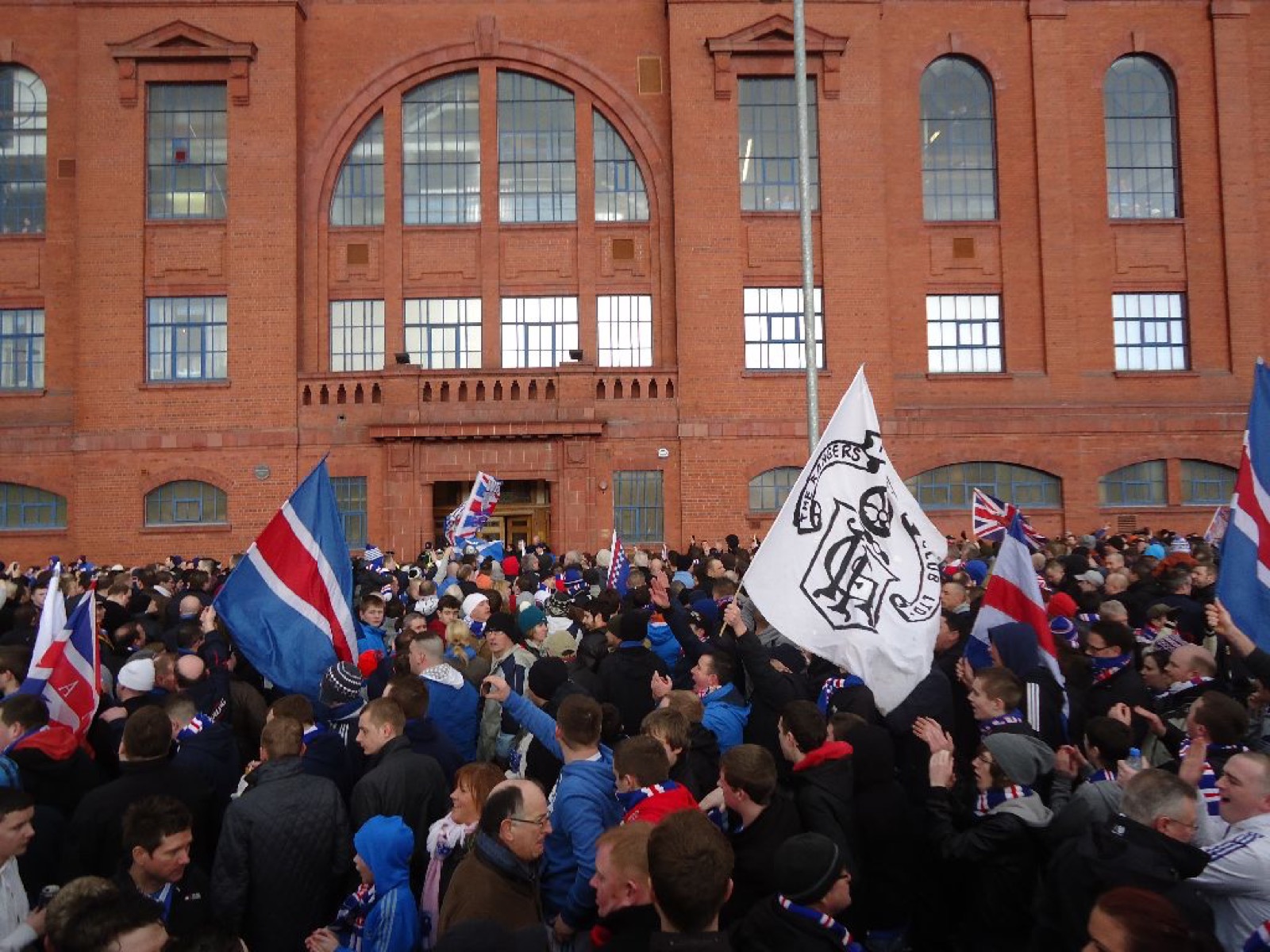
Ibrox also carries real grief, and it should be treated with respect rather than as colour. Two disasters happened here: a terrace collapse in 1902 that killed 25, and, far worse, a crush on Stairway 13 as fans left an Old Firm match on 2 January 1971 that killed 66 people, the worst British football disaster of its era. There is a memorial at the ground and a statue of the club captain of that day, John Greig. If you visit, take a moment at it.
The simplest way to Ibrox is the Glasgow Subway to the Ibrox station, a short walk from the ground, with a second station entrance opened on matchdays to handle the crowds. Govan subway is a nearby alternative that can help spread the load on the way out. From the city centre it's a quick hop on the Subway, which is genuinely the easy option here.
The pub right by the ground is The Louden Tavern on Copland Road, opposite the subway station, the self-styled spiritual home of Rangers support, covered in memorabilia and rammed on a matchday, and effectively a home-fans venue. The Govan pubs around the ground are home turf generally.
If you're a neutral or an away fan and you'd rather not walk into a partisan pub blind, base yourself in the city centre, where a big pub like The Counting House on St Vincent Place is not colour-coded and works as a staging point before the Subway ride out. And, as everywhere in Scotland, remember that alcohol is banned inside the ground itself, so there's no drinking once you're through the turnstiles. What you eat instead is the Scottish ground staple, a Scotch pie and a Bovril, the hot beef drink the terraces run on in place of a pint; Ibrox even had a stand nicknamed the Bovril Stand for it.
The traditional loud, vocal home end is the Copland Road stand behind the east goal, and that's where the atmosphere concentrates, led by the Union Bears, the club's main ultras group, who run the tifos and the singing from the Copland Road corner. The architectural star of the ground is the opposite side, the Bill Struth Main Stand, a category-listed red-brick grandstand from 1929 with the criss-cross facade that the great stadium architect Archibald Leitch put on grounds all over Britain; it's one of the last and best survivors of its kind. Away fans are tucked into the northwest corner, deliberately away from the Copland Road noise. An away day here is tightly policed: expect a ring of ticket checks before you reach the turnstiles, a hold-back of around fifteen minutes after full time, and stewards steering you out with colours covered.
Here's the official club matchday feel from inside Ibrox:
The run-out anthem is Tina Turner's "Simply the Best," which the ground belts out as the team comes on, and it's paired with terrace staples like "Follow Follow" and "Penny Arcade," the latter often sung with a coordinated flag display, the "Blue Sea of Ibrox," rippling across a stand. Those are the unproblematic, rousing side of the matchday.
There's a harder, honest part too. Some of the terrace singing at Ibrox, historically songs like the sectarian ones referencing Catholicism and Irish history, is genuinely offensive and has drawn repeated disciplinary action from UEFA, including a partial stadium closure, as well as club efforts to stop it. It hasn't fully gone away. The guidance for a visitor is the same as at Celtic: enjoy the football songs, understand that some of the material carries real sectarian weight and real sanction behind it, and do not join in with words whose history isn't yours to wade into. It's not decoration, and it's not a laugh; treat it as the serious, contested thing it is.
The main city-centre store is inside the Buchanan Galleries shopping centre, handy if you're in the middle of town, and there's a megastore at the ground itself. Either does the job for a shirt or a scarf.
For an ordinary league game this is manageable. You don't strictly need a paid membership to buy for a routine fixture; a free account can get you into general sale. A MyGers membership, around fifty pounds, buys the priority you'll want for the higher-demand games, and season tickets are effectively closed, with a long waiting list. That tier is the paid membership window in its familiar European shape: it buys you a place in front of the free accounts when a big fixture opens, not a seat. Ordinary league games are realistically gettable for a visitor with a bit of planning. The Old Firm against Celtic is the exception, distributed by ballot to long-standing members and effectively out of reach for a casual buyer through official channels, with hospitality in the home sections the only realistic paid route in. For 2026/27 there is no away allocation at all: the SPFL has barred away supporters from Old Firm matches in the league and the League Cup, after Rangers offered Celtic around 300 tickets following a risk assessment, Celtic declined, and the clubs and the league agreed a full ban. The league calls it temporary and says it will be reviewed, and it does not extend to the Scottish Cup, which the SFA runs. If you follow the visiting side, there is no ticket.
Tickets are named and the club will void a ticket bought outside its own channels, so a third-party resale site carries a genuine risk of being refused at the gate rather than being a reliable way in. Scotland has no football-specific touting offence the way England does, so the club's own sanction, not the law, is what stops you.
Come to Ibrox for a club with an unusual story to tell: enormously successful, that went bankrupt and clawed its way back from the bottom, playing in one of the finest old grandstands in Britain. Take the Subway out, pay your respects at the Stairway 13 memorial, keep the away-colours sense about you around Govan, and get in for Simply the Best and the Copland Road roar. And carry the same care with the songs and the rivalry that any visitor to the Old Firm should.
Ticket availability, the Old Firm allocation and the Scottish alcohol rules can all change; check anything time-sensitive the week you travel, and buy every ticket through the club.
Rangers play at Ibrox Stadium in Govan, on the south side of Glasgow. The ground's Bill Struth Main Stand is a category-listed red-brick grandstand from 1929, one of the last great survivors of the criss-cross facade style the architect Archibald Leitch put on grounds across Britain. Rangers are one of the most successful clubs in the world by trophy count, with 55 Scottish league titles.
For a routine league game, yes. You don't strictly need paid membership, since a free account can buy into general sale, though a MyGers membership (around £50) buys the priority you'll want for higher-demand fixtures. Season tickets are effectively closed with a long waiting list, but an ordinary match is realistically gettable for a visitor with some planning.
Very hard. Old Firm tickets are distributed by ballot to long-standing members, so there's effectively no path in for a casual buyer through official channels, and hospitality is the realistic paid route for a visitor. Tickets are named and the club voids tickets bought outside its own channels, so treat any third-party resale site as a turn-away risk.
The simplest way is the Glasgow Subway to the Ibrox station, a short walk from the ground, with a second station entrance opened on matchdays to handle the crowds. Govan subway is a nearby alternative that can help spread the load on the way out. From the city centre it's a quick hop on the Subway.
The loud, vocal home end is the Copland Road stand behind the east goal, led by the Union Bears, the club's main ultras group, who run the tifos and singing from the Copland Road corner. The Bill Struth Main Stand opposite is the architectural highlight, and away fans are tucked into the northwest corner, deliberately away from the Copland Road noise.
Dates more than a few weeks out show as “date & time TBC”. When do fixtures get confirmed? →