Sun 01 Nov · 20:45 CET
Olympique de Marseille v Toulouse FC
Orange Vélodrome · Marseille
France
Ligue 1Plan a trip around this →
The loudest, proudest, most rebellious club in France, at a ground with an ultra end behind each goal. The metro out to the Prado, the honest word on the city, and why both bends never stop singing.
By Carlos O. · Last updated 7 Aug 2026
For a normal Ligue 1 game OM are gettable: the club sells single-match tickets on its official site, and a visitor planning ahead can usually buy a side-stand seat for a mid-table fixture without membership. The ultra ends, the virages, aren't sold as casual single seats, so if you just want in, buy the Jean Bouin or Ganay side. Le Classique against PSG, the Olympico against Lyon, and the marquee Champions League nights are a different fixture entirely: all three rarely reach general sale, with the club's Peuple Bleu et Blanc members getting first crack, so plan on official resale or hospitality for those rather than a walk-up buy. The Classique also carries a standing away-fan ban at the Vélodrome, a police order renewed every season since 2015. Tickets are named and checked in French football, so a ticket from a stranger or a third-party site risks failing at the gate.
Olympique de Marseille is the great emotional outlier of French football, and a matchday here feels like nowhere else in the country. This is the club of a proud, poor, multicultural port city that has always defined itself against Paris and the French establishment, and the football carries all of that weight. The motto, stitched on the badge, is "Droit au but," straight to goal, and the fanbase is widely reckoned the most passionate in France by some distance. Crucially, OM were the first French club ever to win the European Cup, beating AC Milan in the 1993 final through a Basile Boli header, a night the city still lives on. For three decades they were also the only French side to have done it, a fact worn with fierce pride, until PSG finally matched and passed them with back-to-back Champions Leagues in 2025 and 2026, which is not something the Marseille support enjoys being reminded of. That trophy, and the match-fixing scandal and forced relegation that engulfed the club straight afterwards under the businessman Bernard Tapie, together capture Marseille perfectly: glorious and notorious in the same breath.
The modern club is owned by the American businessman Frank McCourt, and the dugout has spun through a long line of big-name coaches, but none of that is really the point. The point is the relationship between the team and the city, which is closer to religion than sport. Supporting OM in Marseille is not a leisure choice, it is an identity, and the fiercest expression of it is the rivalry with Paris Saint-Germain. Le Classique, OM against PSG, is the most hostile fixture in France, so charged that away fans are banned from both legs, which means if your trip lands on one you will see a one-sided, 100 percent home crowd at its most ferocious.
The Vélodrome itself, carrying the Orange naming sponsorship, is a 67,000-seat bowl in the south of the city, redeveloped and roofed for Euro 2016. What makes it special is not the architecture but the layout of its support, which is genuinely unusual and the reason it is one of the loudest grounds in Europe.
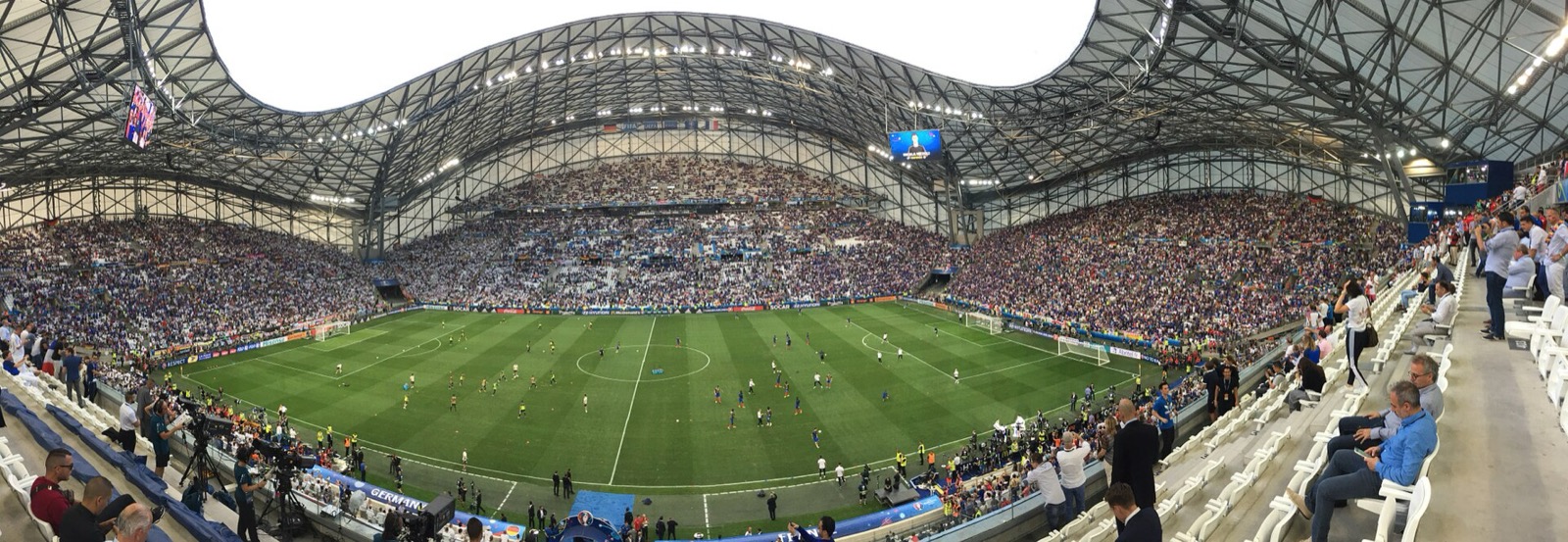
The stadium sits a few kilometres south of the old centre, and the metro is the clean way there. Take Line 2 (M2) and get off at one of the two stops that bracket the ground: Rond-Point du Prado, which brings you out near the Jean Bouin side and the Virage Nord, or Sainte-Marguerite Dromel, which is the better stop for the Ganay side and the Virage Sud. Either is a short signposted walk to the ground with the crowd. A single ticket covers metro, tram and bus for an hour, and you can buy it at the station.
If you are starting the day at the water, as many do, bus 83 runs from the Vieux-Port down along the Corniche Kennedy coast road to the Rond-Point du Prado in around forty minutes, which is a scenic if slower way to arrive. Coming out after the final whistle is the usual crush at the two metro stops, so give it time.
A Marseille matchday genuinely starts hours before kickoff, and it starts at the Vieux-Port, the old harbour at the heart of the city. The waterfront and the quais around it fill with fans on the terraces of the bars and brasseries, and the OM-branded café on the Quai des Belges is a natural gathering point in the thick of it. This is where to feel the build-up: a beer by the water, the harbour full of masts, the whole city turning its attention to the game. The drink to order is a pastis, the anise aperitif born in Marseille and still the classic thing to nurse on a terrace here.
For food and a livelier, younger bar scene, the Cours Julien up the hill is the city's bohemian quarter, full of restaurants, street art and terraces, and a good place to eat before heading for the metro. The local street snack to look for is panisse, the fried chickpea fritters that are Marseille's own. The area immediately around the stadium is ordinary residential Marseille rather than a bar district, so the pattern is the same as at most big-city grounds: make your afternoon in the centre and ride out to the Prado closer to kickoff. A fair word on the city, said plainly rather than nervously: Marseille has a rougher, edgier reputation than most of France, and it rewards normal city street sense, keeping an eye on your things around the stations and at night, but the matchday crowd is overwhelmingly about noise and pride, not menace, and hundreds of thousands of visitors have a brilliant time here.
Here is what makes the Vélodrome special, and it is genuinely unusual: it has an ultra end behind each goal, and they sing at each other for the entire match. The Virage Sud is home to the Commando Ultra '84 and the South Winners, and the Virage Nord to Marseille Trop Puissant and the Yankee Nord, and between them these two curved ends produce non-stop singing, enormous hand-painted tifos, coordinated flag displays and, on the big nights, pyrotechnics. Most grounds have one loud end; Marseille has two, facing off, and the effect on a European night or against a rival is one of the great atmospheres in the sport. The two long sides, the Tribune Jean Bouin and the Tribune Ganay, are the calmer main stands.
The honest calibration barely needs stating here, because even a routine Ligue 1 game at the Vélodrome is loud by the standards of almost anywhere else. If you want the full experience and can handle standing, singing and not seeing much of the pitch through the flags, aim for the lower part of a virage; if you would rather watch the football in relative calm and still soak up the noise across the ground, take a side stand. Away fans, on the rare occasions there are any, are tucked into a corner.
This is the Aux Armes at full volume:
The anthem is a local institution: OM play "Jump Around" by House of Pain and, more importantly, the crowd roars through "Aux Armes," the ultras' own song that borrows the Marseillaise's opening cry, sung across the whole ground, along with a deep book of Provençal-accented terrace songs led by the two virages. The single most famous chant is the simplest, the long rolling "Aux armes" and the call-and-response of the club's name that rolls around the bowl. You do not need to know the words; you need to be there when 60,000 people find them at once.
The official OM Store has a flagship in the city centre as well as retail at the stadium, so if you are spending time around the Vieux-Port and the main shopping streets you can pick up a shirt without the trip out to the ground. The stadium store pairs with the Vélodrome tour on a non-match day.
For a normal Ligue 1 game, OM are gettable: the club sells single-match tickets through its official site, and a visitor planning ahead can usually buy for a mid-table fixture without membership or connections. The two things to know are that the ultra ends, the virages, are not sold as casual single seats in the way the side stands are, so if you simply want in, a place in the Jean Bouin or Ganay is the straightforward buy; and that the big games change everything.
Le Classique against PSG and the marquee European nights sell out fast, carry the away-fan ban, and are hard to get at face value. For those, the club's official channels and hospitality are the safe route. As in the rest of French football, tickets are named and checked, so a ticket bought from a stranger or a third-party resale site risks failing at the gate. Buy early and direct for a league game, and treat the grey market as the last resort it is. That puts OM in the comfortable middle of the range of how hard European clubs are to get into: a midweek fixture asks for nothing but a bit of planning, and Classique day asks for luck you probably don't have.
Come for the noise and the feeling, because that is what Marseille sells better than anyone in France. Start your day on the terraces of the Vieux-Port, eat up around the Cours Julien, ride the M2 out to the Prado, and get yourself somewhere you can hear both virages going at each other, because that duel across the pitch is the thing you came for. Take the city on its own proud, prickly, warm-hearted terms, keep your wits like you would in any big port, and you will understand why OM fans think the rest of French football is just tourism.
Ticket rules, the stadium sponsor name and the club's fortunes all change; check anything time-sensitive the week you travel, and only buy through the club or an official seller.
OM play at the Orange Velodrome, a 67,000-seat bowl in southern Marseille that was redeveloped and roofed for Euro 2016. What makes it stand out is the layout: it has an ultra end behind each goal, the Virage Sud and the Virage Nord, so both ends sing at each other for the entire match.
For a normal Ligue 1 game, yes. OM sell single-match tickets on the club's official site, and a visitor planning ahead can usually buy a side-stand seat for a mid-table fixture without any membership. The catch is that the ultra ends, the virages, aren't sold as casual single seats, so if you just want in, buy the Jean Bouin or Ganay side.
Yes, and there's an extra wrinkle. Le Classique and marquee European nights sell out fast and carry an away-fan ban, so if your trip lands on one you'll only see a one-sided home crowd. Use official channels and hospitality for those games, since tickets are named and checked, and one bought from a stranger risks failing at the gate.
Take metro Line 2 (M2) to Rond-Point du Prado for the Jean Bouin side and Virage Nord, or Sainte-Marguerite Dromel for the Ganay side and Virage Sud; both are a short signposted walk to the ground. A single ticket covers metro, tram and bus for an hour. From the Vieux-Port, bus 83 runs along the Corniche Kennedy to the Prado in about forty minutes.
It comes from both ends at once, which is unusual. The Virage Sud holds Commando Ultra '84 and South Winners, and the Virage Nord holds Marseille Trop Puissant and the Yankee Nord; between them the two ends produce nonstop singing, huge tifos and flag displays through the whole match. The Tribune Jean Bouin and Tribune Ganay on the long sides are calmer if you'd rather watch in relative peace.
Dates more than a few weeks out show as “date & time TBC”. When do fixtures get confirmed? →