Sat 10 Oct* · TBC
Olympiakos Piraeus v Panathinaikos
Georgios Karaiskakis Stadium · Piraeus
Greece
Greek Super LeaguePlan a trip around this →
Greece's most decorated club, in the port city of Piraeus, a metro ride from central Athens. The fan card and the Gov.gr Wallet app you need before you can get in, where the noise and the away fans are, and why the number 7 is picked out in the seats.
By Carlos O. · Last updated 15 Sept 2026
Doable for a visitor, but it takes setup before you travel. For 2026/27 you need the Olympiacos fan card (€15, or €20 for the collector's version) before you can buy. Tickets are sold online only, on olympiacos.org and more.com, usually a week to ten days before the game; choose the Non Greek Resident option. A September 2026 league game ran from €15 to €60, a Europa League game €25 to €70. Entry is only through Greece's Gov.gr Wallet app, set up with your passport, which you should carry; the Gate 25 ticket office helps non-residents on matchday until half an hour before kickoff. Tickets are named and can't be resold, and every adult in a group needs their own card and ticket. The cheapest seats are the Gate 7 end (gates 3 to 7). The derbies against Panathinaikos, AEK and PAOK and the European nights are the hard tickets.
Olympiacos are from Piraeus, not Athens, a distinction their fans care about. The port city runs straight into the Greek capital, and the metro gets you from one to the other in 15 to 20 minutes, but the club is Piraeus's own, founded there in 1925 and nicknamed Thrylos, the Legend. They have won more Greek league titles than anyone else, and in 2024 they beat Fiorentina in the Conference League final in Athens to become the only Greek club to win a major European trophy.
The great rivalry is with Panathinaikos, a fixture known in Greece as the Derby of the Eternal Enemies.
For a visitor, the stadium is the easy part: the metro stops right beside it. The ticket is the part to plan, because Greek football now runs on a fan card and a government ID app, and both are far easier to set up before you travel than at the ground.
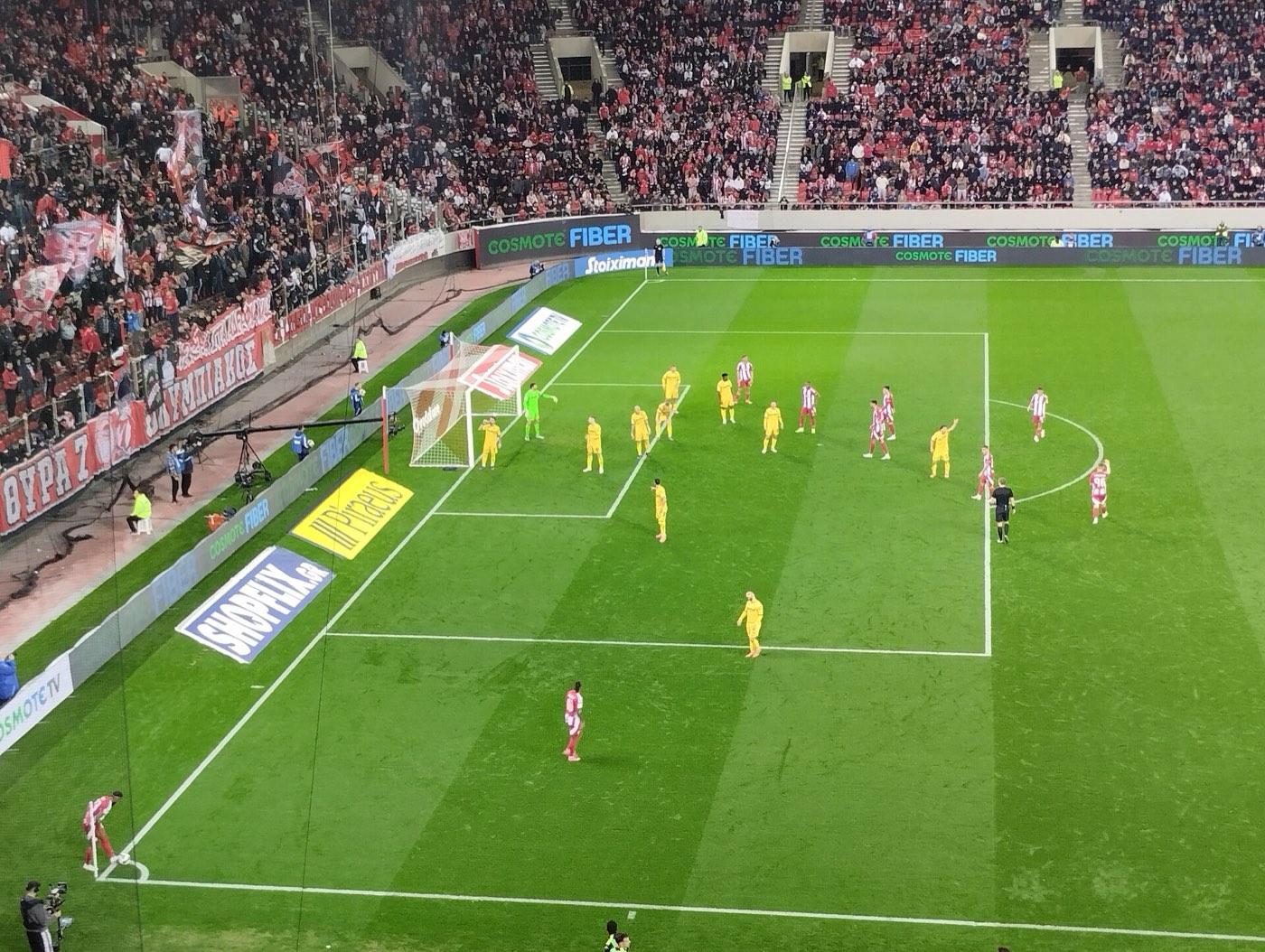
The trip itself is simple. Take metro Line 1, the green line, to Faliro, which sits right next to the stadium in Neo Faliro, about 15 to 20 minutes from Omonia or Monastiraki in central Athens. The coastal tram also has a stop beside the ground, called Gipedo Karaiskaki, which is handy if you're staying along the south coast.
Arrive early. You need the ticket activated in the Gov.gr Wallet app before you reach the gate, and if the app fails, the fallback is the ticket office at Gate 25, which closes half an hour before kickoff. One visitor who got there two hours early found almost no line.
Enjoy it while it lasts. The club unveiled plans in July 2026 to rebuild the Karaiskakis with more than 50,000 seats. Greek reports say works are due to start in summer 2027, with Olympiacos playing two seasons at the Olympic Stadium (OAKA) in Marousi in the meantime, which is a different trip entirely. The plan still needs government approval, so check where they're playing before you book anything from 2027 on.
The streets right around the stadium are roads and a sports complex, not a bar district. The classic matchday food is souvlaki, sold from stands outside the ground, and it's worth having some cash on you, since the street vendors may not take cards.
For a proper meal, Mikrolimano, the small harbor lined with fish tavernas and bars, is about a kilometer from the stadium, and it's the obvious place to eat in Piraeus before an evening game. If you're staying in central Athens, you can eat there first and walk over, or eat in town and ride the green line down.
The noise is in the Gate 7 end, sold as gates 3 to 7 and home of Gate 7, the organized support. The name comes from the worst day in the club's history. On 8 February 1981, after a 6-0 win over AEK, fans leaving through the old stadium's seventh gate were crushed on the stairs, and 21 people died, 20 of them Olympiacos supporters. In today's stadium, black seats in that end spell out the number 7, and a monument outside the ground lists the names of the dead; plenty of fans stop there on the way in.
The main stand (gates 28 to 35) has the suites, the VIP seats and the tunnel, the long side opposite it is gates 10 to 18, and the far end is gates 21 to 25. That matters when you buy, because tickets are sold by gate number, and the Gate 7 end is the cheapest block on the plan. A neutral after a calmer seat should look at gates 21 to 23, the main stand, or the long side at gates 10 to 18.
Away fans, when they're allowed, go in the corner at gates 26 and 27, between the main stand and the gates 21 to 25 end. Whether they're allowed is decided game by game: authorities can ban visiting supporters for high-risk matches, and they did for PAOK against Olympiacos in May 2026.
This is the Karaiskakis before and during a Champions League night against Real Madrid in November 2025:
Greek football has a real problem with violence, and a visitor should go in knowing it. In December 2023, after a string of serious incidents, the Greek government ordered all Super League games played without fans for two months. Away-fan bans for high-risk games are routine, and the big derbies run under heavy security.
An ordinary league game isn't dangerous for a neutral in a normal seat. Keep rival colors out of sight, though, and stay out of gates 3 to 7 unless you know what you're doing. On derby day, take the police seriously.
The chant to know is a quiet one. Every year on 8 February, and whenever Olympiacos honor the 1981 victims, the stadium sings "Αδέρφια ζείτε, εσείς μας οδηγείτε": "Brothers, you live, you lead us." On an ordinary night the Gate 7 end runs the rest of the singing, and it's loud enough that you don't need the words.
The club's members and fans office is under Gate 19, in the stadium's commercial arcade, open daily from 10:00 to 18:00, and it's also where you can get a plastic fan card. The club museum is at the stadium as well, with tickets sold through more.com, the same site that sells match tickets.
There are three steps, and you want all of them done before you get to Piraeus.
First, the fan card. For 2026/27 you need the Olympiacos fan card, €15 or €20 for the collector's version, before the club will sell you a ticket. You can buy it online through the club's members site (olympiacossfp.gr links to it) or at the Gate 19 office.
Second, the ticket. Olympiacos sell home tickets online only, on olympiacos.org and more.com, usually a week to ten days before the game: for the league match against OFI on Saturday 12 September 2026, the sale opened the Wednesday of the week before. Choose the Non Greek Resident option when you buy. Prices for that game ran from €15 to €60, with VIP seats at €120 and €180, and European nights cost more, €25 to €70 for the Europa League game against Jagiellonia the same month. Tickets carry your name and can't be resold or passed on.
Third, the Gov.gr Wallet app. Entry is only through it. Non-residents download the app, scan their passport with the phone's NFC reader to create an account, then scan the ticket to add it; at the gate the ticket shows as a QR code, so the phone itself doesn't need NFC for entry. Carry the passport you registered with. If the app won't cooperate, the Gate 25 ticket office helps non-residents on matchday: for the OFI game it opened three and a half hours before kickoff and closed half an hour before.
For a group, every adult needs their own fan card, their own named ticket, the app on their own phone and their own passport. Children born in 2011 or later pay a reduced price and don't need a fan card, but must come with a guardian.
Don't buy from resale sites. The ticket is tied to your identity, and visitors report groups being turned away at the gate with fake tickets bought on the secondary market. Our general advice on tickets abroad holds here, with the extra steps. The derbies against Panathinaikos, AEK and PAOK, and the European nights sell fast and are the hardest tickets of the season. Olympiacos are in the Europa League in 2026/27, which is usually an easier ticket elsewhere, but not at the Karaiskakis.
Set up the fan card and the Gov.gr Wallet the week before, not the morning of. After that, it's a short metro ride to Faliro and a souvlaki outside the ground before the Gate 7 end starts up.
Ticket rules, security measures and stadium plans all change; check anything time-sensitive the week you travel, and only buy through the club or an official seller.
Olympiacos play at the Georgios Karaiskakis Stadium in Neo Faliro, Piraeus, the port city next to Athens. It holds about 32,000 to 33,000, depending on the configuration. Faliro station on metro Line 1, the green line, is right beside it, about 15 to 20 minutes from central Athens.
Yes, with some setup. You need the club's 2026/27 fan card (€15, or €20 for the collector's version) before you can buy, then tickets are sold online only, on olympiacos.org and more.com, usually a week to ten days before the game; choose the Non Greek Resident option at checkout. Entry is only through Greece's Gov.gr Wallet app, which non-residents set up by scanning their passport, and you should carry that passport to the game. For a September 2026 league game, prices ran from €15 to €60.
When visiting fans are allowed, they go in the corner by gates 26 and 27, between the main stand and the end opposite Gate 7. Greek authorities decide match by match whether away supporters can attend, and they ban them for high-risk games, as the sports ministry did for PAOK against Olympiacos in May 2026.
Take metro Line 1, the green line, to Faliro, which is right next to the stadium, about 15 to 20 minutes from Omonia or Monastiraki in central Athens. The coastal tram also stops beside the ground.
In the end sold as gates 3 to 7, home of Gate 7, the organized support named after the 1981 disaster in which 21 fans died at the stadium's seventh gate. Black seats in that end spell out the number 7. It is also the cheapest block, so a neutral who wants a calmer seat should look at gates 21 to 23, the main stand, or the long side at gates 10 to 18.
Dates more than a few weeks out show as “date & time TBC”. When do fixtures get confirmed? →