Mon 26 Oct · 21:30 GMT+3
Galatasaray v Fenerbahçe
Rams Park · Sarıyer
Turkey
Süper LigPlan a trip around this →
One of the loudest, most intimidating grounds on earth, out in the north of Istanbul. The Passo Taraftar card you cannot enter without, the metro out from the centre, and an honest word on the derby.
By Carlos O. · Last updated 24 Sept 2026
Every ticket for a Turkish league match is tied to a personal, government-backed fan-ID card, the Passo Taraftar card that replaced Passolig, under the same 22-club agreement that names Galatasaray as a partner club. Foreign visitors can only apply online at passotaraftar.com.tr with passport details for the prepaid route; the digital card is meant to reach the Passo app as soon as the application is complete, but visiting fans regularly get stuck there: SMS verification can need a Turkish mobile number, the app often refuses to link a card the site says you have paid for, and some visitors are told to present their passport at the stadium box office before the card will work at a turnstile. Start it weeks ahead, not the night before. There is also an annual e-ticket fee charged per club, and Beşiktaş, Galatasaray and Fenerbahçe all sit in the top tier at 1,200 TL, up from 800 at the start of 2026. With the card in hand, buy through the club's official channels and the Passo platform for an ordinary Süper Lig game, which a visitor can usually manage, though RAMS Park runs close to 80% full most weeks and releases can clear out within minutes, so buy the moment sale opens and keep checking even after a 'sold out' message, since abandoned baskets and returned season-ticket seats recirculate. Both Istanbul derbies are the exception, and Galatasaray's home sale is the most closed in Istanbul: tickets go to GSPara and GSPlus bank-card holders and then to holders of a Galatasaray-logo Passo card, and no phase ever opens beyond that, with the opposing club's cardholders barred by provincial security decision. The bank-card window has emptied inside about a minute. These nights run under heavy security and away-fan restrictions, so the club's own hospitality packages are the more realistic route for those nights. The biggest European nights sell out too (Galatasaray's 2025 Champions League game against Liverpool moved every ticket in the ground), though a routine group-stage fixture against a less glamorous side is still findable through the same official channels. The card-and-ID system makes informal resale both risky and pointless.
Galatasaray put on one of the most intense matchday experiences in world football, and the single most important thing to grasp before you go is that this is not a place you drift into casually. The club, founded in 1905 by pupils of the Galatasaray High School, is the most successful in Turkey and the only Turkish club to win a major European trophy, the UEFA Cup and the UEFA Super Cup in 2000, in the era of Gheorghe Hagi. The fans, the "Cimbom" faithful, and their organised support have built the ground a fearsome global reputation, most famously captured by the old banner that greeted visiting teams: "Welcome to Hell."
That reputation is earned by the ultRAslan, the club's ultra movement, who fill an end with pyrotechnics, deafening noise and coordinated displays that begin long before kickoff and do not stop. A Galatasaray home game against serious opposition is loud in a way that has to be experienced to be believed, and the two Istanbul derbies raise it further still. The rivalry with Fenerbahçe, whose ground sits across the Bosphorus on the Asian side, is billed as the Intercontinental Derby and is one of the most bitter and charged fixtures anywhere in the sport; the derby with Beşiktaş is not far behind.
The ground is RAMS Park, in the Seyrantepe district in the north of the European side of the city, which carries the historic name Ali Sami Yen from the club's old central stadium. It holds around 52,000 and it is modern and steep, but the atmosphere it generates is anything but corporate.
Before anything else, set up your ticket identity, because in Turkey it is not optional. Every ticket for a Turkish league match is tied to a Passo Taraftar card, a personal, government-backed electronic fan-ID card, and without one you physically cannot buy a valid ticket or pass the turnstiles. This is the single biggest thing that trips up visiting fans. The good news is that foreign visitors can apply, in English, online at passotaraftar.com.tr, using your passport details, a phone number and a passport photo; the operator's own FAQ says foreign nationals can only apply that way, so don't plan on an in-person card office as a backup. One naming point, because it confuses people: the card is now branded Passo Taraftar rather than Passolig, so that is the name you will see on the application site, and an existing Passolig card stays valid until its e-ticket period runs out. On paper the digital card reaches the Passo app the moment the application clears. This is the step that actually strands visiting fans. SMS verification may want a Turkish mobile number, and visitors on a foreign SIM report codes timing out or never arriving. The app often will not link a card the website says you have paid for, showing only its last four digits. And plenty of visitors are told, in the app itself, to present their passport to staff at the stadium box office before the card will pass a turnstile, so budget time for that errand and go early, because the queue is long on a matchday. Support has a poor record of fixing any of it quickly. So there are two different box-office errands, and it is worth keeping them apart: the window can switch on a card you already hold, but it cannot create one for you, because the operator sends foreign nationals to the website to apply. None of this is a reason to stay home; it is a reason to start weeks out, from home, so a failed step costs you days rather than the game. One catch fans flag: beyond registering the card you also pay an annual e-ticket fee, and without it the card can't buy a ticket, so clear that when you set up. It is not a token sum at this level, either, because Galatasaray, Fenerbahçe and Beşiktaş all sit in the top tier at 1,200 TL, up from 800 at the start of 2026. The fee is charged per club, too, so a Saturday at one Istanbul ground and a Sunday at another means paying it twice, and the club on your card decides whose early sales you can buy in; other cardholders get in when general sale opens. Get it all done well before matchday, because showing up without it means you are not getting in, however much you paid for a ticket.
RAMS Park is a fair way out, about twelve kilometres north of the Sultanahmet and Beyoğlu tourist areas, so the trip needs the metro. Take the M2 line north and change at Sanayi Mahallesi onto the short branch that runs the last stretch up to Seyrantepe, the stop beside the ground, which connects to the stadium through pedestrian tunnels running under the TEM motorway rather than over it, so follow the crowd down rather than looking for a bridge. The metro is far better than fighting the road traffic, which seizes up around kickoff. Coming out with 50,000 other people is a slow, packed shuffle, so be patient.
The area right around the stadium is not a bar-and-restaurant quarter, so a Galatasaray day splits in two. The build-up on the doorstep is about food and noise: get there early, at least a couple of hours before kickoff, when the streets outside fill with fans grilling köfte and simit sellers and the singing starts in the open air. It is a genuinely electric scene and a big part of the experience, so do not show up at kickoff.
For the rest of your day, base yourself in the centre. Most visitors stay around Beyoğlu, with Taksim Square and the long İstiklal Caddesi pedestrian street the hub of the city's eating, drinking and nightlife, and it is from there that you ride the M2 out to the game. Do your sightseeing across the historic peninsula and your eating in the centre, and treat the stadium trip as an evening expedition north.
The noise is the reason to come, and it comes from the ultRAslan end behind one goal, where the flags, the drums, the flares and the relentless singing are concentrated. For a big league game and above all for a derby, RAMS Park is as intimidating an atmosphere as exists in the club game, a wall of yellow and red and sound that visiting players talk about for years. The side stands are calmer and more mixed, so if you want the full experience aim for a place nearer the ultra end, and if you would rather take it in from a slight remove, a side stand still puts you inside one of the great atmospheres in the sport.
A serious, honest word on the derby, because it matters. The Istanbul derbies, and the Galatasaray-Fenerbahçe fixture in particular, have a real and heavy history of violence, and Istanbul matchdays more broadly carry a genuine edge: two Leeds United supporters were stabbed to death in the city in 2000, the night before Galatasaray played Leeds in a UEFA Cup semi-final. Turkish authorities have for long stretches banned away fans from the biggest Istanbul games entirely. If your trip lands on a derby, treat it with real seriousness, keep club colours and opinions to yourself outside your own section, and understand that the intensity here has a genuine edge that is not for an outsider to test.
This is the Welcome to Hell that visiting teams dread:
The support sings almost without pause, led by the ultra end, and the sound is built around the club's yellow-red identity, the "Sarı-Kırmızı," and a deep book of Turkish terrace anthems and drums. You will not know the words and it does not matter; the thing to do is arrive early, find the noise, and let a full RAMS Park wash over you, because sustained, organised, ferocious support like this is increasingly rare in the sanitised grounds of western Europe.
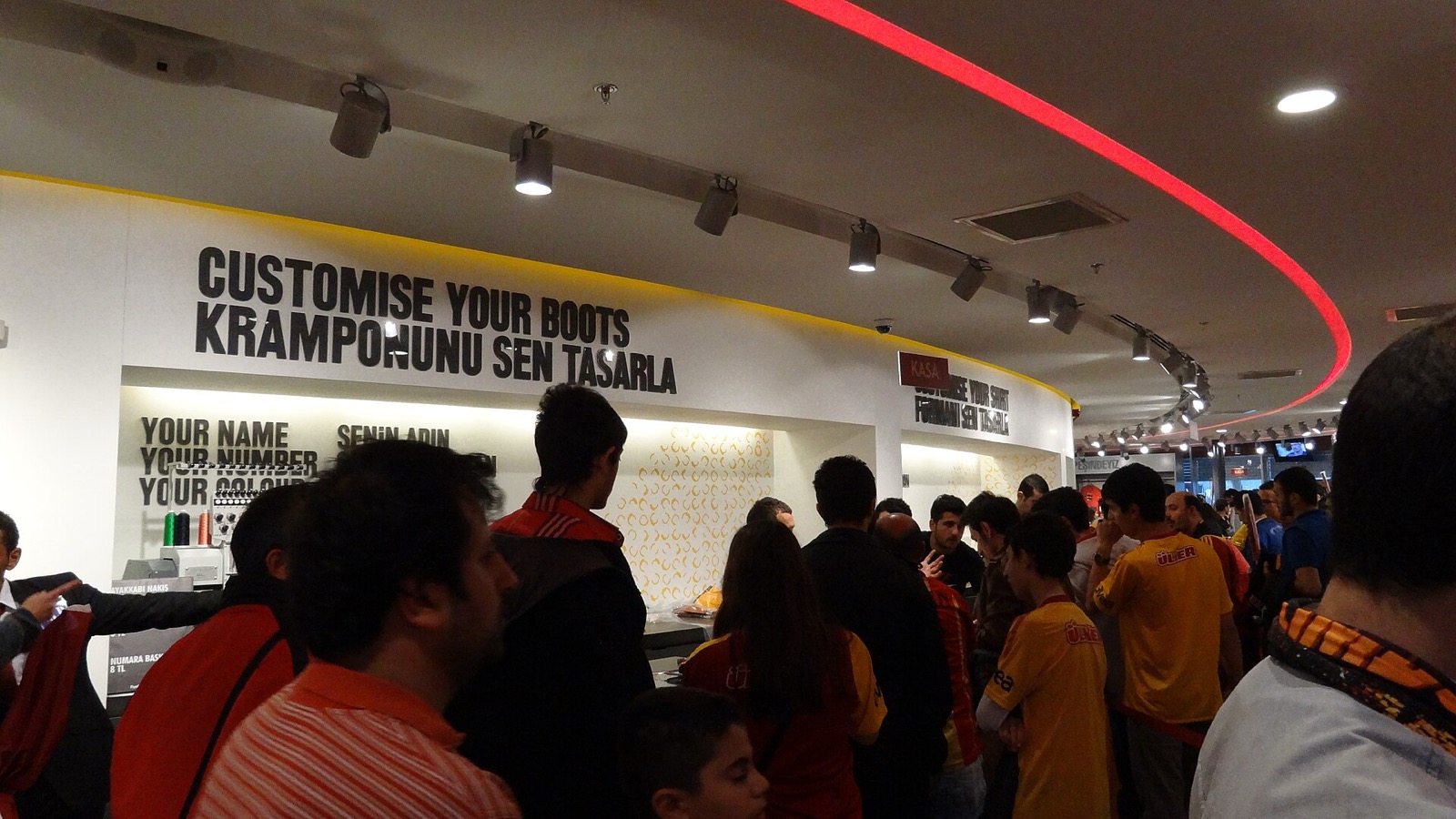
The GSStore, the official club shop, has branches around the city as well as at the stadium, so you can pick up the yellow-and-red without the trip north; the central stores are the convenient option if you are based around Beyoğlu. The stadium store pairs with the ground tour and museum on a non-match day.
Once you have your Passo Taraftar card, the tickets themselves follow the Turkish system: buy through the club's official channels and the Passo platform, with the ticket loaded onto your card. For an ordinary Süper Lig home game against mid-table opposition, a visitor who has arranged the card in advance can usually get in without much trouble. There's also a genuinely useful fallback if the website defeats you, which it often does for a foreign card: go to the stadium ticket window, the Bilet station, before the match with your passport. The staff there usually speak English and can sell you a ticket on the spot. Do not count on sorting the card itself there, though: the operator directs foreign visitors to apply online, so treat the window as the place to buy a ticket once you already hold a card rather than the place to fix a missing one; if a steward waves you off saying it's sold out, check the Bilet window anyway, because they don't always know a foreigner can buy there. The derbies are a different order, and worth understanding precisely, because Galatasaray run the most closed sale in Istanbul. A home derby goes to GSPara and GSPlus bank-card holders first, then to holders of a Galatasaray-logo Passo card, and then it stops. There is no phase for anyone else, and supporters holding the opposing club's card have been barred outright by the provincial security board, so a neutral visitor with another club's card has no queue to join. The bank-card window has emptied inside about a minute. Big European nights are hard in the ordinary way; the derbies are hard in this particular way.
Because the whole system is card-based and ID-linked, the informal resale market is both risky and largely pointless, since a ticket has to sit on a Passo Taraftar card registered to a person. One thing worth knowing: season-ticket holders can hand their seat back to the club for official resale right up to the last minute, so tickets keep surfacing on the Passo platform after an apparent sellout, so watch it late rather than giving up. Going back to the club's own platform for a return instead of to a stranger is the one habit worth carrying to every ground abroad, and in Istanbul it's also the only version that scans. Set up your own card, buy through official channels, and do not rely on a stranger's ticket. Plan the Passo Taraftar step early and the rest is manageable.
Come for the noise, and come prepared. Get your Passo Taraftar card set up before you fly, base yourself in Beyoğlu, ride the M2 out well before kickoff, and give yourself over to the köfte smoke and the singing outside before you even reach your seat. Aim for the ultra end if you can handle it, treat the derby with the seriousness it demands, and you will experience one of the last truly ferocious atmospheres in the European game, at a club that treats a football match as something much closer to war.
Ticket and Passo Taraftar rules, prices and derby restrictions all change; check anything time-sensitive well before you travel, and set up your Passo Taraftar card in advance.
Galatasaray play at RAMS Park in the Seyrantepe district, in the north of the European side of Istanbul. It holds around 52,000 and carries the historic name Ali Sami Yen from the club's old stadium. The ground earned the nickname Welcome to Hell for how loud and intense it gets on a big night.
Yes, but only after you set up a Passo Taraftar card, a personal government-backed fan ID required for every ticket in Turkish football (the current name for what used to be called Passolig). International visitors apply online at passotaraftar.com.tr with a passport and phone number; the digital card is supposed to reach the Passo app as soon as the application clears, but this is where visitors get stuck: SMS verification may need a Turkish mobile number, the app often refuses to link a card you have paid for, and some are told to present their passport at the stadium box office before it works at a turnstile. Start it weeks before you fly, not the night before. Without the card you cannot buy a ticket or get through the turnstiles, no matter what you paid. The card itself is free, but each club charges an annual e-ticket fee and the big three all sit in the top tier at 1,200 TL, charged per club, so two Istanbul clubs in one weekend means paying it twice.
An ordinary Süper Lig game against mid-table opposition is usually manageable for a visitor who set up their Passo Taraftar card ahead of time. The Fenerbahçe and Beşiktaş derbies and big European nights are a different story. Galatasaray's home derby sale runs to bank-card holders and then to Galatasaray-logo cardholders and never opens beyond that, so unless you hold their card there is no phase for you; add away-fan restrictions and face value is out of reach.
Take the M2 metro line north and change at Sanayi Mahallesi onto the short branch that runs the last stretch to Seyrantepe, the stop beside the ground, linked to it by pedestrian tunnels that run under the TEM motorway. The metro beats fighting matchday road traffic. Leaving with around 50,000 other fans is a slow, packed shuffle, so build in patience.
The noise comes from the ultRAslan end behind one goal, where flags, drums, flares, and constant singing build long before kickoff. For a big league game, and especially a derby, that end makes RAMS Park one of the most intimidating atmospheres in the club game. The side stands are calmer if you'd rather watch from a slight remove.
Dates more than a few weeks out show as “date & time TBC”. When do fixtures get confirmed? →