Wed 21 Oct · 21:00 CEST
Club Brugge KV v Racing Club de Lens
Jan Breydel Stadion · Bruges
Belgium
Champions LeaguePlan a trip around this →
Belgium's champions in a crumbling shared bowl outside one of Europe's prettiest cities. The digital identity rule that catches foreign fans, where the noise is, and what to drink in Bruges.
By Carlos O. · Last updated 20 Sept 2026
Two gates stand between a visitor and a ticket, and the second one catches people out. First, a free Club ID account is required to buy at all; one ID covers up to four singles for a home game and holders pay below the standard price. Second, since 1 January 2026 revised Belgian football law ties every ticket to the identity of the person entering, so every buyer must verify digitally at purchase: itsme for sixteen European nationalities, Onfido for everyone else, renewed annually, with the league telling anyone stuck to contact the club. Tickets are sold online only and are personalised. Supply is the third constraint: about 24,000 of the 29,062 seats are season tickets and they sold out before free sale opened for a ninth straight season, so only a limited batch of singles is released per match. Belgian kickoff days and times are confirmed in batches during the season and singles go on sale a few days after that confirmation, so a game two months out may have nothing to buy yet. 2026/27 prices run about EUR 20-60 with a Club ID for ordinary league games and EUR 30-80 for the games the club bands as top matches (Anderlecht, Gent, Genk, Antwerp, Union SG); the Brugse derby against Cercle is priced as an ordinary game. Champions League is harder: the four-game mini-season-tickets sold out, with season-ticket holders then members served first and the public left the remainder. Note the ground is shared with Cercle Brugge, who sell separately.
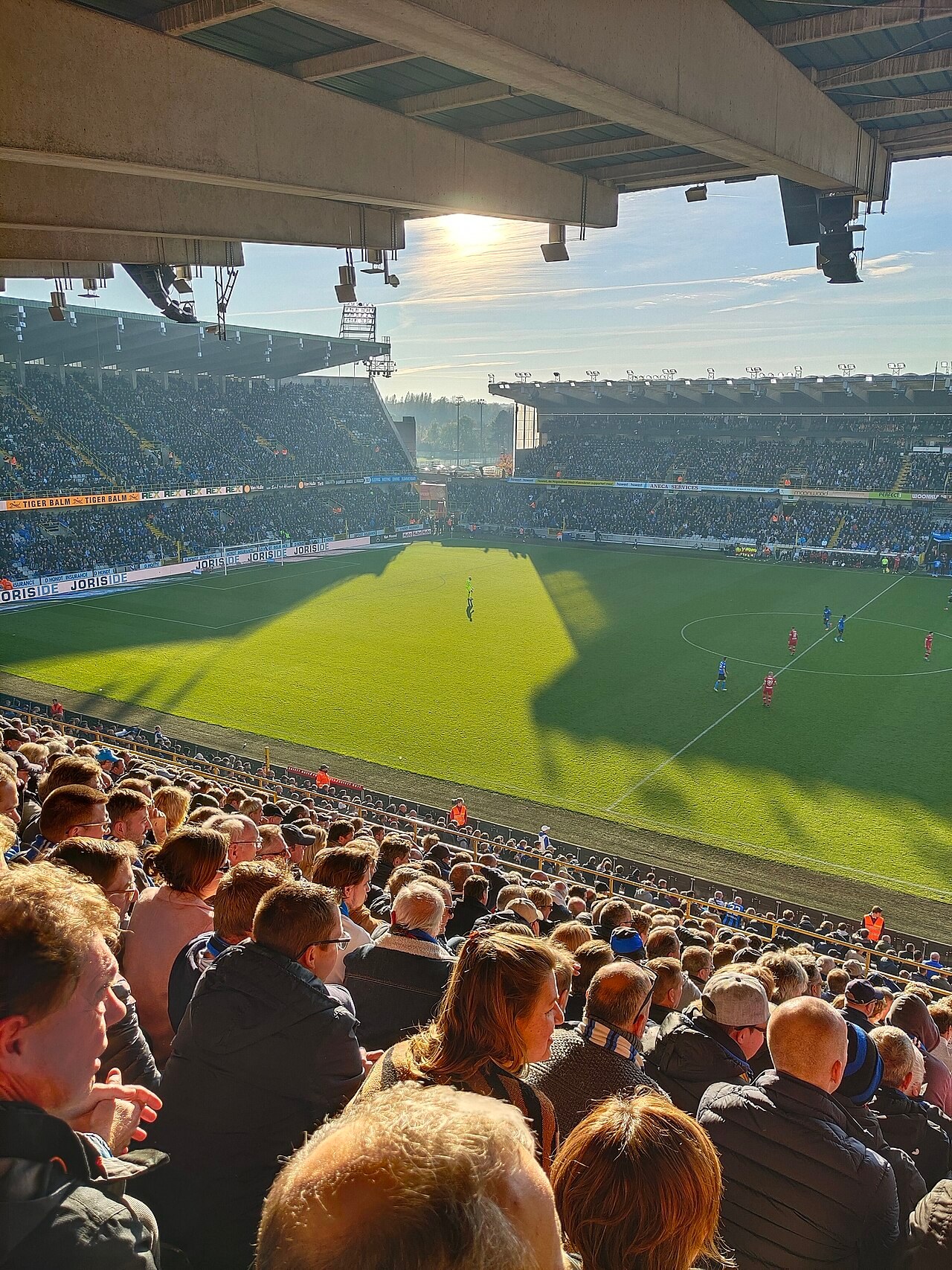
Club Brugge have been the dominant side in Belgian football for a decade, champions again last season for a twentieth title, and they play in a ground the club's own stadium-project pages describe without flinching: concrete rot, water getting in, corroded pipes, sagging tiers, nearly half the stands uncovered. Supporters are fonder about it. It is a dump, regulars will tell a visitor, but it is their dump and they will miss it.
It is on the way out. After roughly twenty years of legal fighting, a Flemish planning court threw out the last residents' appeal in July 2026, and the club has permission to build a 40,116-seat bowl on the Olympiasite next door, with a single twelve-thousand-capacity supporter wall along one side, modelled openly on Dortmund and Tottenham. The club's own timetable has preparatory work starting in autumn 2026, construction in early 2027 and the new ground opening in summer 2029. One thing still stands in the way, a ground lease that has to clear the city council, which is not expected to reach the councillors before October 2026. So the honest summary is that you have a few seasons left to see the old place, and that anyone quoting you an opening date should be treated with suspicion.
This ground is also shared. Cercle Brugge, the city's other club, play here too, which makes the Brugse derby a fixture where nobody travels. The rivalry is the oldest in Belgium and runs along social lines that are a century old: Club were historically the Boeren, the farmers, and Cercle the Snobs, a hangover from Cercle's founding by a Catholic college association.
The stadium is in Sint-Andries, west of the historic centre, and the club's own instruction is the one to follow: De Lijn bus 30 from Bruges railway station to the Sint-Andries Kerk stop, then under five minutes on foot. It runs every ten minutes on weekdays and Saturdays, every fifteen on Sundays. Line 30 also runs from the city centre along the Gistelse Steenweg, so you can pick it up without going back to the station. Away supporters are pointed to bus 3 and the Sint-Michiels Vogelzang stop, about ten minutes' walk.
If a guide tells you to take bus 5 or 15, it is out of date: De Lijn renumbered in January 2024 and those lines are gone. The bigger thing is the way back, because De Lijn puts on no extra buses after the match. The normal timetable applies, so the stop outside the church absorbs a whole stadium, and services thin out late: a 21:00 midweek kickoff finishes near 22:50, which leaves very little margin against a last bus around eleven. Walking back into the centre takes about three quarters of an hour along a suburban road, safe enough if unlovely, and the other option is a taxi, which you are better off booking than hoping to flag down outside a church in Sint-Andries. Work the return out before you go.
Bruges is the reason half of you are coming, and the football fits around the city. In the centre, Brouwerij De Halve Maan on Walplein has been brewing in the middle of the city since 1856 and makes Brugse Zot, the blond named after the nickname for the city's own people, plus Sportzot, an alcohol-free version that exists precisely for days like this. 't Brugs Beertje on Kemelstraat is the classic beer café, and De Garre is the hidden alley bar people queue for.
Eat what is actually from here: garnaalkroketten, croquettes of tiny North Sea grey shrimp, which belong to this coast, not to Belgium at large, and stoofvlees, beef slow-cooked in beer, for a cold afternoon.
Nearer the ground, the pre-match cluster is the row of cafés and chip shops on the Gistelse Steenweg by the Sint-Andries church, known locally as De Platse, which is the same stop you get off at. De Chalet at number 530 is the hub of it. Regulars advise getting out there about two hours before kickoff, doing the pubs and the small club shop, and going in around forty minutes before.
Eat before you go in. Inside the stadium, paying generally means a Club Brugge card, which is a season-ticket-holder's thing and not something a visitor picks up on the day, so for most of us the practical answer is that you cannot buy anything once you are through the turnstiles. The food trucks outside take cash and ordinary cards.
The four stands are named by compass point and numbered by vak, though the club never publishes which way the ground actually faces, so treat the names as labels, not bearings. The Westtribune is the main stand, with the boxes and the club offices. The Noordtribune at the north end is the biggest stand and holds the spionkop, where Club's loudest support sits. The Oosttribune along the far side contains vak 313, the second atmosphere block. The Zuidtribune is the south end, and the away section is tucked into its south-east corner, vakken 421 and 422, with an allocation of around 1,500 and a section that is partly open to the weather.
It is all-seater, standing having gone by 1993, so this is not a terrace experience. Regulars steer first-timers toward the middle of the upper east or west sides for the view, while warning that those are the pricier seats, and note that the north end is where the die-hards are. Nobody will mind you speaking English. One thing the club does not publish is a map of which seats are under cover, and close to half the ground is not, so in winter ask when you buy or dress for the weather.
Because Cercle share the ground, the geography flips when they are the home club: their own support sits at the south end, the opposite end from Club's spionkop. For the derby itself we could not confirm which section the visiting half of the city is given, so read the stand name on your ticket instead of assuming. If you are booking a game at Jan Breydel, check which club is hosting, because the two sell tickets entirely separately.
The crowd's anthem is "Blauw en Zwart forever," blue and black forever, sung in West Flemish, not standard Dutch, and the colours give the club its everyday name: Blauw-Zwart. The supporters' federation behind the organised end dates to 1967 and runs some sixty affiliated clubs.
There is a club shop at the ground on Olympialaan, small enough that regulars call it exactly that, and a bigger store on Steenstraat in the middle of Bruges, which is the easier stop if you are sightseeing anyway.
Belgian ticketing changed in January 2026, and it has not filtered through to most English-language guides.
First, a Club ID. You cannot buy a home ticket without one. It is free to create on the club's ticket site, a single ID can buy up to four singles for a home game, and holders pay less than the standard price. Buying for friends is the grey area: one ID covers four tickets, but every ticket is tied to an identity, so if your group is not all verified, ask the club rather than assuming you can hand a ticket over at the gate.
Second, identity verification. Since 1 January 2026, under revised Belgian football legislation, every ticket has to be tied to the identity of the person using it, and everyone buying, season-ticket holders included, must verify themselves at the point of purchase. Belgians and fifteen other European nationalities use itsme, the national digital ID app; the practical rule for everyone else is simpler than the list, because if you do not hold one of those passports you are on Onfido, a verification platform that takes identity documents from most countries. Expect to photograph a passport and yourself, and expect it to take a little time, which is why this is a job for the week before rather than the morning of. The league's own guidance if neither route works is to contact the club. Verification lasts a year, tickets are sold online only, and they carry your name, so travel with the document you verified with; the club does not publish exactly what is checked at the turnstile.
Third, supply. About 24,000 of the 29,062 seats belong to season-ticket holders, and those sold out before free sale even opened, for the ninth season running. What is left for each home game is a limited release. A further quirk of the Belgian calendar is that exact days and kickoff times are confirmed in batches through the season, and single tickets only go on sale a few days after that confirmation, so for a game two months out there may be nothing to buy yet and no date to book flights around. When the batch does sell out, there is no official exchange to fall back on that the club advertises.
Prices for 2026/27 are published in two bands. Ordinary league games run about 20 to 60 euros with a Club ID, 25 to 65 without. The bigger games, which the club lists as Anderlecht, Gent, Genk, Antwerp and Union Saint-Gilloise, are 30 to 80 with a Club ID. The Brugse derby against Cercle is priced as an ordinary game, and so is Standard Liège, which is not what you would guess.
The Champions League is a different order. The four-match mini-season-tickets for this season's league phase sold out, with season-ticket holders served first, then club members, and the general public left with whatever the club releases from the UEFA allocation. What is left of the home draw this season is Lens in October, Liverpool on 25 November and Bodø/Glimt in January, and you can guess which of those will be hardest. All of this is the same principle as buying direct anywhere abroad, with the Belgian ID layer added on top.
One planning note that is new this season: Belgium has scrapped its play-offs. From 2026/27 the Jupiler Pro League, Belgium's top division, is eighteen clubs playing a straight home-and-away season of thirty-four games, with no split into championship and Europa groups and no halving of points in spring. The practical consequence for a visitor is good news: the fixture list is knowable from the start of the season instead of half the spring being unscheduled, so a Bruges trip can be booked much further ahead than in any previous year.
Come for the double bill. Bruges is a museum of a city, and three quarters of an hour's walk from the middle of it there is a leaky 1975 bowl where the champions of Belgium play in front of people who love it for exactly what it is. Sort your Club ID and your identity verification from home, take the 30 out to the church, eat chips on the Gistelse Steenweg, and see the old ground while it is standing. And if the batch has gone, remember who else plays here: Cercle's home games are in the same four stands and a great deal easier to get into.
Ticket rules, prices and the new-stadium timetable all move, and the identity-verification system is less than a year old. Check anything time-sensitive the week you travel, and buy only through the club.
Club Brugge play at the Jan Breydelstadion in Sint-Andries, a couple of miles west of the medieval centre of Bruges. It is an all-seater holding 29,062, it dates from 1975, and it is shared with the city's other club, Cercle Brugge, so the same four stands serve both.
Yes, but two things stand in the way and the second catches people out. You need a free Club ID account to buy at all. Then, under a Belgian football law in force since January 2026, every buyer has to verify their identity digitally: Belgians and fifteen other European nationalities use the itsme app, and if you are not one of them you go through a platform called Onfido, which takes identity documents from most countries. Do it days before you try to buy, not on the morning of the game.
Harder than the size of the ground suggests. About 24,000 of the 29,062 seats are season tickets, and they sold out before general sale even opened for a ninth straight year, so only a limited batch of singles goes on sale per match. Champions League nights are tougher again: the four-game mini-season-tickets sold out, and the public only gets whatever is released afterwards.
Take De Lijn bus 30 from Bruges railway station to the Sint-Andries Kerk stop, under five minutes' walk from the ground. The bus runs every ten minutes on weekdays and Saturdays. Away fans are directed to bus 3 instead. Ignore any guide that still tells you buses 5 and 15; that numbering was retired in 2024.
The spionkop in the Noordtribune, the north end, is where Club's loudest support sits, with vak 313 in the east stand as the second singing block. Away fans go in the south-east corner, vakken 421 and 422, part of which is uncovered. When Cercle are the home club in the same stadium, the roles flip to the other end.
Dates more than a few weeks out show as “date & time TBC”. When do fixtures get confirmed? →